A professional CNC router machine should offer more than a large work area: rigidity, repeatable motion, and a spindle suited to your materials matter just as much. I rank the LUNYEE 8080 Pro Max as the best overall pick for buyers who need broad capacity, while the AnoleX 4030-Evo Ultra 2 stands out for its ball screws and dual steel linear guides, and the WolfPawn 6060 merits attention for its closed-loop motors. The main tradeoff is between work envelope and machine stiffness, with spindle choice, setup complexity, and support also shaping the decision. A compact machine can make more sense for precise small parts than a larger, less rigid frame. Read on for the full comparison and a guide to matching machine capability to your work.

Prime made for students and young adults
- Fast, free delivery for dorm and study essentials
- Prime Video and Amazon Music included
- Member-only deals
Key Takeaways
- The LUNYEE 8080 Pro Max is the capacity pick: its 800 × 800 mm work area is the largest stated envelope in this lineup, making it appealing for larger panels, though buyers should confirm that the machine’s rigidity matches their cutting demands.
- The AnoleX 4030-Evo Ultra 2 emphasizes motion precision: dual steel linear guides and ball screws distinguish it from many router-style machines here, especially for buyers prioritizing controlled movement over maximum work area.
- The WolfPawn 6060 takes a different route to motion control: NEMA 24 closed-loop stepper motors are its defining feature, while the listed information does not specify its spindle power.
- Work area varies widely across the selection: the LUNYEE 3020 Nova and 3030-Evo Max favor smaller projects, while the 6060 and 8080 models offer more room but call for more bench space and careful attention to frame stiffness.
- Spindle and trimmer configurations are not interchangeable: several options list 710W or 800W units, but the SainSmart Genmitsu 4040-PRO MAX is offered with either a trimmer or spindle, so buyers should verify the exact configuration before choosing.
| LUNYEE 4040 Nova CNC Router, 800W, 400 × 400 mm Work Area |  | Best for Compact, Rigid Cutting | Work area: 400 × 400 mm | Router power: 800 W | Maximum speed: 30,000 RPM | VIEW ON AMAZON | See Our Full Breakdown |
| LUNYEE 8080 Pro Max CNC Router, 800W Spindle |  | Best for Large Panels and Batch Work | Machining range: 800 × 800 × 100 mm | Spindle power: 800 W | Spindle speed: 6,000–30,000 RPM | VIEW ON AMAZON | See Our Full Breakdown |
| SainSmart Genmitsu 4040-PRO MAX CNC Router with 710W Trimmer |  | Best for Clamping Versatility | Model: 4040PM | Work area: 410 × 405 × 77 mm | Pass height: 100 mm | VIEW ON AMAZON | See Our Full Breakdown |
| Genmitsu 4040-PRO MAX CNC Router with 710W Spindle |  | Best for Upgrade-Friendly GRBL Workflows | Axes: 3 | Work area: 410 × 405 × 77 mm | Spindle power: 710 W | VIEW ON AMAZON | See Our Full Breakdown |
| Twotrees TTC450 Pro All-Metal CNC Router with NEMA 57 Stepper Motor |  | Best for Expansion and Hands-On Control | Work area: 460 × 460 × 80 mm | Touch screen: 3.5-inch IPS capacitive | Stepper motor: NEMA 57 | VIEW ON AMAZON | See Our Full Breakdown |
| FoxAlien Masuter Pro 3-Axis CNC Router Machine |  | Best for Straightforward Desktop Setup | Axes: 3 | Frame material: Aluminum | Work area: 400 × 400 × 60 mm | VIEW ON AMAZON | See Our Full Breakdown |
| Axiscreat 6060 CNC Router Machine with 710W Spindle |  | Best for Larger Workpieces | Working area: 600 × 600 × 75 mm | Spindle power: 710 W | Spindle speed: 6,000–30,000 rpm | VIEW ON AMAZON | See Our Full Breakdown |
| CNC Router Machine 3030-Evo Max with All-Metal XYZ Axis and 800W Trimmer Router |  | Best Compact Precision Upgrade Platform | Router power: 800 W; upgradeable to 1.5 kW spindle | Maximum repeatability: ±0.01 mm | Cutting accuracy: ±0.05 mm on 6061 aluminum | VIEW ON AMAZON | See Our Full Breakdown |
| Twotrees TTC450 Ultra CNC Router Machine 465x465mm Work Area |  | Best for Material Flexibility | Work area: 465 × 465 mm | Spindle power: 500 W; upgradeable to 3,000 W | Spindle speed: 8,000–30,000 rpm | VIEW ON AMAZON | See Our Full Breakdown |
| AnoleX CNC Router Machine 4030-Evo Ultra 2 – All-Metal XYZ Axis with Dual Steel Linear Guides, Ball Screws and 800W Trim Router |  | Best for Rigid Small-Shop Metal Work | Router power: 800 W | Maximum rotational speed: 24,000 rpm | Motion components: Dual steel linear guides and dual-bearing ball screws | VIEW ON AMAZON | See Our Full Breakdown |
| NymoLabs NBS-6040 CNC Router Machine, 710W Spindle for Wood, Acrylic & Metal |  | Best for Broad Material Versatility | Spindle power: 710W | Work area: 24.12 × 16.21 × 4.80 in | Maximum rotational speed: 30,000 rpm | VIEW ON AMAZON | See Our Full Breakdown |
| FoxAlien Masuter Pro MAX Desktop CNC Router |  | Best for Large Desktop Workpieces | Spindle power: 500W brushless | Work area: 600 × 600 mm (23.6 × 23.6 in) | Z-axis pass height: 100 mm (3.94 in) | VIEW ON AMAZON | See Our Full Breakdown |
| LUNYEE 3020 Nova CNC Router with 800W Spindle |  | Best for Precision in a Compact Footprint | Spindle power: 800W | Spindle speed range: 6,000–30,000 rpm | Axis drive: 1204 ball screws | VIEW ON AMAZON | See Our Full Breakdown |
| Genmitsu PROVerXL 4030S CNC Router Machine, 710W Spindle & 130mm Z-Height |  | Best for Tall Workpieces | Spindle power: 710W | Z-height: 130 mm | Repeatability: ±0.05 mm | VIEW ON AMAZON | See Our Full Breakdown |
| WolfPawn 6060 CNC Router with NEMA 24 Closed-Loop Stepper Motors |  | Best for Heavy-Duty, Offline Production | Spindle power: 2,200W air-cooled | Maximum spindle speed: 24,000 rpm | Working area: 600 × 600 × 110 mm | VIEW ON AMAZON | See Our Full Breakdown |
| professional cnc router machine | Spindle power | Work area | Weight |
|---|---|---|---|
| LUNYEE 4040 Nova CNC Router | — | 400 × 400 mm | 87.5 lb |
| LUNYEE 8080 Pro Max CNC Router | 800 W | — | 69 lb |
| SainSmart Genmitsu 4040-PRO MA | — | 410 × 405 × 77 mm | — |
| Genmitsu 4040-PRO MAX CNC Rout | 710 W | 410 × 405 × 77 mm | 16.4 kg |
| Twotrees TTC450 Pro All-Metal | — | 460 × 460 × 80 mm | — |
| FoxAlien Masuter Pro 3-Axis CN | — | 400 × 400 × 60 mm | 13 kg |
| Axiscreat 6060 CNC Router Mach | 710 W | — | — |
| CNC Router Machine 3030-Evo Ma | — | — | — |
| Twotrees TTC450 Ultra CNC Rout | 500 W; upgradeable to 3,000 W | 465 × 465 mm | 19 kg |
| AnoleX CNC Router Machine 4030 | — | — | 38 kg |
| NymoLabs NBS-6040 CNC Router M | 710W | 24.12 × 16.21 × 4.80 in | — |
| FoxAlien Masuter Pro MAX Deskt | 500W brushless | 600 × 600 mm (23.6 × 23.6 in) | 26 kg |
| LUNYEE 3020 Nova CNC Router wi | 800W | — | 19.2 kg |
| Genmitsu PROVerXL 4030S CNC Ro | 710W | — | — |
| WolfPawn 6060 CNC Router with | 2,200W air-cooled | — | — |
More Details on Our Top Picks
LUNYEE 4040 Nova CNC Router, 800W, 400 × 400 mm Work Area
I’d pick the LUNYEE 4040 Nova for a shop that needs substantial motion hardware without committing to a large machine footprint. HG15 linear rails and ball screws on all three axes provide a more controlled mechanical platform than a basic desktop router, while the 800W, six-speed router and ER11 collet accept common 1/4-inch and 1/8-inch bits. Its pre-assembled base, gantry, and router mount can shorten the initial setup. Compared with the LUNYEE 8080 Pro Max, this model gives up half the work-area span in each direction, but it takes less room and suits smaller stock. The tradeoff is that its 400 × 400 mm cutting area limits panel work, and its open-loop steppers lack position feedback. I’d choose it for compact, repeatable jobs rather than large-format production.
Pros:- Ball screws and HG15 linear rails on all three axes support controlled movement.
- 800W router has six speed settings and reaches up to 30,000 RPM.
- ER11 collet accepts common 1/4-inch and 1/8-inch bits.
- Base, gantry, and Z-axis router mount arrive pre-assembled.
Cons:- The 400 × 400 mm work area restricts panel size and batch layout.
- Open-loop NEMA 23 steppers do not provide position feedback.
- At 87.5 lb, it is not a lightweight desktop machine to reposition.
Best for: Small-shop woodworkers and makers cutting compact parts who want ball-screw motion and an 800W router in a smaller machine.
Not ideal for: Sign shops or fabricators processing large panels, or buyers who need closed-loop motor feedback and a larger cutting area.
- Work area:400 × 400 mm
- Router power:800 W
- Maximum speed:30,000 RPM
- Collet:ER11
- Compatible bit sizes:1/4 in and 1/8 in
- Motion system:HG15 linear rails and ball screws on XYZ axes
- Motors:NEMA 23 open-loop stepper motors
- Weight:87.5 lb
Our verdict“Choose the 4040 Nova for a compact work area with all-axis ball screws; step up to the LUNYEE 8080 Pro Max for larger panels.”
LUNYEE 8080 Pro Max CNC Router, 800W Spindle
When the job is defined by stock size, I’d put the LUNYEE 8080 Pro Max ahead of the smaller routers in this group. Its 800 × 800 mm machining range lets a shop lay out larger panels or nest several smaller parts in one setup, reducing the need to reposition material between cuts. An 800W spindle with six speed settings, ER11 collets, a reinforced X-axis profile, and dual Z-axis guides supports a capable, controlled setup. It also uses GRBL 1.1F, with compatibility for Candle and UGS. Compared with the LUNYEE 4040 Nova, the Pro Max offers far more bed area, but its 100 mm machining height still limits thick workpieces. Its 44-inch width and 69 lb weight also call for a dedicated, sturdy bench rather than frequent relocation. I’d favor it for flat-stock throughput, not thick-block work.
Pros:- 800 × 800 mm machining range accommodates larger panels and multi-part layouts.
- 800W spindle offers six speeds from 6,000 to 30,000 RPM.
- Reinforced X-axis profile and dual Z-axis linear guides support controlled tool movement.
- GRBL 1.1F works with control software such as Candle and UGS.
Cons:- The 100 mm machining height limits workpiece thickness.
- Its 44-inch width requires a substantial, dedicated work surface.
- At 69 lb, it is less convenient to move between work areas.
Best for: Cabinet, sign, and fabrication shops that need to machine large sheets or arrange multiple smaller parts on a broad bed.
Not ideal for: Buyers with limited bench space, frequent machine moves, or workpieces thicker than the 100 mm machining height allows.
- Machining range:800 × 800 × 100 mm
- Spindle power:800 W
- Spindle speed:6,000–30,000 RPM
- Collets:1/4 in and 1/8 in ER11
- X-axis profile:40 × 60 mm reinforced aluminum
- Z-axis:Dual HG15 linear guides and 1204 ball screw
- Controller:GRBL 1.1F
- Weight:69 lb
Our verdict“Choose the 8080 Pro Max when broad panel capacity matters more than compact storage or extra Z clearance.”
SainSmart Genmitsu 4040-PRO MAX CNC Router with 710W Trimmer
The SainSmart Genmitsu 4040-PRO MAX with 710W trimmer earns its place for buyers who need flexible workholding as much as cutting power. Its reinforced MDF spoilboard incorporates an aluminum T-track, giving users more ways to clamp irregular stock than a plain flat bed. X- and Z-axis linear guides support stable tool movement, and the listed 100 mm pass height can accommodate taller materials. Compared with the Genmitsu 4040-PRO MAX with 710W spindle, this version is distinguished by its included corded trimmer and stated pass-height figure; the other listing calls out optional wireless control and upgrade compatibility. The shared roughly 410 × 405 mm work area is still modest for production panels. MDF can also sag under load without its central support bar, so I’d check bed support before demanding cuts. It suits varied small jobs better than heavy, large-format machining.
Pros:- Integrated aluminum T-track provides flexible clamping positions.
- X- and Z-axis linear guides support stable tool movement.
- 710W corded trimmer handles engraving and cutting tasks.
- Listed 100 mm pass height allows taller material than the stated work-area height alone suggests.
Cons:- The MDF spoilboard may sag under load without its central support bar.
- The 410 × 405 mm work area limits panel size and batch capacity.
- Corded power requires access to a suitable outlet and cable management around the machine.
Best for: Makers and small-shop operators who frequently clamp different shapes of wood or sheet material and want a 710W trimmer included.
Not ideal for: Production users machining large panels or applying heavy loads to the MDF bed without adequate central support.
- Model:4040PM
- Work area:410 × 405 × 77 mm
- Pass height:100 mm
- Router power:710 W
- Voltage:24 V
- Control:GRBL
- Base:Fixed
Our verdict“Pick this Genmitsu version for T-track workholding and an included 710W trimmer, but support the MDF bed for demanding cuts.”
Genmitsu 4040-PRO MAX CNC Router with 710W Spindle
I’d shortlist the Genmitsu 4040-PRO MAX with 710W spindle for a buyer who wants a compact GRBL machine with room to add features later. Linear rails and a lead screw provide the motion system, while the reinforced MDF spoilboard and integrated T-track help secure different workpieces. The mainboard can support wireless control with an optional Wi-Fi module, and the machine is compatible with several upgrade accessories. Compared with the closely related SainSmart Genmitsu 4040-PRO MAX with 710W trimmer, this listing emphasizes optional wireless control and upgrades; both have a similarly sized work area and 710W-class cutting hardware. Its footprint is practical for a small shop, but a 410 × 405 × 77 mm work area will not suit large panels, and Wi-Fi is not included. I’d treat it as a flexible desktop platform, not a ready-made large-format production router.
Pros:- Linear rails and a lead screw support stable motion.
- 710W router is suited to engraving and cutting tasks.
- Integrated T-track allows varied workholding on the spoilboard.
- Mainboard supports optional Wi-Fi control and compatible upgrades.
Cons:- Wireless control requires a separately purchased optional module.
- The 410 × 405 × 77 mm work area restricts stock size and machining height.
- The reinforced spoilboard is MDF rather than a fully rigid metal bed.
Best for: GRBL users with limited shop space who want a small router that supports optional wireless control and accessory upgrades.
Not ideal for: Buyers who need wireless control out of the box, a large cutting bed, or a stated pass height for taller stock.
- Axes:3
- Work area:410 × 405 × 77 mm
- Spindle power:710 W
- Voltage:110 V
- Control:GRBL
- Weight:16.4 kg
- Power source:Corded electric
- Wireless control:Optional Wi-Fi module
Our verdict“Choose this version for compact GRBL work and a path to optional upgrades, not for large stock or built-in Wi-Fi.”
Twotrees TTC450 Pro All-Metal CNC Router with NEMA 57 Stepper Motor
The Twotrees TTC450 Pro stands apart from the two Genmitsu 4040-PRO MAX options with its 3.5-inch capacitive touch screen, all-metal frame, and stated expansion support for a rotary axis, laser module, and spindle speed control. Its 460 × 460 mm bed is also slightly larger than the Genmitsu machines’ 410 × 405 mm areas, giving some added room for square stock and layouts. NEMA 57 stepper motors, limit switches, and GRBL support round out a desktop-oriented package, with compatibility across Windows, macOS, and Linux. The listed 80W power figure and included 775 brushed spindle motor deserve scrutiny by buyers expecting professional cutting capacity; the data does not specify an 800W-class router. Assembly and a CH340 driver installation add setup work, especially for Windows 11 users. I’d choose it for a flexible, expandable platform, not assume it is the strongest cutter here.
Pros:- 3.5-inch capacitive touch screen adds an onboard control option.
- Expansion support includes a rotary axis, laser module, and spindle speed control.
- Aluminum alloy and stainless steel frame includes XYZ-axis limit switches.
- GRBL supports Windows, macOS, and Linux.
Cons:- The listed 80W power and included 775 brushed spindle do not establish high-power cutting capacity.
- Assembly and CH340 driver installation add setup steps.
- Windows 11 users must install the CH341 driver separately.
Best for: Technically confident makers who want a touch-screen interface, multi-OS GRBL support, and a platform they can expand with rotary or laser accessories.
Not ideal for: Buyers prioritizing a clearly specified high-power spindle, quick setup, or production cutting over expansion features.
- Work area:460 × 460 × 80 mm
- Touch screen:3.5-inch IPS capacitive
- Stepper motor:NEMA 57
- Z-axis positioning accuracy:Up to 0.0025 mm
- Control system:GRBL
- Compatible operating systems:Windows, macOS, Linux
- Power:80 watts
- Included spindle motor:775 brushed spindle motor
Our verdict“Choose the TTC450 Pro for its touch-screen controls and expansion options, but verify spindle requirements before assigning it demanding professional cutting work.”
FoxAlien Masuter Pro 3-Axis CNC Router Machine
The Masuter Pro is a sensible choice for a small shop that values a pre-wired, approachable setup over a large cutting envelope. Its aluminum frame and linear-rail Z-axis support engraving and cutting in wood, acrylic, MDF, and nylon, while the controller’s emergency-stop and home buttons make core controls easy to reach. Compared with the Axiscreat 6060, its 400 mm square work area is much smaller and its listed spindle power is lower, but the compact footprint and pre-assembled parts suit more modest projects. The supplied 52 mm and 65 mm clamps allow spindle choices, though a 69 mm clamp and the Y-axis extension are separate purchases. I’d shortlist it for regular desktop work, not for oversized panels or production-scale cutting.
Pros:- Aluminum frame and linear-rail Z-axis provide a more solid platform than a basic lightweight gantry.
- Pre-assembled and pre-wired parts reduce setup work.
- Dust-resistant controller includes emergency-stop and home buttons.
- 52 mm and 65 mm spindle clamps support more than one spindle size.
Cons:- The 400 × 400 mm work area limits the size of one-piece projects.
- The 69 mm spindle clamp and Y-axis extension kit are optional purchases.
- Listed 60 W horsepower and 10,000 rpm maximum speed point to a less powerful setup than the 710 W or 800 W machines here.
Best for: Small-shop owners and experienced hobbyists who want a pre-wired desktop machine for engraving and cutting modest-size wood, acrylic, MDF, or nylon parts.
Not ideal for: Buyers making large panels or planning heavier spindle upgrades without extra purchases; the work area is limited and the 69 mm clamp and Y-axis extension are not included.
- Axes:3
- Frame material:Aluminum
- Work area:400 × 400 × 60 mm
- Spindle clamps:52 mm and 65 mm
- Compatible spindle power:60 W and 300 W
- Maximum rotational speed:10,000 rpm
- Weight:13 kg
- Included components:1/8-inch collet, 10 engraving bits, CNC machine body, screw box, and Z probe
- Warranty:1 year
Our verdict“Choose the Masuter Pro for compact, pre-wired desktop work, but pick the Axiscreat 6060 if your projects need a substantially larger work area.”
Axiscreat 6060 CNC Router Machine with 710W Spindle
The Axiscreat’s main advantage is its 600 × 600 mm work area, which gives it room for larger signs, panels, and repeated parts that won’t fit on the FoxAlien Masuter Pro. A 710 W spindle, six preset speeds, automatic tool setter, and offline touchscreen add useful capability without relying on a computer for every control task. Its modular, partly pre-assembled design is also aimed at making assembly more manageable. The tradeoff is that this is still an entry-level belt-driven X/Y machine: belts need inspection and tensioning, and high feed rates may bring missed steps or positional drift. Its 110 V spindle also needs a step-down transformer on 220 V mains. I’d pick it for work size and convenience, not when rigid, high-speed precision is the priority.
Pros:- 600 × 600 mm work area accommodates larger parts than the FoxAlien Masuter Pro.
- 710 W spindle offers six preset speeds across a broad operating range.
- Automatic tool setter and offline touchscreen reduce reliance on a connected computer.
- Modular, partly pre-assembled design is intended to simplify setup.
Cons:- Belt-driven X/Y axes need regular inspection and tension adjustment.
- The entry-level design may miss steps or drift at high feed rates.
- The spindle is 110 V only, so 220 V mains users need a step-down transformer.
Best for: Small workshops and sign makers who need a roughly 600 mm square cutting area, offline controls, and a spindle suited to varied wood and other projects.
Not ideal for: Buyers who need dependable accuracy at high feed rates, want a low-maintenance drive system, or use 220 V mains without a suitable step-down transformer.
- Working area:600 × 600 × 75 mm
- Spindle power:710 W
- Spindle speed:6,000–30,000 rpm
- Drive system:Belt-driven X/Y axes; linear-rail Z axis
- Controller:4.3-inch offline touchscreen
- Axes:3
- Power and voltage:Corded electric; 24 V listed, factory-set to 110 V
- Maximum rotational speed:30,000 rpm
- Setup time:About 20 minutes
Our verdict“Choose the Axiscreat 6060 when a large work area matters more than the rigidity and positional confidence of a more robust drive system.”
CNC Router Machine 3030-Evo Max with All-Metal XYZ Axis and 800W Trimmer Router
The 3030-Evo Max is a compact option for makers who value fine positioning and upgrade paths more than a large cutting area. Its all-metal XYZ structure, dual MGN-15 linear guides, and stated ±0.01 mm repeatability support detailed engraving and light-duty cutting; the listed aluminum cutting accuracy is ±0.05 mm on 6061 aluminum. WiFi control and compatibility with software such as Fusion 360 and VCarve add flexibility, while the 800 W router can be upgraded to 1.5 kW. Compared with the AnoleX 4030-Evo Ultra 2, this model has a smaller stated table and T8 lead screws rather than ball screws, so it is the more compact, lighter-duty route. The tradeoff is a technical assembly and limited capacity for large or sustained industrial jobs.
Pros:- All-metal frame and dual linear guides support a rigid platform for detailed work.
- Stated ±0.01 mm repeatability and ±0.05 mm cutting accuracy on 6061 aluminum offer useful precision targets.
- 800 W router can be upgraded to a 1.5 kW spindle.
- WiFi control and listed compatibility with several CAD/CAM programs provide flexible workflow options.
Cons:- Designed for light-duty work rather than industrial production.
- Compact table limits the size of parts that can be machined.
- Assembly and possible component upgrades require technical confidence.
Best for: Technically confident hobbyists and small-shop makers producing detailed, light-duty parts in a compact workspace who may upgrade the spindle or motion components later.
Not ideal for: Production shops, buyers cutting large panels, or beginners seeking a simple setup; its capacity is limited and assembly may call for technical skill.
- Router power:800 W; upgradeable to 1.5 kW spindle
- Maximum repeatability:±0.01 mm
- Cutting accuracy:±0.05 mm on 6061 aluminum
- Spindle mount diameter:65 mm
- Linear guides:Dual MGN-15 guides
- Lead screws:T8; upgradeable to 1204 ball screw
- Stepper motor:650 mN·m NEMA 17; upgradeable to closed-loop
- Control and connectivity:GRBL 1.3a; WiFi via ESP32
- Supported software:UCS, Fusion 360, VCarve, Easel, and Lightburn
Our verdict“Pick the 3030-Evo Max for precision-focused compact work and future upgrades, but choose the AnoleX 4030-Evo Ultra 2 for ball screws and a larger machine format.”
Twotrees TTC450 Ultra CNC Router Machine 465x465mm Work Area
The TTC450 Ultra earns its place through a wide stated material range and a touch-based offline control system, rather than through the biggest work area in this group. Its 465 × 465 mm bed is a useful middle ground: larger than the FoxAlien Masuter Pro’s 400 mm square area, but well short of the Axiscreat 6060. The 500 W spindle runs from 8,000 to 30,000 rpm and is listed as upgradeable to 3,000 W, giving owners a path to change the machine as their work develops. All-metal construction, linear rails, and stated axis accuracy figures are appealing for detailed jobs. Still, the broad material compatibility claim doesn’t make it an industrial metal cutter, and assembly is required. I’d choose it for varied projects and offline operation, not for oversized work or turnkey production.
Pros:- 465 × 465 mm work area sits between compact desktop machines and the larger Axiscreat 6060.
- 500 W spindle has a listed speed range of 8,000–30,000 rpm and an upgrade path.
- All-metal chassis and linear rails are aimed at stability and precise movement.
- 3.5-inch touchscreen supports offline control.
Cons:- Assembly and setup are required before machining.
- The 465 × 465 mm work area excludes larger one-piece jobs.
- Broad metal compatibility does not establish that it can handle sustained industrial metal cutting.
Best for: Makers and small shops switching among hardwood, acrylic, and light metal projects who want a touchscreen controller and room to upgrade.
Not ideal for: Buyers who need a large-format bed, a ready-to-run machine, or proven industrial capacity for sustained metal cutting.
- Work area:465 × 465 mm
- Spindle power:500 W; upgradeable to 3,000 W
- Spindle speed:8,000–30,000 rpm
- X/Y-axis accuracy:0.01 mm
- Z-axis accuracy:0.0025 mm
- Engraving speed:Up to 3,000 mm/min
- Control system:LKS CNC V1.0 motherboard with 3.5-inch touchscreen
- Weight:19 kg
- Certifications:CE, ROHS, FCC
Our verdict“Choose the TTC450 Ultra for varied materials and offline touchscreen control in a mid-size format, but look to the Axiscreat 6060 for larger parts.”
AnoleX CNC Router Machine 4030-Evo Ultra 2 – All-Metal XYZ Axis with Dual Steel Linear Guides, Ball Screws and 800W Trim Router
The AnoleX 4030-Evo Ultra 2 is the strongest fit here for a buyer prioritizing rigid motion components over a broad work area. Dual steel linear guides and dual-bearing ball screws are intended to resist play under load, and the stated ±0.005 mm repeatability is tighter than the 3030-Evo Max’s ±0.01 mm figure. Its 800 W trim router has six speed settings, while the 32-bit WiFi controller supports GRBL-compatible workflows. Pre-assembled components and documentation help, though they don’t remove the learning curve of assembly and advanced firmware. At 38 kg, this is a substantial fixed-base machine, not a portable desktop unit. I’d favor it over the Axiscreat 6060 for rigidity-focused work, while the Axiscreat offers a much larger work area for broad panels.
Pros:- Dual steel linear guides and dual-bearing ball screws are designed for rigid, controlled movement.
- Stated ±0.005 mm repeatability suits buyers focused on precision.
- 800 W trim router has six speed settings for different materials and cutters.
- 32-bit WiFi controller supports wireless operation with GRBL-compatible software.
Cons:- At 38 kg, it is heavy and less convenient to relocate.
- Assembly can take time despite pre-assembled components.
- Advanced GRBL features may be challenging for beginners.
Best for: Advanced hobbyists and small-shop operators machining compact metal, wood, acrylic, or PCB parts who value ball-screw motion and repeatability over bed size.
Not ideal for: Beginners seeking simple controls, shops that need to move the machine often, or buyers whose jobs require a 600 mm square work area.
- Router power:800 W
- Maximum rotational speed:24,000 rpm
- Motion components:Dual steel linear guides and dual-bearing ball screws
- Repeatability:±0.005 mm
- Controller:32-bit MCU with ESP3D WiFi control
- Motor interfaces:NEMA 23 stepper motors with closed-loop interfaces
- Power source:Corded electric
- Weight:38 kg
- Base type:Fixed
Our verdict“Choose the AnoleX for a rigid, precision-oriented small-shop machine, but select the Axiscreat 6060 if your priority is machining larger parts.”
NymoLabs NBS-6040 CNC Router Machine, 710W Spindle for Wood, Acrylic & Metal
The NymoLabs NBS-6040 pairs a 710W spindle with a 24.12 × 16.21-inch work area, giving it more room for larger panels than the LUNYEE 3020 Nova. Its ball screws and linear rails are aimed at controlled movement, while the offline touchscreen lets operators run jobs without keeping a computer connected. That mix suits a small shop that wants one machine for varied wood, acrylic, and metal projects. The tradeoff is that the listed material range does not specify metal grades or cutting limits, so I would not assume it is ready for demanding metal removal. Assembly is described as quick, but the setup may still challenge first-time CNC owners; the 110V requirement and sparse warranty details also make it less reassuring for some buyers.
Pros:- 710W spindle supports a range of listed material types.
- 24.12 × 16.21-inch work area accommodates larger workpieces than compact-format routers.
- Linear rails and ball screws support controlled axis movement.
- Offline touchscreen controller allows operation without a connected computer.
Cons:- 110V power requirement may limit use where that supply is unavailable.
- Setup can be challenging for beginners despite the modular design.
- Warranty details and specific metal-cutting capabilities are not clearly supplied.
Best for: Small-shop operators who need a larger work area than a compact 3020 machine and plan to switch among wood, acrylic, and suitable metal projects.
Not ideal for: First-time CNC owners seeking a simple guided setup, or buyers needing clearly documented support and metal-cutting limits.
- Spindle power:710W
- Work area:24.12 × 16.21 × 4.80 in
- Maximum rotational speed:30,000 rpm
- Horsepower:0.95 hp
- Voltage:110V
- Frame material:Aluminum
- Collet range:1–8 mm, 1/4 in, 1/8 in
- Controller:2.8-inch offline touchscreen
Our verdict“Choose the NBS-6040 if you want a relatively large work area and a 710W spindle for varied materials, and can handle setup and confirm support details yourself.”
FoxAlien Masuter Pro MAX Desktop CNC Router
The Masuter Pro MAX stands out for its 600 × 600 mm work area and 100 mm Z-axis pass height, giving it room for broad panels and thicker stock. That capacity is a different priority from the NymoLabs NBS-6040, which has a smaller stated work area but a more powerful 710W spindle. FoxAlien instead uses a 500W brushless spindle and a reinforced aluminum X-axis, a setup pitched toward steadier, quieter work in wood, plastics, acrylic, and soft metals. Its dedicated A-axis port also makes adding a rotary attachment more straightforward than a controller without a designated connection. The limits are clear: hard-metal use is not specified, and closed-loop motors are a future upgrade rather than included equipment. Buyers should also plan around the 110V supply.
Pros:- 600 × 600 mm work area accommodates larger panels than many desktop routers.
- 100 mm Z-axis pass height allows thicker stock.
- Reinforced aluminum X-axis is designed to reduce vibration.
- Dedicated A-axis port supports a rotary attachment without unplugging the Y-axis.
Cons:- Closed-loop stepper motors are not included and require a later upgrade.
- Hard-metal machining is not among the stated material capabilities.
- 110V operation may not suit every workshop power setup.
Best for: Makers and small workshops cutting oversized panels or thicker wood, acrylic, plastic, and soft-metal workpieces who may add a rotary axis later.
Not ideal for: Shops that need included closed-loop motors or documented capability for machining hard metals.
- Spindle power:500W brushless
- Work area:600 × 600 mm (23.6 × 23.6 in)
- Z-axis pass height:100 mm (3.94 in)
- Maximum rotational speed:12,000 rpm
- Control:3-axis GRBL with dedicated A-axis port
- Voltage:110V
- Weight:26 kg
- Warranty:1-year manufacturer warranty
Our verdict“Pick the Masuter Pro MAX for large desktop work and rotary-axis upgrade options, but not for hard-metal jobs or a machine that includes closed-loop motors.”
LUNYEE 3020 Nova CNC Router with 800W Spindle
The LUNYEE 3020 Nova puts its emphasis on guided motion and stated accuracy: 1204 ball screws and HG-15 linear guides serve all three axes, with a listed accuracy of ±0.05 mm. Its 800W spindle also gives it more power on paper than the 500W FoxAlien Masuter Pro MAX, though the FoxAlien offers a much larger 600 × 600 mm work area. The Nova makes more sense when a compact machine and controlled movement matter more than panel capacity. It arrives mostly assembled with wiring pre-connected, reducing some setup work, but the Z-axis module still needs installation. The supplied details also do not establish that a vise or engraving module comes in the box, so buyers should confirm tooling and accessories before planning a workflow around them.
Pros:- Ball screws and HG-15 linear guides are specified on all three axes.
- 800W spindle offers more listed power than the FoxAlien Masuter Pro MAX.
- Stated accuracy is ±0.05 mm.
- Pre-connected wiring and mostly assembled delivery reduce some setup work.
Cons:- The Z-axis module must be installed after unpacking.
- Vise and engraving modules are supported but are not listed as included.
- Its compact 3020 format limits workpiece size compared with larger-area machines.
Best for: Small-shop users prioritizing ball-screw and linear-guide motion, a compact footprint, and an 800W spindle for engraving or cutting supported materials.
Not ideal for: Buyers who need a large work envelope, a fully assembled machine, or confirmation that optional vise and engraving accessories are included.
- Spindle power:800W
- Spindle speed range:6,000–30,000 rpm
- Axis drive:1204 ball screws
- Linear guides:HG-15 on X, Y, and Z axes
- Accuracy:±0.05 mm
- Maximum movement speed:5,000 mm/min
- Voltage:48V
- Weight:19.2 kg
Our verdict“Choose the LUNYEE 3020 Nova when motion hardware and a compact, precision-oriented setup matter more than the larger work areas offered by the FoxAlien or NymoLabs.”
Genmitsu PROVerXL 4030S CNC Router Machine, 710W Spindle & 130mm Z-Height
The PROVerXL 4030S is the pick here when vertical clearance is the deciding factor: its 130 mm Z-height exceeds the FoxAlien Masuter Pro MAX’s 100 mm pass height. That extra room can accommodate taller stock or fixtures, while a 710W spindle and ±0.05 mm repeatability support detailed cutting and engraving. A 32-bit MCU and listed 5,000 mm/min maximum speed round out the control and motion specifications, although speed alone does not establish cutting performance on every material. Compared with the NymoLabs NBS-6040, this model’s standout listed advantage is Z clearance rather than a stated wide work area. Its wireless connectivity depends on an optional Wi-Fi module, and the machine still requires assembly and setup. The provided specifications also leave its work-area dimensions and voltage unstated.
Pros:- 130 mm Z-height gives more vertical clearance than the FoxAlien Masuter Pro MAX.
- 710W spindle supports demanding cutting and engraving compared with lower-powered desktop options.
- Listed repeatability is ±0.05 mm.
- 32-bit MCU and modular pre-assembled design support control capability and faster setup.
Cons:- Wi-Fi module is optional, so wireless connectivity adds a separate requirement.
- Assembly and setup are still required.
- Work-area dimensions and operating voltage are not supplied in the listed specifications.
Best for: Fabricators and makers who need extra vertical clearance for tall stock, fixtures, or projects that exceed the FoxAlien Masuter Pro MAX’s stated pass height.
Not ideal for: Buyers who need a confirmed large XY work area, wireless control included in the box, or a ready-to-run machine with minimal assembly.
- Spindle power:710W
- Z-height:130 mm
- Repeatability:±0.05 mm
- Maximum speed:5,000 mm/min
- Controller:32-bit MCU
- Connectivity:Wireless via optional Wi-Fi module
- Noise level:Under 65 dB
Our verdict“Choose the PROVerXL 4030S if tall workpieces make its 130 mm Z-height more useful than a larger stated XY work area or included wireless control.”
WolfPawn 6060 CNC Router with NEMA 24 Closed-Loop Stepper Motors
The WolfPawn 6060 is the most power-focused machine in this group, pairing a 2,200W air-cooled spindle with four NEMA 24 closed-loop motors and a 600 × 600 mm work area. Its motor feedback is intended to correct position and help prevent step loss, while linear rails and ball screws across all axes provide a motion system more production-oriented than the LUNYEE 3020 Nova’s compact format. A 7-inch offline touchscreen also supports running G-code from USB without a computer at the machine. The cost of that capability is a larger, more involved machine that still needs routine rail cleaning and coupler checks. Material claims specify light aluminum, not heavy aluminum machining, so I would keep expectations within that boundary rather than treating spindle power as proof of broad metal-cutting capacity.
Pros:- Four closed-loop NEMA 24 motors provide position correction to help prevent step loss.
- Linear rails and ball screws are used on all axes.
- 7-inch touchscreen supports offline G-code operation from USB.
- 600 × 600 mm work area and 110 mm Z clearance accommodate larger or thicker projects.
Cons:- Material capability is specified for light aluminum, not heavier aluminum machining.
- Rails need routine cleaning and couplers need inspection.
- Its large work area and 2,200W spindle make it a more involved setup than compact machines such as the LUNYEE 3020 Nova.
Best for: Small production shops needing a large work area, closed-loop positioning, an offline touchscreen, and capacity for wood, MDF, acrylic, PCB, carbon fiber, or light aluminum work.
Not ideal for: Buyers planning heavy aluminum machining, seeking a compact desktop router, or unwilling to perform routine rail and coupler maintenance.
- Spindle power:2,200W air-cooled
- Maximum spindle speed:24,000 rpm
- Working area:600 × 600 × 110 mm
- Motors:Four NEMA 24 closed-loop stepper motors
- Motor torque:2.6 N·m each
- Controller:7-inch offline touchscreen
- Axis construction:Linear rails and ball screws on all axes
- Horsepower:3 hp
Our verdict“Choose the WolfPawn 6060 for large-format work and closed-loop offline operation, provided light-aluminum limits and routine mechanical upkeep fit your workflow.”
How We Picked
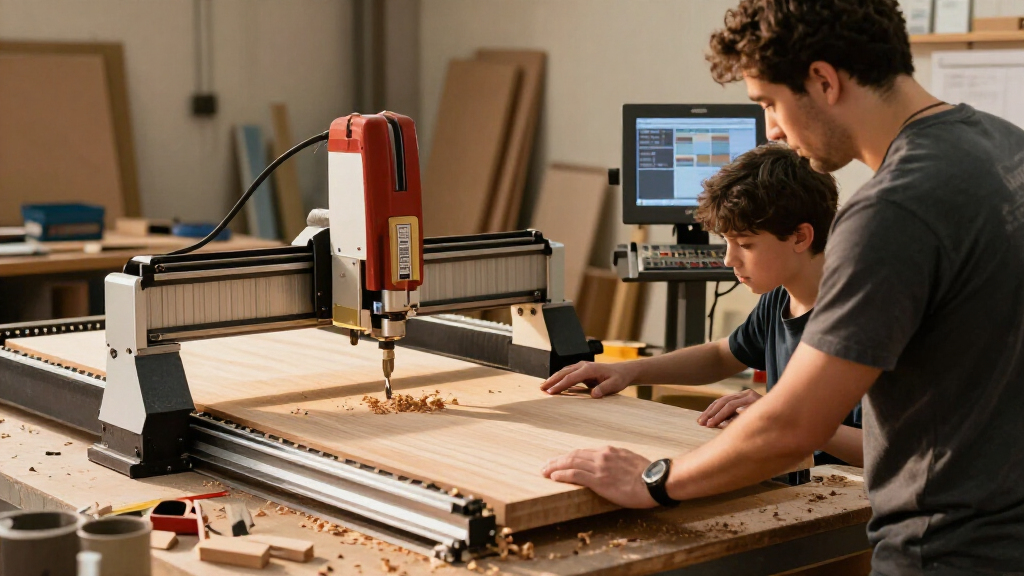
I ranked these machines around the needs behind a professional CNC router: dependable motion, useful capacity, and the ability to match the machine to repeated work rather than occasional hobby use. I compared stated work areas, frame and guide construction, drive components, motor or spindle details, and the breadth of material claims. I also weighed usability and practical ownership questions—such as setup, footprint, and how clearly a machine’s configuration is described—because a strong specification has limited value if it does not suit the buyer’s workflow.
The order reflects the balance of those factors, not a single specification. The LUNYEE 8080 Pro Max leads for its unusually broad stated work area, while the AnoleX and WolfPawn earn distinct attention for their motion-system features. Machines with smaller envelopes can still be better fits for compact, detailed work; they rank lower as general professional choices when their stated capacity is more limited. Product details are based on the supplied model information, so I avoid inferring unstated features and recommend confirming the exact package, spindle, controller, and support arrangements before purchase.
Factors to Consider When Choosing Professional Cnc Router Machine
Choosing a professional router starts with the work you need it to repeat, not the largest number on a product page. I would settle the part size, material, and production rhythm first, then compare machine architecture and ownership demands against those needs.
Match the Work Area to Real Parts
Measure the largest workpiece you expect to machine, including room for clamps, probing, and tool access. A stated work area is not the same as usable cutting space once fixtures and workholding take up room. Avoid buying a much larger machine solely for occasional oversized parts: a larger frame uses more floor or bench space and may demand greater attention to rigidity. For nested production, allow room for multiple parts and safe toolpaths rather than sizing the table to one finished object. If most jobs are small, a compact machine can leave more budget and workspace for tooling and dust collection.
Prioritize Rigidity for the Materials You Cut
Frame stiffness affects how consistently a router holds its path under cutting forces, particularly during deeper passes or work in harder materials. All-metal construction can be a useful signal, but it does not by itself establish rigidity; rail spacing, joints, gantry design, and machine mass matter too. A common mistake is assuming that a more powerful trimmer compensates for a flexible structure. For aluminum or brass, look for a machine whose guides and frame are suited to controlled, conservative cuts, and confirm what the manufacturer supports. For wood, acrylic, and PCB work, the required rigidity still depends on tool diameter, depth of cut, and desired finish.
Compare Motion Components, Not Just Motor Labels
Linear guides and ball screws can support controlled movement, while closed-loop stepper systems add feedback that may help identify or limit lost-position problems. These features address different parts of motion performance; one should not be treated as a substitute for the other. Ask how the axes are driven, what backlash or repeatability information is available, and whether spare components can be sourced. A motor size or closed-loop label alone cannot tell you how a complete machine will perform under load. For repeated production, prioritize documented motion specifications and serviceability over a feature name without supporting detail.
Choose the Spindle Package for Your Duty Cycle
Spindle wattage is only one part of cutting capability. Collet compatibility, speed range, cooling, runout, noise, and whether the package is a spindle or a handheld-style trimmer all affect daily use. A trimmer may be convenient for common router bits, while a spindle package may better fit a setup designed around continuous CNC operation; confirm the specific machine configuration rather than relying on a shared model name. Check whether the control system can manage spindle speed or whether manual adjustment is required. Do not assume an 800W unit will cut every material faster or more cleanly than a 710W option.
Plan for Setup, Workholding, and Dust Control
A router is part of a workshop system, not a standalone purchase. Budget space for the machine, a stable table, clamps or a spoilboard, cable routing, dust extraction, and safe access to the emergency stop. Larger work areas can make loading sheet goods easier but also complicate enclosure design and chip management. Before ordering, check the assembly process, electrical requirements, controller connections, software compatibility, and whether the package includes the accessories your workflow needs. These details can change how quickly the machine becomes productive and how much additional equipment is required.
Pay More for Verifiable Capability, Not a Longer Feature List
A higher-spec machine makes sense when its frame, motion system, or capacity addresses a recurring production constraint. If your parts are small and your cuts shallow, a large work envelope may offer little practical return. Ask for clear documentation on supported materials, motion accuracy, spindle limits, and replacement parts before paying extra for broad claims. Also compare warranty terms, technical support access, and the availability of consumables, since downtime can outweigh a small difference in machine features. When details are missing, treat that uncertainty as a buying cost rather than assuming the best-case performance.
Frequently Asked Questions
Can a desktop CNC router count as a professional machine?
Yes, if its rigidity, repeatability, work area, and support fit the job it will perform. “Desktop” describes the general footprint, not whether the machine can meet a production requirement. For steady commercial work, confirm documented motion performance, spindle duty suitability, and the availability of replacement parts. A compact router may be a sensible professional tool for small components, engraving, or short runs, but it may not suit large panels or sustained heavy cuts. Judge it by the work it can reliably repeat, not by its size category.
Is a larger work area more important than a stronger frame?
Not if the larger machine cannot hold its path under the forces of your intended cuts. Work area determines the maximum practical part size, while rigidity affects how consistently the machine can cut that part. Buyers often focus on table dimensions and overlook the gantry, rail layout, and structural joints. If your work is small but calls for precise or harder-material cuts, a stiffer machine with a smaller envelope may be the better fit. Choose extra capacity when your jobs actually need it and the structure supports the cutting demands.
What should I verify before choosing a router for aluminum or brass?
Check the manufacturer’s material guidance, machine rigidity, guide and drive design, spindle details, and recommended cutting parameters. A product listing that names a metal does not show what alloys, tool sizes, or cut depths the machine can handle. Ask whether the machine is intended for light engraving, shallow passes, or more demanding machining, since those are very different workloads. You will also need suitable tooling, secure workholding, and chip management. If performance data is vague, plan for conservative expectations rather than treating a material claim as proof of production capability.
Should I choose a spindle or a trimmer-router configuration?
The right choice depends on the package, tool ecosystem, and duty cycle you need. A trimmer-style unit can offer familiar bit compatibility and straightforward replacement, while a spindle may suit a CNC-focused setup with speed control and a more integrated installation. Neither label alone guarantees better cutting results. Confirm collet sizes, speed adjustment, cooling, runout information, electrical compatibility, and whether the machine controller manages the motor. The Genmitsu 4040-PRO MAX appears in both trimmer and spindle configurations, so check the exact version rather than assuming the listings are equivalent.
Which features are worth paying extra for in a production shop?
Pay for features that reduce a specific production bottleneck: a larger usable envelope for bigger parts, stronger motion components for controlled movement, or feedback features that help catch position errors. The AnoleX’s ball screws and dual steel linear guides and the WolfPawn’s closed-loop motors illustrate different feature priorities, not a universal upgrade ladder. Before spending more, confirm the specifications, service options, and compatibility with your tooling and workflow. A high-capacity machine is poor value if your parts remain small, while a compact unit can become limiting when jobs grow. Match the upgrade to a recurring need, not a feature list.
Conclusion
For buyers seeking the broadest stated work area, I would start with the LUNYEE 8080 Pro Max as my best overall pick, while checking that its structure and setup suit the intended cuts. For best value, I would compare the Genmitsu 4040-PRO MAX configurations and choose the trimmer or spindle version that matches the shop’s tooling and workflow. The AnoleX 4030-Evo Ultra 2 is my best premium-style choice for buyers focused on ball screws and dual steel linear guides, while the FoxAlien Masuter Pro is the more approachable option for buyers who value a desktop format and a simpler entry point. For specific needs, choose the WolfPawn 6060 if closed-loop motors are a priority, or the LUNYEE 3020 Nova when a smaller footprint matters more than large-part capacity. Before ordering any of them, confirm the exact spindle package, usable work envelope, controller, and support terms.