
TL;DR

Prime made for students and young adults
- Fast, free delivery for dorm and study essentials
- Prime Video and Amazon Music included
- Member-only deals
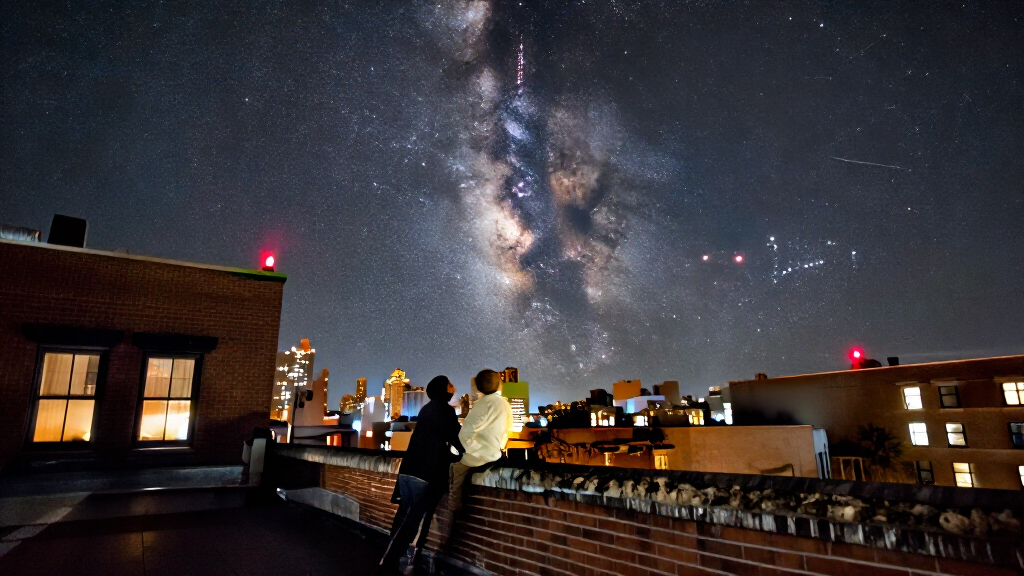
NASA’s Astronomy Picture of the Day for Oct. 15, 2026, features an image of the Milky Way above Manhattan by Jason Kurth and Ty Buckley. NASA says the photograph uses a filter to capture near-infrared light, reducing much of the city light that would otherwise obscure the stars.
NASA’s Astronomy Picture of the Day for October 15, 2026, features the Milky Way over Manhattan in a photograph credited to astrophotographers Jason Kurth and Ty Buckley. NASA says the image was made with a filter that blocks most visible light and records near-infrared light, allowing the galaxy’s stars to stand out against a bright urban setting.
The NASA Science page explains that the filter captures light in the near-infrared region of the electromagnetic spectrum, which has lower energy than visible light. The technique reduces much of the city’s visible glow, but does not remove every source: NASA says older incandescent bulbs and some neon lights remain bright in near-infrared, while fluorescent and LED bulbs do not.
Stars also emit near-infrared light, NASA notes, making it possible to record the Milky Way while suppressing many of the sources that make it difficult to see from the ground in a brightly lit city. The page presents the photograph as an example of how a choice of wavelength can change what is visible in an image of the night sky.
The entry is part of NASA’s daily APOD service, which pairs an astronomy image or photograph with an explanation written by a professional astronomer. The October 15 page credits Kurth and Buckley for the image and lists Cecilia Chirenti, Robert Nemiroff, Jerry Bonnell and Keighley Rockcliffe as authors and editors.
How Infrared Reveals City Skies
The image offers a specific illustration of the limits of ordinary night-sky viewing in a city: urban lighting can overwhelm visible starlight, but its effects depend on the wavelength being recorded. By filtering out most visible light, the photographers could capture a view of the Milky Way that is not apparent to the unaided eye under the same conditions.
That distinction matters for readers interpreting the picture. It is not evidence that the Milky Way is readily visible over Manhattan in a normal visual observation; rather, NASA attributes the result to the near-infrared filter and the camera setup. The image also serves NASA’s broader educational purpose, showing how astronomical observations can reveal features of the sky even in places where light pollution is substantial.
infrared camera for astrophotography
As an affiliate, we earn on qualifying purchases.
As an affiliate, we earn on qualifying purchases.
The APOD Image and Its Method
NASA’s Astronomy Picture of the Day has published a different image or photograph with an explanatory note each day. The October 15, 2026 entry is titled “The Milky Way over Manhattan” and is credited to Jason Kurth and Ty Buckley. NASA identifies the service as supported by the Astrophysics Science Division at Goddard Space Flight Center, NASA Science Activation and Michigan Technological University.
In its explanation, NASA describes the photograph as a reminder that people share the same sky and that astronomy can help explore humanity’s place in the cosmos. The note’s technical explanation is narrower: a filter blocks most visible wavelengths, while near-infrared light from stars remains recordable. Different types of artificial lighting behave differently in that part of the spectrum, so the filter reduces some sources of light pollution more than others.
As an affiliate, we earn on qualifying purchases.
Details Beyond the NASA Caption
NASA’s APOD page explains the wavelength and broad effect of the filter, but the supplied entry does not give exposure settings, camera specifications, the exact location, or the date and conditions of the shoot. It also does not quantify how much city light was reduced or describe the image-processing steps. Those details cannot be established from the caption alone.
The page identifies the photographers and explains that the image records near-infrared light, but it does not claim that all light pollution was eliminated. NASA specifically notes that incandescent bulbs and some neon lights can still be bright in near-infrared. The photograph should therefore be understood as a filtered astronomical image, not a direct representation of what a person would see with unaided vision.
urban light pollution reduction filter
As an affiliate, we earn on qualifying purchases.
As an affiliate, we earn on qualifying purchases.
The Next Daily Astronomy Image
NASA’s listing says the following day’s APOD is titled “Chasing the ISS.” The October 15 page does not announce a follow-up investigation or a further technical report about the Manhattan photograph. Readers seeking more information about how the image was captured would need details from the photographers or a more extensive description than the APOD caption provides.
As an affiliate, we earn on qualifying purchases.
Key Questions
What does NASA’s October 15, 2026 APOD show?
It features the Milky Way over Manhattan, in a photograph credited to Jason Kurth and Ty Buckley.
How could the Milky Way be photographed over a brightly lit city?
NASA says the image was made with a filter that blocks most visible light and captures near-infrared light. Stars emit near-infrared light, while many city lights are reduced by the filter.
Does the filter block all city lighting?
No. NASA says older incandescent bulbs and some neon lights can remain bright in near-infrared, although fluorescent and LED bulbs do not.
Is this what Manhattan’s night sky looks like to the naked eye?
No. The NASA explanation attributes the view to a filter that changes which wavelengths the camera records. The image is not a direct view of the sky in visible light.
Who is credited with the photograph?
NASA credits Jason Kurth and Ty Buckley. The page lists Cecilia Chirenti, Robert Nemiroff, Jerry Bonnell and Keighley Rockcliffe as authors and editors.
Source: primary
Halloween Picks
halloween
As an affiliate, we earn on qualifying purchases.