
TL;DR

Prime made for students and young adults
- Fast, free delivery for dorm and study essentials
- Prime Video and Amazon Music included
- Member-only deals
NASA says four volunteers will leave its CHAPEA Mars simulation habitat at Johnson Space Center on Oct. 31, after 378 days in isolation. The agency says data from the mission may inform preparations for Artemis and future lunar missions; it has not yet reported findings from the crew’s year inside.
Four volunteers in NASA’s CHAPEA Mission 2 are scheduled to leave their simulated Mars habitat at Johnson Space Center in Houston on Saturday, Oct. 31, after 378 days of isolation. NASA has invited media to watch the crew’s exit and hear from the participants, as the agency completes a yearlong study intended to inform preparations for future Artemis and lunar missions.
The departure ceremony is scheduled to begin at 3 p.m. EDT and will be streamed on NASA Johnson’s YouTube channel and social accounts. NASA says Johnson Center Director Vanessa Wyche, astronaut Jack Hathaway, and crew members Ross Elder, Ellen Ellis, James Spicer, and Matthew Montgomery are expected to give remarks. The agency described the event as the crew’s exit from the Crew Health and Performance Exploration Analog, or CHAPEA, habitat.
NASA invited media to attend in person at Johnson Space Center, where the ceremony will be shown on a screen outside the hangar containing the habitat. Afterward, a subject matter expert is expected to answer questions, and journalists will have an opportunity to film the crew stepping outdoors after more than a year inside. U.S. media seeking in-person access or a virtual interview with crew members in the days after the mission must contact the Johnson newsroom by 2 p.m. EDT on Friday, Oct. 30.
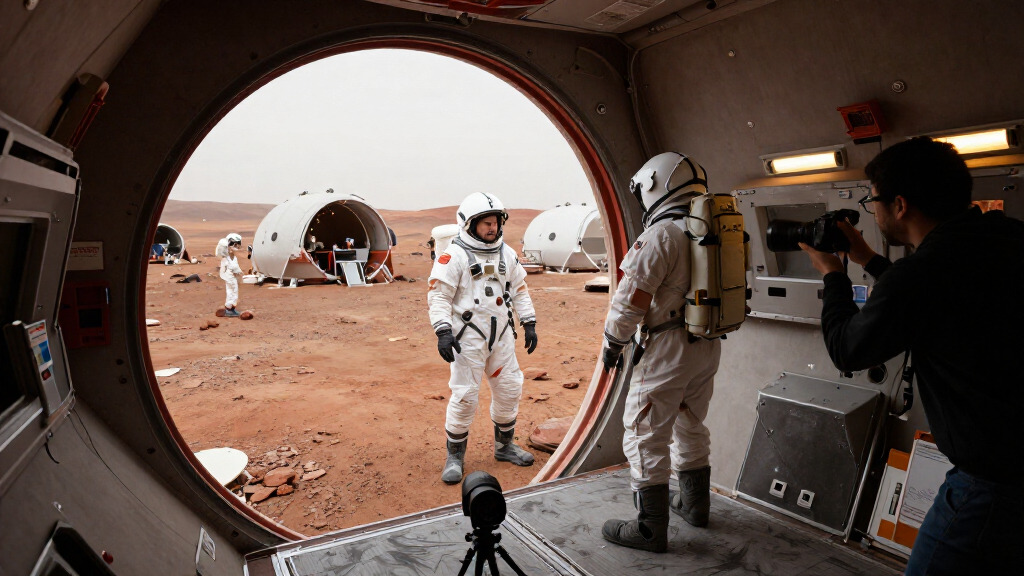
The four volunteers lived and worked in a 1,700-square-foot, 3D-printed facility while carrying out simulated mission activities. NASA says those activities included simulated spacewalks, exercise, habitat maintenance, and growing plants. The crew also operated under conditions designed to resemble some challenges of deep-space missions, including communication delays, limited resources, and isolation.
How the Simulation Could Aid Lunar Missions
NASA says the mission’s health and performance data can help the agency develop ways to address human risks during future spaceflight. The agency points in particular to potential uses in planning food systems, crew schedules, and communications, including efficient use of bandwidth on NASA’s Deep Space Network. The data may also support work on medical care and behavioral health for crews operating far from Earth.
The relevance extends beyond a simulated Mars mission. NASA says findings from CHAPEA can help prepare for Artemis and future Moon Base missions, where crews may face isolation, constrained supplies, and communication delays. These conditions can affect how astronauts manage work and maintain health, but the agency has not yet published the study’s results. The scheduled exit marks completion of the simulation, not confirmation that any particular intervention or mission plan has been validated.
Popular right now

Samsung 42-Inch S90H OLED 4K Smart TV Bundle

Dyson Car+Boat Cordless Handheld Vacuum

Shark Navigator Robot Vacuum with 30-Day Self-Emptying Base, White (AV2110S)
As an affiliate, we earn on qualifying purchases.
Inside CHAPEA Mission 2
CHAPEA stands for the Crew Health and Performance Exploration Analog. NASA uses the habitat at Johnson Space Center to simulate aspects of living and working on a Mars mission without sending participants to space. The facility’s layout and activities offer a controlled setting for studying crew performance under selected mission-like constraints.
Mission 2 began on Oct. 19, 2025, and the four volunteers have remained in the habitat for 378 days, according to NASA’s announcement. The agency says participants carried out a range of work and routine tasks, from maintenance and exercise to plant growing, alongside simulated exploration activities. This is a ground-based analog: the source does not describe the crew as having traveled to Mars or taken part in an actual spaceflight.
Study Results Still Await Publication
NASA’s announcement describes the study’s purpose and the activities carried out, but it does not provide results, measurements, or conclusions from the 378-day mission. It is not yet clear which aspects of crew health or performance the data will show, when NASA will release an analysis, or how any findings might change mission planning.
The agency also has not specified in this announcement what follow-up evaluations the participants will undergo after leaving the habitat. The listed speakers are expected to provide remarks at the ceremony, but NASA has not supplied their comments in advance. Any interpretation of the mission’s outcomes will depend on evidence released after the simulation is complete.
Crew Exit and Follow-Up Briefings
The next scheduled milestone is the crew’s departure on Oct. 31 at 3 p.m. EDT, with live coverage planned on NASA Johnson’s online channels. NASA says in-person media will be able to film the volunteers leaving the building and speak with a subject matter expert after the ceremony.
NASA also says media may request virtual conversations with crew members in the days following completion of the mission. The agency has not announced a date for publishing study results. Further reporting will depend on what NASA shares about the data, the participants’ post-mission assessments, and how the agency plans to apply the findings to future lunar or deep-space operations.
Key Questions
When will the CHAPEA Mission 2 crew leave the habitat?
NASA scheduled the crew’s exit for Saturday, Oct. 31, with the ceremony beginning at 3 p.m. EDT.Who are the four volunteers?
NASA identifies the crew members as Ross Elder, Ellen Ellis, James Spicer, and Matthew Montgomery.What did the volunteers do during the simulation?
They lived and worked in a 1,700-square-foot habitat, carrying out simulated spacewalks, exercise, maintenance, plant growing, and other mission-like activities under conditions including isolation, communication delays, and resource limits.Has NASA released the mission’s findings?
The announcement does not include study results. NASA says the collected data may help with preparations for future missions, but specific findings and their release timeline remain unknown.How can media follow the crew’s departure?
NASA plans to stream the ceremony through NASA Johnson’s YouTube and social accounts. U.S. media seeking in-person access or virtual interviews must contact the Johnson newsroom by 2 p.m. EDT on Oct. 30.Source: nasa.gov