TL;DR
Open a free Amazon Business account
Business pricing, bulk buying and tax-exempt orders.
Create a free accountAs an affiliate, we earn on qualifying purchases.
Archaeologists have uncovered a 4,400-year-old tomb at Saqqara belonging to an Egyptian judge, notable for its preserved wall paintings. This discovery offers new insights into early Egyptian judicial and funerary practices.
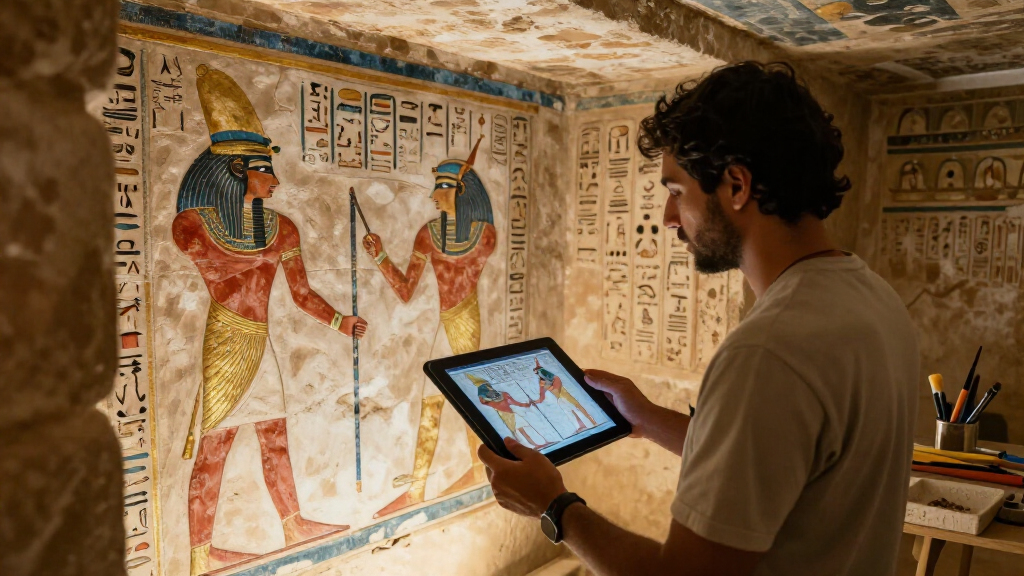
Archaeologists have uncovered a 4,400-year-old tomb at Saqqara belonging to an Egyptian judge, featuring remarkably preserved wall paintings with vibrant colors. This discovery, confirmed by Egypt’s Ministry of Tourism and Antiquities, provides new insights into early Egyptian judicial figures and funerary art, highlighting the historical significance of Saqqara as a key archaeological site.
The tomb was discovered during ongoing excavations at Saqqara, a vast necropolis near Cairo, known for its extensive ancient burial sites. The structure dates back to the Third Dynasty of Egypt, roughly 2400 BCE, and is believed to belong to a high-ranking judicial official based on inscriptions found within. The walls of the tomb are decorated with colorful murals depicting scenes of judgment, offerings, and daily life, with the colors still vividly intact.
According to Egypt’s Ministry of Tourism and Antiquities, the tomb’s architecture features a rectangular burial chamber with a small antechamber, typical of elite tombs from that period. The wall paintings include depictions of deities, hieroglyphic inscriptions, and scenes illustrating the judge’s role in legal proceedings. The preservation of the wall colors is considered exceptional, given the tomb’s age, and suggests that the site was well-maintained or sealed shortly after burial.
Preliminary analysis indicates that the tomb belonged to a person of significant status, possibly involved in legal or administrative functions, reflecting the complexity of early Egyptian society. The find adds to the growing body of evidence about the roles and status of judicial officials in ancient Egypt, which is still being actively studied by Egyptologists.
Why the Tomb’s Preservation and Art Matter
This discovery is significant because it offers a rare glimpse into the funerary practices and societal structure of Egypt over four millennia ago. The well-preserved wall paintings provide valuable iconographic and textual data, helping scholars better understand the roles of judges and officials in early Egyptian civilization. The vibrant colors challenge previous assumptions about the deterioration of ancient murals, indicating that some tombs may have been sealed quickly or constructed with materials that aided preservation.
Furthermore, the find underscores Saqqara’s importance as a cultural and archaeological hub, with ongoing excavations continuing to yield vital artifacts. It also enhances Egypt’s reputation as a key location for understanding ancient history, potentially attracting more scholarly interest and tourism.
Egyptian wall painting replica art
As an affiliate, we earn on qualifying purchases.
As an affiliate, we earn on qualifying purchases.
Saqqara’s Role in Egypt’s Ancient Burial Practices
Saqqara, located south of Cairo, has been a major archaeological site since the 19th century, known primarily for the Step Pyramid of Djoser, built around 2670 BCE. Over the years, excavations have uncovered numerous tombs, mastabas, and burial complexes from various dynasties, revealing the evolution of Egyptian funerary architecture and art. The site has yielded important artifacts related to royal and elite burials, but discoveries of non-royal tombs, such as this recent find, continue to expand understanding of societal hierarchies and professional roles.
Previous discoveries at Saqqara have included well-preserved statues, inscriptions, and funerary objects, but intact wall paintings from this period are rare. The current find aligns with a broader trend of renewed archaeological activity at Saqqara, driven by increased funding and advanced imaging technologies. Interest in the site has surged in recent months, partly fueled by the discovery of other significant tombs and artifacts, although details about this specific excavation remain preliminary.
ancient Egyptian hieroglyphic art supplies
As an affiliate, we earn on qualifying purchases.
As an affiliate, we earn on qualifying purchases.
Unconfirmed Details and Ongoing Analysis
While the initial findings confirm the age and preservation of the tomb, many details remain unverified, including the full extent of the murals and the identity of the tomb owner. Further analysis, including carbon dating and detailed inscription reading, is underway. It is not yet clear whether the tomb belonged to a prominent judge or a different official, or how typical its preservation is compared to other tombs from the same period.
Additionally, some claims about the significance of the wall colors and their state of preservation are preliminary, pending peer review and further examination by conservators and Egyptologists.
Egyptian archaeological replica models
As an affiliate, we earn on qualifying purchases.
As an affiliate, we earn on qualifying purchases.
Next Steps in Excavation and Study
Researchers plan to conduct detailed conservation of the tomb and its murals, including high-resolution imaging and chemical analysis. Further excavations at the site are expected to uncover additional artifacts that may clarify the owner’s identity and social role. Publication of detailed findings is anticipated within the next year, which will help contextualize this discovery within Egypt’s broader archaeological record.
Scholars also aim to compare this tomb to other contemporaneous sites to better understand the evolution of funerary art and judicial roles in early Egypt. Increased public and scholarly interest is likely to follow the ongoing research and potential future discoveries at Saqqara.
As an affiliate, we earn on qualifying purchases.
Key Questions
How old is the tomb?
The tomb dates back approximately 4,400 years, placing it in the early dynastic period of Egypt around 2400 BCE.
What makes the wall paintings special?
The paintings are remarkably well-preserved, with vibrant colors still visible after more than four millennia, which is rare for tomb murals from this period.
Who was the tomb owner?
It is not yet confirmed who the owner was; initial evidence suggests a high-ranking official, possibly a judge, but further analysis is ongoing.
What does this discovery tell us about ancient Egypt?
It provides new insights into the societal roles, funerary practices, and artistic conventions of early Egyptian civilization, especially regarding judicial figures.
When will more details be available?
Further analyses and publications are expected within the next year, after comprehensive conservation and study are completed.
Source: hn
NFL season / tailgating Picks
team gear
As an affiliate, we earn on qualifying purchases.