Cubism changed art by intentionally breaking away from realistic scenes, using geometric shapes and multiple viewpoints to challenge how you see space and form. Artists like Picasso and Braque fractured traditional perspective, creating layered, abstract compositions that invite you to see beyond surface appearances. This revolutionary style, with its use of collage and textured materials, redefined modern art and influenced countless movements. If you explore further, you’ll uncover the full story behind why Cubism truly broke reality on purpose.
Key Takeaways
- Cubism intentionally deconstructed realistic forms to challenge traditional perspectives and portray multiple viewpoints simultaneously.
- Artists used geometric shapes and fractured surfaces to abstract reality, emphasizing perception over realism.
- Techniques like collage and layered media further broke conventional boundaries, creating complex, fragmented images.
- The movement shifted focus from naturalistic depiction to symbolic, interpretive representations of subjects.
- Cubism’s purpose was to reinvent art’s understanding of space, form, and perception by breaking the illusion of reality.
How Did Cubism Start and Break From Tradition
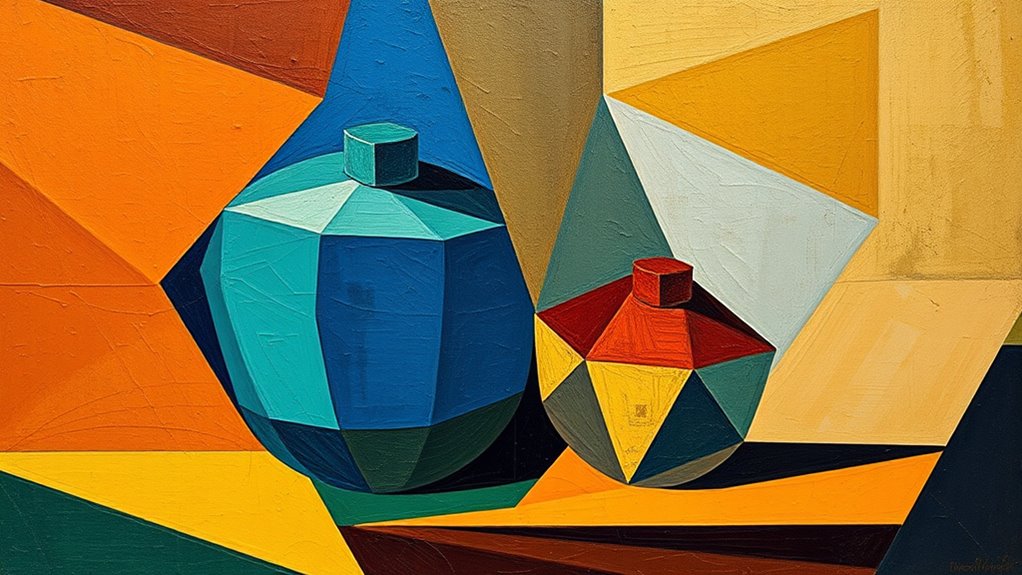
Cubism began in the early 20th century as a radical departure from traditional artistic styles. Instead of realistic depictions, you see artists experimenting with geometric shapes and fractured perspectives.
The color palette was often subdued, favoring earth tones and muted shades to emphasize form over emotion.
Artistic influences played a vital role; you can trace Cubism’s roots to Cézanne’s geometrization of nature and African tribal masks’ abstract patterns.
These influences pushed artists to break away from perspective and realistic representation, focusing instead on multiple viewpoints within a single composition.
Who Were the Key Artists Behind Cubism
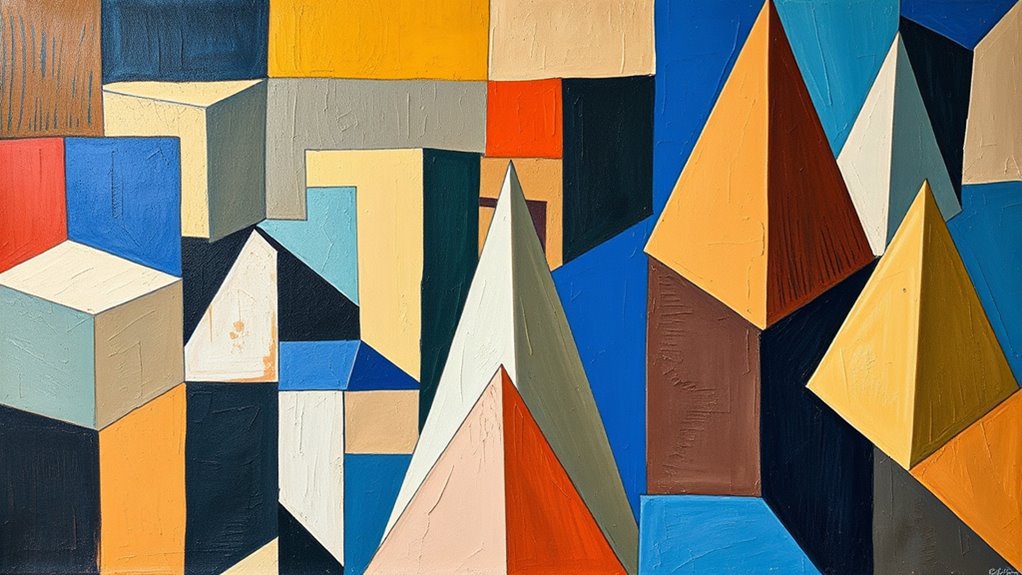
Who were the artists responsible for shaping this revolutionary movement? The famous cubist painters, Pablo Picasso and Georges Braque, led the cubism art movement. Picasso’s bold experiments with form and perspective transformed traditional art, making him a central figure. Braque, his close collaborator, contributed equally with his innovative approach to breaking down objects into geometric shapes. Together, they challenged viewers to see multiple angles simultaneously, a hallmark of cubism. Other notable artists, like Juan Gris and Jean Metzinger, expanded on these ideas, further defining the movement. These key figures revolutionized modern art by abandoning realistic depictions and embracing abstraction. Their groundbreaking work laid the foundation for future avant-garde movements by emphasizing geometric abstraction, forever changing how we interpret and experience art, especially through their influence on Free Floating compositional techniques. Additionally, their exploration of multiple perspectives encouraged viewers to engage with art in a more dynamic and interpretive manner. Moreover, their work also inspired new approaches to visual perception, influencing subsequent art styles and artistic thinking.
What Are the Main Ideas That Define Cubism

At its core, cubism is defined by its innovative approach to representing three-dimensional objects on a two-dimensional surface. You’ll notice a focus on geometric abstraction, breaking down complex forms into simple shapes like cubes, spheres, and cones. This technique allows you to see multiple viewpoints simultaneously, creating a fragmented, layered effect. Perspective distortion plays a key role, as traditional single-point perspective is abandoned in favor of multiple perspectives within one composition. This challenges your perception of reality, making you question how space and form are related. Cubism emphasizes reducing reality into geometric forms, encouraging you to interpret scenes in a new, abstract way. Additionally, the integration of music therapy techniques into artistic expression can deepen the emotional impact of cubist artworks, fostering a more profound viewer experience. Exploring visual perception concepts helps deepen your understanding of how these artistic choices influence viewer engagement. Embracing innovative artistic methods expands the viewer’s understanding of how art can break traditional boundaries and evoke new emotional responses. Recognizing the influence of artistic movements aids in appreciating how cubism emerged as a response to prior styles and cultural shifts, further enriching your experience of these groundbreaking artworks. These core ideas transform the way you experience and understand visual reality in art.
How Did Analytical and Synthetic Cubism Differ
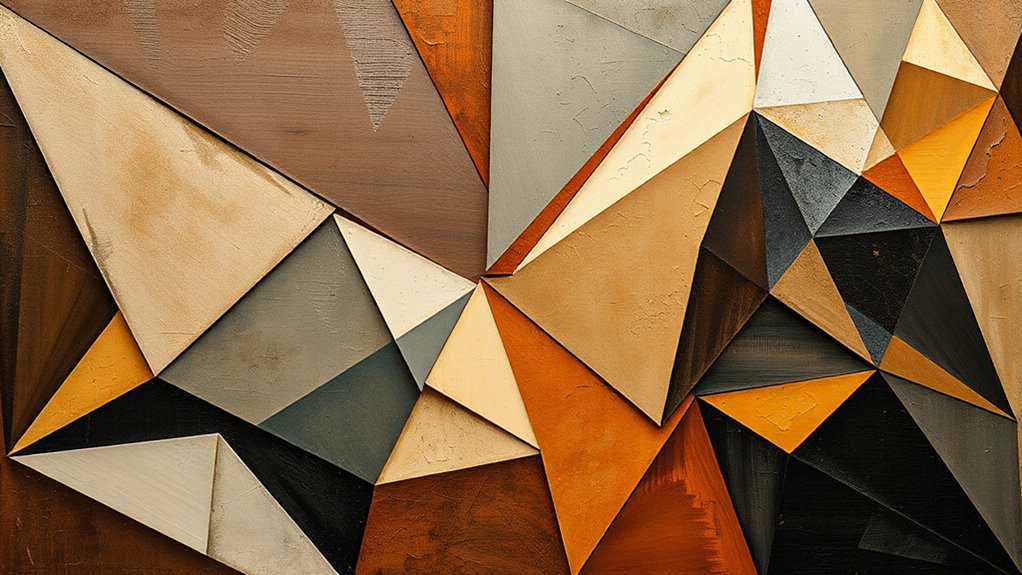
You’ll notice that Analytical Cubism breaks down objects into fragmented perspectives, making the image look complex and layered. In contrast, Synthetic Cubism simplifies this approach by incorporating collaged elements and bold shapes. This shift results in a different visual experience, emphasizing overall composition over detailed fragmentation. Additionally, Synthetic Cubism often employs mixed media techniques to create more accessible and vibrant imagery. This approach aligns with the movement’s focus on collaboration with diverse materials, which contributed to innovative artistic expressions. Recognizing the importance of material experimentation highlights how Synthetic Cubism expanded artistic boundaries beyond traditional painting methods and fostered new artistic collaborations.
Analytical: Fragmented Perspectives
How did Analytical Cubism achieve its distinctive fragmented perspective? You see, it breaks down objects into abstract forms, presenting multiple viewpoints simultaneously. Instead of depicting a subject from a single angle, artists like Picasso analyze it from various perspectives within one composition. A key aspect of this approach is the emphasis on geometric abstraction, which highlights the use of geometric shapes to deconstruct and interpret the subject matter. This method creates a mosaic of overlapping planes, emphasizing the fractured, complex nature of reality. The focus isn’t on realistic representation but on revealing the subject’s underlying structure through geometric abstraction.
Synthetic: Collaged Elements
While Analytical Cubism emphasizes breaking down objects into geometric facets, Synthetic Cubism introduces a different approach by incorporating collaged elements into the artwork.
This technique uses collaged elements, such as newspaper clippings, wallpapers, and textured papers, to create a layered, mixed media surface. Instead of dissecting forms into tiny facets, Synthetic Cubism simplifies the composition, combining painted shapes with real-world materials.
This approach blurs the line between art and everyday objects, making the artwork more tangible and accessible. Collaged elements add texture and depth, enriching the visual experience.
Visual Complexity Shift
Analytical and Synthetic Cubism differ markedly in their approach to visual complexity. Analytical Cubism emphasizes breaking down subjects into geometric abstraction, creating a dense, fragmented view that challenges your visual perception. It presents multiple perspectives simultaneously, making the image appear intricate and layered.
In contrast, Synthetic Cubism simplifies these complexities by reintroducing recognizable elements and textures, reducing visual clutter. This shift makes the artwork more accessible, with clearer forms and brighter colors. The focus moves from dissecting reality to reconstructing it in a way that balances abstraction with coherence.
Which Are the Most Iconic Cubist Paintings to Know
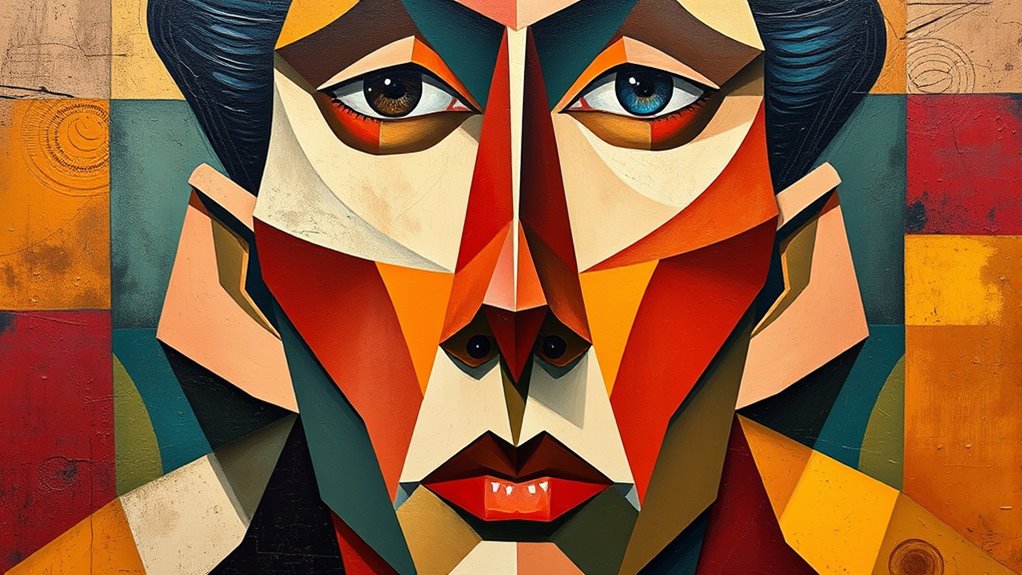
You’ll want to become familiar with Picasso’s *Les Demoiselles d’Avignon*, a groundbreaking work that challenged traditional perspectives.
Picasso’s *Guernica* powerfully captures the horrors of war and remains one of the most impactful pieces of 20th-century art.
Additionally, *Man with a Guitar* showcases how Cubism explores fragmented forms to convey emotion and movement.
Les Demoiselles D’avignon
Have you ever wondered which painting marked the beginning of Cubism? It’s “Les Demoiselles d’Avignon” by Picasso. This groundbreaking work breaks away from traditional perspectives, using Cubist symbolism to depict five women with distorted, angular forms. The painting’s bold, fractured shapes challenge your perception of reality and invite you to see beyond surface appearances. Cultural influences from African and Iberian art shape its mask-like faces and primitive style. Picasso’s intention was to portray raw emotion and complex symbolism, rather than realistic beauty. This piece radically shifts your understanding of form and space, making it a pivotal moment when art intentionally broke reality to explore new ways of seeing and interpreting the world. Connected art movements further expanded these ideas, emphasizing the importance of breaking conventional boundaries in creative expression.
Guernica’s Impact
What makes Picasso’s “Guernica” one of the most powerful Cubist masterpieces? Its raw emotion and fragmented forms convey the horrors of war, making a lasting impact. Cubism’s influence extends beyond painting, shaping sculpture with geometric abstraction and multiple perspectives. Its impact on fashion is evident in avant-garde designs that challenge traditional forms, emphasizing bold shapes and deconstructed aesthetics. “Guernica” changed how viewers interpret art’s role in society, inspiring artists to express complex ideas through fractured visuals. This masterpiece not only redefined artistic boundaries but also demonstrated Cubism’s capacity to influence multiple creative fields. Its revolutionary approach continues to resonate, influencing sculpture and fashion, proving Cubism’s enduring power to break reality and reshape artistic expression.
| Cubism’s influence on sculpture | Cubism’s impact on fashion |
|---|---|
| Geometric abstraction | Deconstructed garments |
| Multiple perspectives | Bold, unconventional styles |
| Modernist experimentation | Challenging traditional aesthetics |
Man With a Guitar
Among the most celebrated Cubist paintings, “Man With a Guitar” stands out for its dynamic composition and innovative use of form.
You can see how the fractured shapes and multiple perspectives symbolize musical symbolism, capturing the rhythm and movement of music itself.
This piece exemplifies how Cubists used artistic expression to break away from traditional realism, emphasizing emotion and conceptual ideas over literal representation.
The geometric fragmentation invites you to interpret the figure and instrument from various angles simultaneously, creating a sense of vibrancy and energy.
As you observe, you realize that Cubism isn’t just about visual distortions but about conveying deeper layers of meaning through artistic experimentation.
“Man With a Guitar” invites you to experience music and emotion through a revolutionary approach to form and perception.
How Did Cubism Change Modern Art and Its Legacy

Cubism revolutionized modern art by breaking away from traditional perspectives and encouraging artists to explore multiple viewpoints simultaneously. This shift led to the use of abstract forms that deconstructed objects into geometric shapes, challenging viewers to see familiar scenes in new ways.
Cubism broke traditional perspectives, inspiring new ways of seeing through abstract, geometric forms.
Artists experimented boldly with color, moving beyond naturalistic palettes to emphasize mood and structure. Cubism’s innovations influenced countless future movements, including Surrealism and Abstract Expressionism, by emphasizing innovation over realism.
It also expanded the boundaries of artistic expression, inspiring artists to experiment with form and perspective. The legacy of Cubism endures in contemporary art, where breaking conventional rules remains essential.
Its impact transformed how we understand reality in art, encouraging a more complex, layered approach to visual storytelling.
What Techniques and Materials Did Cubists Use

To achieve the innovative perspectives characteristic of Cubism, artists employed a variety of distinctive techniques and materials. They embraced geometric abstraction, breaking subjects into fragmented, angular forms that challenge traditional perspectives. geometric abstraction was fundamental in creating the fractured, multi-angle views that define Cubism. Material experimentation was key; they used collage, incorporating newspaper clippings, labels, and textured surfaces to add depth and complexity. Artists like Picasso and Braque layered paint, created multiple viewpoints within a single plane, and played with transparency to distort reality. They often combined different media—oil, charcoal, and found objects—to push the boundaries of traditional art materials. This approach allowed them to explore new ways of representing subjects, emphasizing form and structure over realistic depiction. Through these techniques and materials, Cubism redefined how art could interpret and deconstruct reality.
How Did Cubism Challenge Our Views of Space and Reality
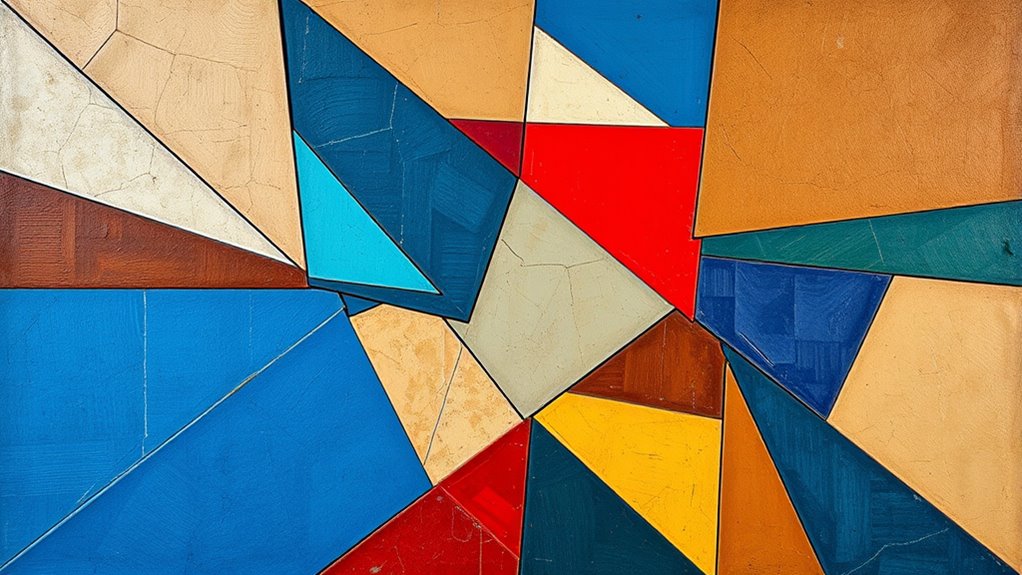
Have you ever wondered how Cubist artists changed the way we see space and reality? They mastered perspective distortion, breaking the rules of traditional linear perspective. Instead of viewing objects from a single vantage point, they depicted multiple angles simultaneously, creating a fragmented, layered effect.
This approach introduces spatial ambiguity, making it difficult to determine depth or distance clearly. Cubism challenges your perception by merging foreground and background, flattening the picture plane, and disrupting usual notions of space. Additionally, the movement’s influence extended into other art forms, inspiring new ways of thinking about visual perception and multiple perspectives.
You’re encouraged to see beyond realistic representation and engage with the artwork on a conceptual level. Through these techniques, Cubists invite you to experience space as a complex, multi-dimensional construct, fundamentally altering how you interpret visual reality.
What Was Happening in the World When Cubism Emerged
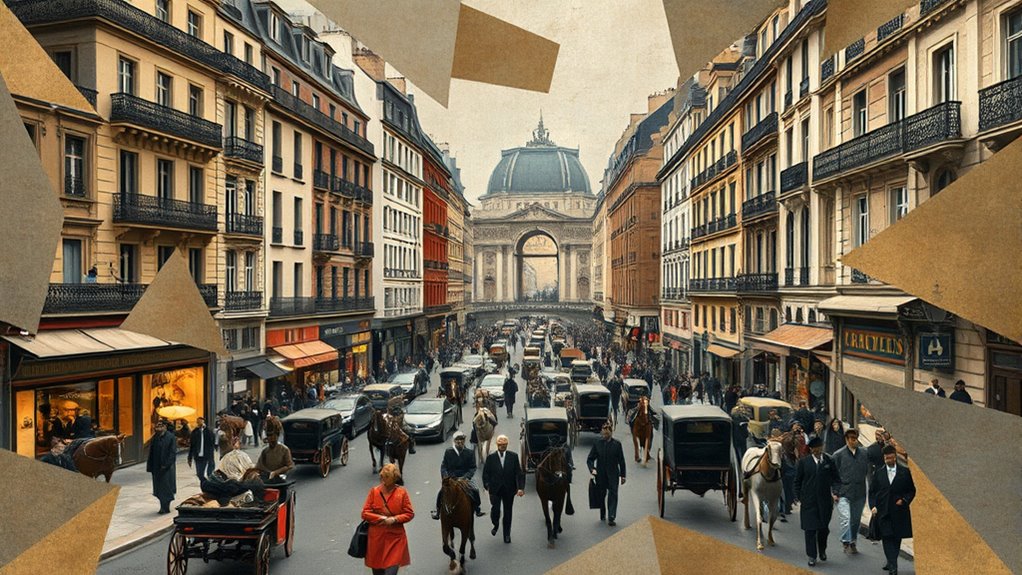
At the start of the 20th century, the world was undergoing rapid change, shaped by technological innovations, social upheaval, and political tensions. Artistic innovation was thriving as artists sought new ways to express a shifting reality. Cultural upheaval challenged traditional values and prompted fresh perspectives in art, music, and literature. The invention of photography and advances in transportation expanded visual and cultural horizons, influencing artists to experiment with form and perspective. Major political events like revolutions and wars created a sense of uncertainty and upheaval, fueling the desire to break free from classical conventions. During this time, artists felt compelled to reflect the chaos and complexity of their world, leading to groundbreaking movements like Cubism that deliberately broke away from conventional notions of space and realism. Additionally, the rise of self-sufficiency and homesteading movements encouraged a return to more organic, handcrafted artistic expressions that challenged industrialized art production. This era also saw a rise in modernist ideals, emphasizing innovation and breaking away from traditional artistic standards.
Frequently Asked Questions
How Did Cubism Influence Later Abstract Art Movements?
Cubism influences later abstract art movements by inspiring you to explore geometric abstraction and visual fragmentation. You see how artists break down forms into geometric shapes, emphasizing structure over realism.
This approach encourages experimentation with multiple perspectives and deconstructing images, shaping movements like Futurism and Constructivism. As a result, you learn to prioritize composition and form, pushing boundaries beyond traditional representation, and embracing abstraction’s expressive potential.
What Cultural or Political Factors Contributed to Cubism’s Development?
You see, political upheavals like the upheaval of World War I and cultural exchanges among Europeans and Africans fueled Cubism’s development. These factors challenged traditional perspectives, encouraging artists to experiment with fragmented forms and multiple viewpoints.
As a result, Cubism emerged as a revolutionary movement, breaking away from conventional art and reflecting the complex, changing world around them, driven by the turbulence and cross-cultural influences of the time.
How Was Cubism Received by Contemporary Critics and Audiences?
You see that when Cubism first emerged, the public reception was mixed, sparking critical debates. Some critics praised its innovation and bold approach, while others dismissed it as confusing or chaotic.
Audiences struggled to grasp the fractured perspectives, leading to controversy. Over time, however, many began to appreciate Cubism’s revolutionary break from traditional art, recognizing its influence on modern art’s evolution and shifting the critical perspective positively.
Did Cubism Have Any Impact Outside Visual Arts, Like Architecture or Design?
You’ll find that Cubism influenced beyond visual arts, especially in architecture and fashion. Cubist-inspired architecture features fragmented, geometric forms, shaping modern buildings like the Villa Savoye.
In fashion, Cubism inspired bold, angular designs, pushing creative boundaries. This movement’s emphasis on abstraction and multiple perspectives helped reshape design thinking, encouraging artists and architects to experiment with form and structure.
Making Cubism a catalyst for innovation in various creative fields.
Are There Modern Artists Still Inspired by Cubist Principles Today?
Yes, you can see modern artists inspired by cubist principles today. They often use digital collage and geometric abstraction to reinterpret cubist ideas, breaking objects into facets and multiple perspectives.
These artists challenge traditional views, blending technology with cubist aesthetics to create fresh, innovative works. If you’re exploring contemporary art, you’ll notice how cubist concepts continue to influence and inspire new approaches in digital and mixed media.
Conclusion
You can see how Cubism shattered traditional perspectives, transforming art by breaking reality into geometric forms. It challenges you to view space and objects differently, encouraging a new way of seeing the world. By experimenting with techniques and materials, Cubists pushed boundaries and inspired countless artists afterward. Its revolutionary approach continues to influence modern art, reminding you that breaking the rules can lead to powerful, innovative expressions that change how we perceive reality forever.