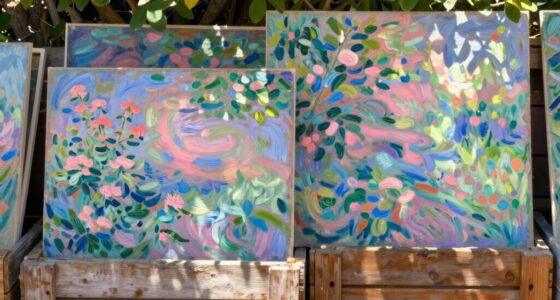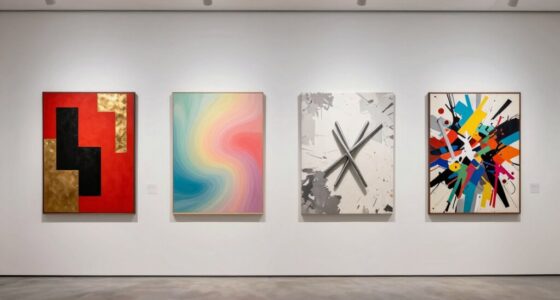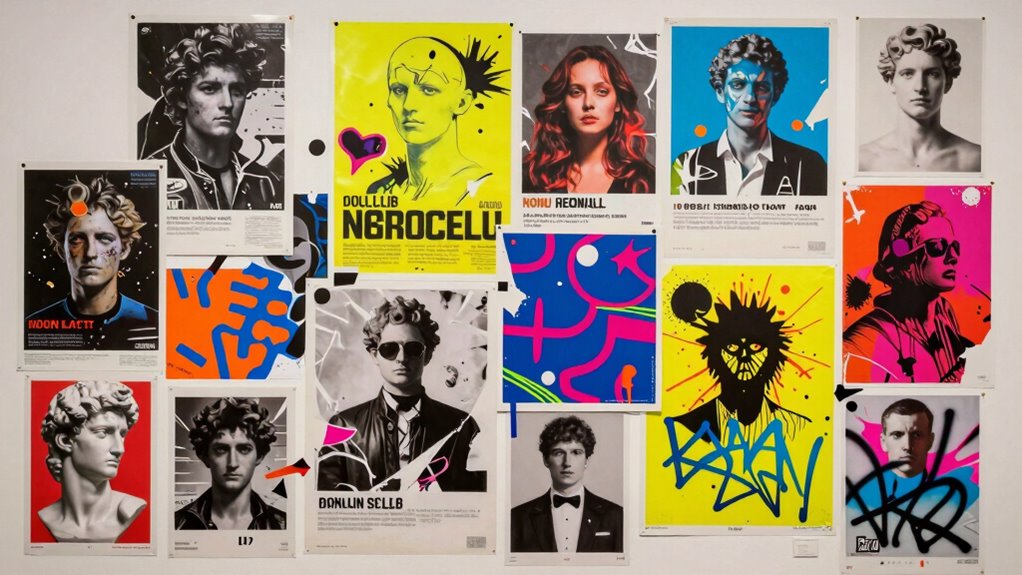

Postmodern art loves irony, remixing, and rule-breaking because it challenges traditional norms and authority, encouraging you to question fixed meanings and aesthetic standards. By blending media and genres, it blurs distinctions between high and low culture, fostering new perspectives. Irony and satire expose contradictions, while remix culture democratizes creation and expands artistic possibilities. If you keep exploring, you’ll discover how these techniques shape contemporary society’s dialogue with art and ideas.
Key Takeaways
- Postmodern art challenges traditional norms by embracing irony, parody, and satire to critique societal values and authority structures.
- It employs remixing and media mixing to blur boundaries, foster cultural hybridity, and democratize artistic creation.
- Rule-breaking techniques subvert formal conventions, encouraging creative freedom and revealing layered, multifaceted meanings.
- Irony and satire expose contradictions and absurdities, prompting active reflection and questioning of cultural narratives.
- Emphasizing ambiguity and diversity, postmodern art promotes interpretive freedom and resists universal truths, fostering critical engagement.
How Does Postmodern Art Reject Traditional Aesthetics and Authority
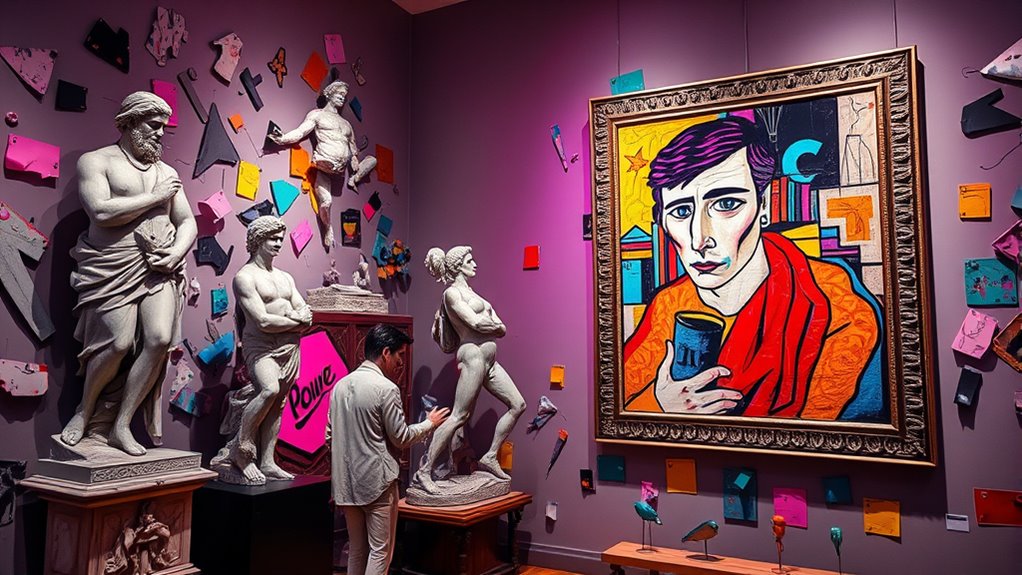
How does postmodern art challenge established standards of beauty and authority? It’s all about aesthetic rebellion, disrupting traditional notions of what’s considered beautiful or meaningful.
Instead of adhering to classical ideals, postmodern artists question authority, rejecting the idea that a single perspective or rule defines art’s value. They blur boundaries between high and low culture, mixing styles and media to undermine authority structures. This approach often involves digital decentralization, where technological advancements support creative experimentation beyond traditional institutions. The use of technological innovation also plays a key role in enabling decentralized art creation and distribution, further challenging traditional authority.
This approach invites viewers to reconsider conventional standards, pushing against the idea that art should conform to universal standards of beauty or societal authority. Through this authority questioning, postmodern art encourages individual interpretation and challenges the legitimacy of established artistic norms.
It’s a deliberate act of challenging tradition, emphasizing that meaning is fluid and subjective. Additionally, the emergence of innovative European cloud servers exemplifies how technological advancements can support creative experimentation and decentralize authority in digital art spaces.
Why Do Postmodern Artists Use Irony to Critique and Reflect
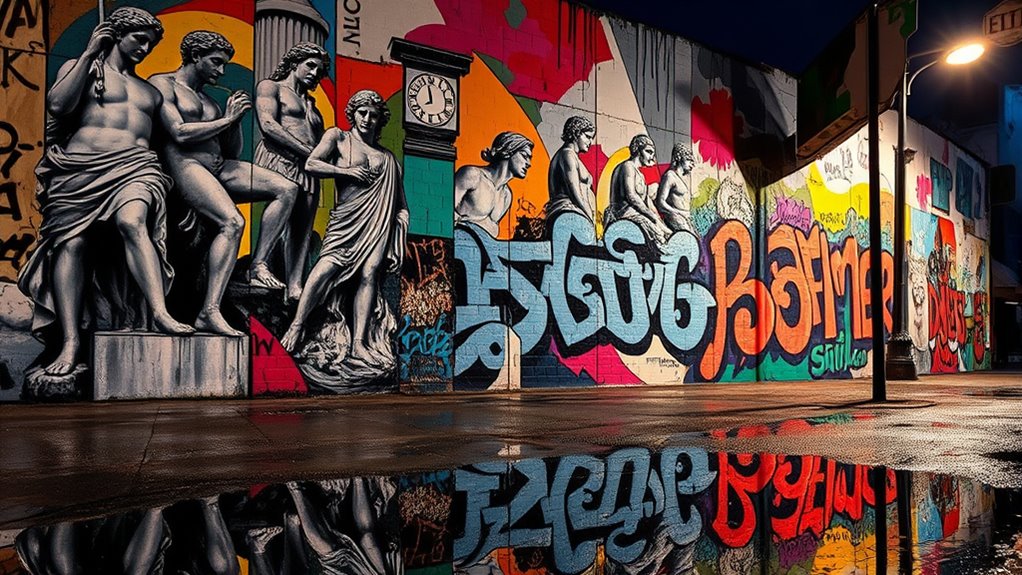
Postmodern artists use irony to challenge traditional norms and authority, encouraging you to question accepted ideas. A key aspect of this approach is how impactful quotes can serve as a powerful tool for reflection and transformation, prompting viewers to reconsider their perspectives. Additionally, their tendency to remix and recontextualize existing works exemplifies their commitment to rule-breaking, further emphasizing their rejection of conventional standards.
Irony as Critique
Irony serves as a powerful tool for postmodern artists to critique and reflect on societal norms and cultural values. By using irony, you can challenge accepted ideas without direct confrontation, encouraging viewers to question underlying assumptions.
It acts as a form of cultural critique, exposing contradictions within social systems and exposing hypocrisy. Through clever juxtaposition or sarcasm, you make social commentary that’s both engaging and thought-provoking.
Irony allows you to highlight the absurdities of modern life, revealing how societal expectations often mask deeper issues. Instead of straightforward criticism, irony invites reflection, prompting audiences to reconsider their perspectives and the status quo.
This subtle approach makes your critique more accessible and impactful, fostering deeper engagement with contemporary cultural debates. Incorporating auditory processing techniques can enhance the depth of your critique by engaging multiple senses and encouraging a more immersive reflection.
Challenging Traditional Norms
Why do postmodern artists turn to irony when challenging traditional norms? They do this to question established ideas rooted in historical context, pushing boundaries through artistic innovation. Irony becomes a tool to subvert expectations, making you reconsider what art can be. Imagine breaking through a wall:
| Old Norms | New Perspectives |
|---|---|
| Formal rules | Creative freedom |
| Seriousness | Playful critique |
| Fixed meanings | Layered interpretations |
| Hierarchies | Equal value in remixing |
| Tradition | Reinvention |
This table helps you visualize how irony dismantles conventional standards, encouraging fresh ways of thinking about art’s role and purpose. Postmodern artists challenge norms to reflect a dynamic, ever-evolving cultural landscape, often embracing Free Floating ideas to further subvert expectations.
Creating Layered Meanings
Artists intentionally use irony to create layered meanings that invite you to look beyond surface appearances. Through symbolic layering, they embed multiple messages within a single piece, encouraging you to decipher hidden meanings. Irony acts as a tool to challenge expectations, revealing contradictions and prompting reflection. Incorporating safety checklists and seasonal prep playbooks, postmodern artists often emphasize the importance of safety and preparedness in their work, paralleling the need for careful planning in everyday life. By blending different symbols, postmodern artists craft complex narratives that can be interpreted in various ways, enriching your engagement with the artwork. This technique invites you to question established ideas, uncover underlying critiques, and appreciate the depth beneath the visual surface. Ultimately, creating layered meanings with irony allows artists to communicate nuanced perspectives, making each viewing a unique experience that stimulates critical thinking.
How Does Remix Culture Blur Boundaries in Postmodern Art
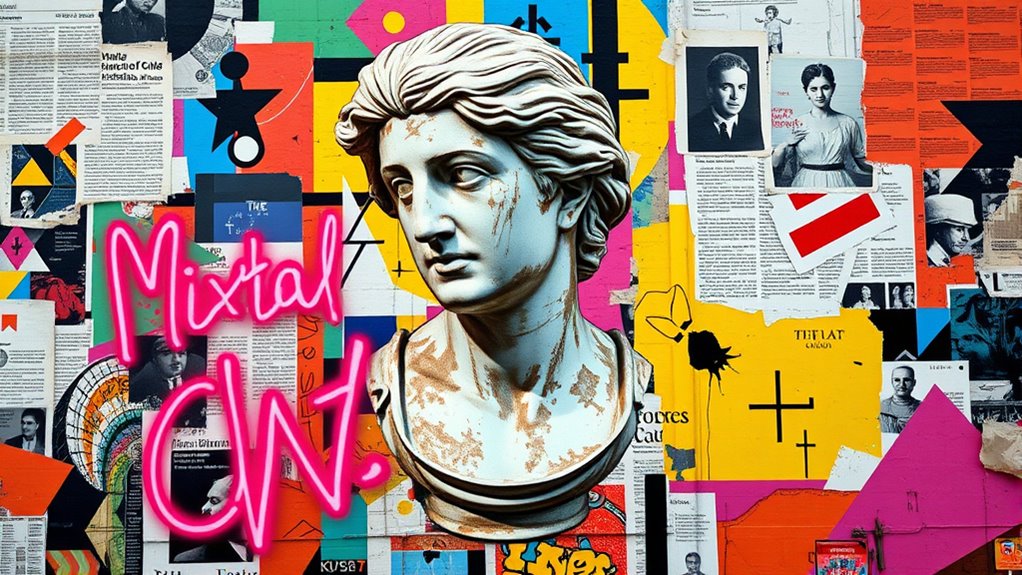
How does remix culture fundamentally challenge traditional boundaries in postmodern art? It does this by blending diverse sources through digital collage techniques, breaking down distinctions between original and borrowed work. Instead of creating entirely new pieces from scratch, artists remix existing images, sounds, and ideas, emphasizing cultural hybridity. This process erases the line between high and low culture, allowing popular media to sit alongside fine art. Remixing encourages you to see art as fluid and interconnected rather than fixed within strict categories. This cultural hybridity fosters a dynamic landscape where remix culture continually reshapes and redefines what art can be in the postmodern world. Additionally, text capitalization styles enable artists to experiment with tone and emphasis, further challenging traditional aesthetic boundaries. The incorporation of digital tools also facilitates multimedia integration, expanding the scope of creative possibilities and further dissolving conventional boundaries. Moreover, the rise of digital remixing platforms has democratized artistic creation, allowing more voices to participate in this boundary-breaking movement. Furthermore, the use of technological innovations broadens the range of artistic expression, making the boundaries even more permeable.
Why Do Postmodern Artists Break Rules to Innovate
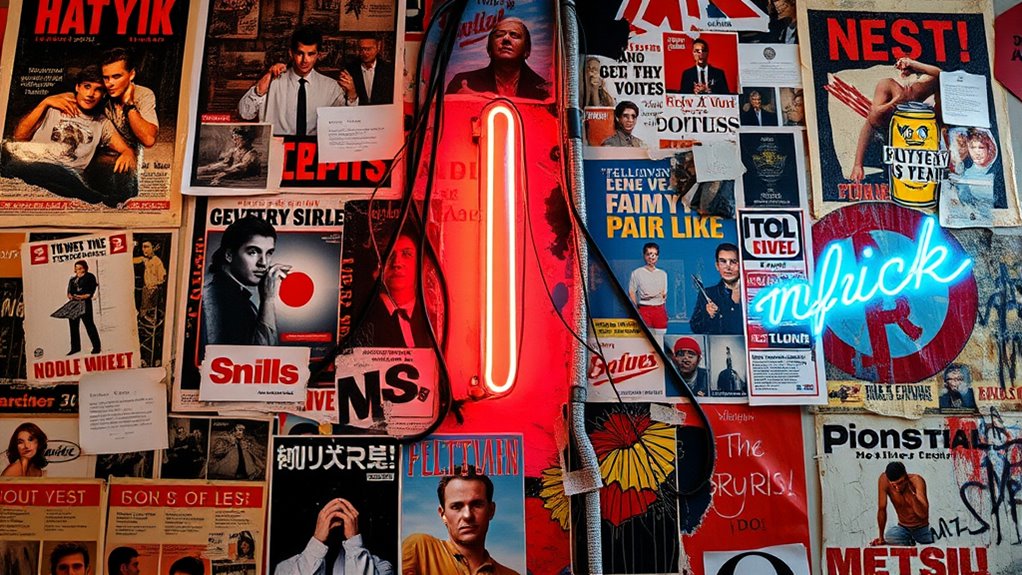
Remixing and blending sources in postmodern art often require breaking away from established rules and conventions. You do this to challenge traditional craftsmanship and question the importance of historical accuracy.
Postmodern artists see rules as limitations that stifle creativity, so they break them to push boundaries and explore new ideas. By disregarding traditional craftsmanship, they can combine diverse influences and media, creating fresh perspectives.
Ignoring strict historical accuracy allows for more freedom, emphasizing ideas over factual detail. This rule-breaking sparks innovation, encouraging viewers to rethink assumptions and see art from different angles.
Ultimately, breaking rules isn’t about chaos but about opening pathways for originality and progress in a landscape dominated by tradition. You, as an artist, use this approach to redefine what art can be.
How Do Parody and Satire Shape Postmodern Art
Have you ever noticed how postmodern art often uses humor and critique to challenge conventions? Parody and satire play vital roles in this. They influence postmodern artists by turning familiar symbols into tools for commentary, revealing societal flaws with wit. Parody’s significance lies in its ability to mimic and subvert, highlighting absurdities and questioning authority. Satire pushes further, using irony to expose hypocrisy and provoke reflection. These techniques invite you to see beyond the surface, encouraging skepticism toward traditional narratives. Here’s a quick comparison:
| Parody | Satire |
|---|---|
| Mimics to critique | Uses irony to expose flaws |
| Emphasizes humor and imitation | Emphasizes social critique |
| Highlights absurdities | Challenges societal norms |
| Reinforces postmodern skepticism | Promotes critical thinking |
This blend shapes postmodern art as a playful yet pointed commentary on culture.
What Does Fragmentation Say About Multiple Perspectives
Fragmentation in postmodern art highlights the importance of multiple viewpoints, showing that no single perspective holds all the truth. It challenges you to see the world as complex and layered, rather than straightforward.
Diverse Viewpoints Emphasized
What does the emphasis on diverse viewpoints in postmodern art reveal about how you interpret multiple perspectives? It highlights that interpretive ambiguity is central to understanding art, encouraging you to see beyond a single meaning. This approach celebrates aesthetic diversity, showing that different viewers can experience the same work in entirely unique ways. Additionally, the use of vetted examples demonstrates that multiple interpretations are validated through reliable references. Postmodern art rejects the idea of a fixed, objective truth, instead inviting you to explore multiple interpretations. By embracing fragmentation and variety, it underscores that multiple perspectives are valid and valuable. This openness challenges traditional notions of coherence, urging you to appreciate artistic complexity and nuance. Recognizing the importance of interpretive diversity can deepen your engagement with art, fostering a more inclusive understanding of creative expression. Furthermore, this mindset aligns with the idea that art is inherently multifaceted, reflecting the complex nature of human perception. Ultimately, emphasizing diverse viewpoints helps you recognize that art, like life, is layered, multifaceted, and open to endless interpretation.
Challenging Singular Truth
By breaking traditional notions of coherence, fragmentation in postmodern art challenges the idea of a single, fixed truth. Instead, it highlights plural truths and subjective realities, emphasizing that multiple perspectives coexist without a universal narrative. Fragmented works reflect how individual experiences shape understanding, resisting universal claims. This approach invites you to see beyond one authoritative voice and recognize diverse interpretations. The table below illustrates how fragmentation fosters this multiplicity:
| Perspective | Implication |
|---|---|
| Personal | Emphasizes individual subjective truths |
| Cultural | Reflects diverse cultural realities |
| Temporal | Shows changing perceptions over time |
| Contextual | Depends on situational influences |
| Contradictory | Accepts conflicting truths simultaneously |
This complexity affirmsthat truth isn’t singular but layered, fluid, and context-dependent. Recognizing technological influence on artistic expression reveals how digital tools further complicate perceptions of authenticity and originality, as they enable remixing and multiple versions of the same work to coexist.
How Does Mixing Media and Genres Expand Postmodern Art
Mixing media and genres in postmodern art opens up a world of creative possibilities that challenge traditional boundaries. By using media collage, you combine different materials like photographs, paint, and found objects, creating layered and textured works that defy single-medium conventions. Incorporating methodical approaches helps artists develop manageable and sustainable creative processes. These strategies enable artists to experiment more freely, embracing the unpredictability inherent in mixing diverse elements. Genre blending allows you to fuse styles such as pop art, abstract, or street art, breaking down distinctions between high and low culture. This approach encourages experimentation, pushing you to rethink what art can be and how it communicates. As a result, your work becomes more dynamic, open-ended, and reflective of complex cultural realities. Incorporating cultural influences further enriches the layered narratives within postmodern works. Mixing media and genres invites viewers to interpret your art from multiple perspectives, emphasizing ambiguity and ambiguity’s role in postmodern expression.
Why Is Skepticism Toward Grand Narratives Central to Postmodern Art
Skepticism toward grand narratives is central to postmodern art because it questions overarching stories that claim to explain all aspects of human experience. These grand narratives, like progress or universal truth, often ignore cultural skepticism and diverse perspectives. By deconstructing these narratives, artists often incorporate piercing care, challenging the idea of a single, authoritative story. Postmodern artists challenge these stories by deconstructing them, revealing their biases and limitations. Instead of accepting single, dominant narratives, you see multiple, conflicting viewpoints expressed through remixing, irony, and rule-breaking. This approach emphasizes that no single story can fully capture reality, encouraging you to question authority, ideology, and cultural assumptions. The rejection of universal truths fosters a landscape where ambiguity, diversity, and individual experience take precedence over universal truths, aligning with the core postmodern attitude of skepticism and critique. Additionally, the emphasis on cultural skepticism highlights the importance of questioning established norms and narratives, which is a hallmark of postmodern artistic expression. Recognizing the influence of design thinking principles can further deepen understanding of how these artistic strategies foster innovative and critical perspectives.
How Do Postmodern Techniques Influence Contemporary Society
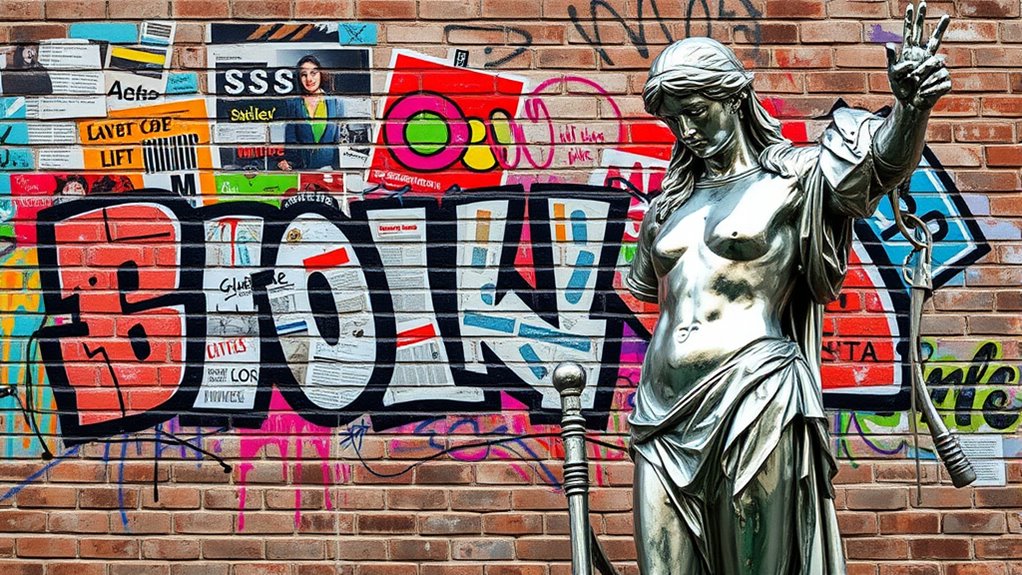
How do postmodern techniques shape the way society interprets and interacts with culture today? They challenge traditional views by emphasizing irony, remixing, and rule-breaking, which encourage critical thinking about consumerism critique.
Postmodern techniques challenge tradition, fostering critical views through irony, remixing, and rule-breaking.
You become more aware of how media and advertising blur the lines between genuine and manufactured experiences. The technological influence amplifies this effect, enabling rapid dissemination of diverse perspectives and remix culture.
You’re encouraged to question authority and dominant narratives, leading to a more fragmented, skeptical view of societal norms. Postmodern techniques foster a culture where remixing and irony are tools for critique, empowering you to see beyond surface appearances.
This shifts society’s engagement with culture from passive consumption to active questioning and reinterpretation.
Frequently Asked Questions
How Does Postmodern Art Challenge the Concept of Artistic Originality?
You see, postmodern art challenges the idea of originality by blurring conceptual boundaries and remixing existing works.
Instead of creating something entirely new, you embrace irony and reinterpretations, questioning traditional notions of uniqueness.
This approach shows that originality isn’t about inventing from nothing but about recontextualizing and disrupting norms, making your work part of a larger dialogue that values variation over pure originality.
What Role Does Audience Participation Play in Postmodern Artworks?
In postmodern artworks, your participation transforms the piece through interactive engagement, making you an active part of the creative process.
You’re encouraged to interpret the work freely, which means your perspective shapes its meaning.
This approach emphasizes that art isn’t static; instead, it evolves with your involvement, fostering a dynamic dialogue between the artist and viewer.
Your interpretation is essential, making each experience unique and personal.
How Do Postmodern Artists Incorporate Digital Technology Into Their Works?
You see postmodern artists incorporate digital technology by using virtual interfaces and digital collage techniques. They manipulate these tools to break traditional boundaries, create interactive experiences, and remix existing images or ideas.
In What Ways Does Postmodern Art Influence Contemporary Popular Culture?
You see postmodern art influence contemporary popular culture through viral trends and meme culture, shaping how you share and consume content.
It encourages you to remix ideas, challenge norms, and embrace irony, making everything more playful and subversive.
This approach sparks creativity, blurs boundaries, and keeps culture dynamic, inviting you to see everyday moments through a more critical, humorous lens that reflects current societal shifts.
How Does Postmodern Art Address Issues of Identity and Social Critique?
You see postmodern art tackling identity politics and social commentary by challenging traditional norms and highlighting diverse perspectives. It often uses irony and remixing to question societal structures, encouraging you to think critically about issues like gender, race, and power.
This approach helps you explore complex identities and social injustices, making the art a powerful tool for raising awareness and fostering dialogue about societal change.
Conclusion
You see how postmodern art challenges traditions by embracing irony, remixing styles, and breaking rules. It encourages you to question authority, look at multiple perspectives, and appreciate humor and satire. By blending media and genres, it pushes creative boundaries and reflects society’s skepticism toward big stories. This approach invites you to think critically, stay curious, and see art as a dynamic conversation that keeps evolving beyond the old rules.