TL;DR

Prime made for students and young adults
- Fast, free delivery for dorm and study essentials
- Prime Video and Amazon Music included
- Member-only deals
NASA’s Astronomy Picture of the Day for October 11, 2026, describes IceCube, a neutrino observatory built into Antarctic ice, and shows a detector string being lowered into place in 2010. The NASA page also reports that a founding leader of the IceCube Collaboration is to receive the Nobel Prize in Physics, but it does not name the recipient or give further details.
NASA’s Astronomy Picture of the Day for October 11, 2026, describes how the IceCube Neutrino Observatory uses light sensors embedded in Antarctic ice to detect high-energy neutrinos arriving from space. The accompanying image shows a detector string being lowered near the South Pole in 2010, while the page also reports that a founding leader of the IceCube Collaboration is to receive the Nobel Prize in Physics.
IceCube’s detectors are installed in nearly 100 holes melted into the ice near the South Pole, according to the NASA Astronomy Picture of the Day (APOD) explanation. Astronomers lower a long string of sensors into each hole; after the water refreezes, the instruments remain suspended in the surrounding clear ice. The sensors are described as basketball-sized and sensitive to blue light.
That light is produced when a high-energy neutrino collides with an ice molecule and releases secondary particles moving through the ice. Those particles generate detectable blue light. NASA’s account says IceCube has detected many such neutrinos, but the APOD item does not give a count, observation period, or details about individual detections.
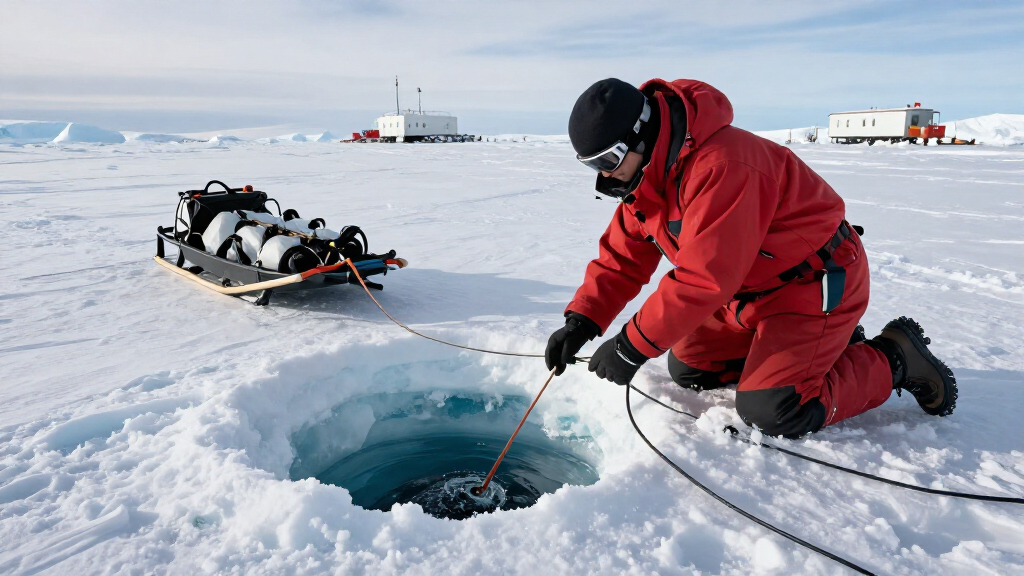
The picture was taken in 2010 and shows one of the last IceCube detector strings being lowered into a borehole. NASA’s caption calls IceCube the largest neutrino detector ever created. It also says that, earlier in the week, a founding leader of the collaboration was announced as a Nobel Prize in Physics recipient. The item does not identify that person or provide the Nobel committee’s citation.
How IceCube Detects Cosmic Neutrinos
Neutrinos are difficult to detect because they interact only rarely with matter. IceCube addresses that challenge by using a vast volume of naturally occurring Antarctic ice as part of its detector. Instead of capturing a neutrino directly, the observatory looks for the blue light from secondary particles created in occasional collisions.
The method allows researchers to study particles that can carry information from powerful processes far beyond Earth. NASA’s description connects IceCube’s detections to neutrinos emitted by energetic cosmic sources, making the observatory a tool for investigating phenomena that ordinary light-based telescopes may not fully reveal. The APOD article does not describe a new discovery announced on October 11; its news value is the explanation of the instrument and the Nobel recognition it reports.
The reported Nobel announcement also places the project’s scientific contribution in the spotlight. Recognition of a founding collaboration leader points to the importance attributed to the work, although the APOD page alone does not establish the award’s specific rationale or say which IceCube results were cited.
As an affiliate, we earn on qualifying purchases.
A Detector Built Beneath Antarctic Ice
IceCube is an observatory installed in the ice near the South Pole. Its construction involved drilling deep vertical holes with hot water, then lowering sensor-bearing strings before the water froze again. The resulting arrangement leaves the instruments surrounded by clear ice, where they can register light from particle interactions.
The APOD image documents one moment in that installation process: a detector string being lowered in 2010. NASA identifies the image credit as NSF, B. Gudbjartsson, and the IceCube Collaboration. The daily astronomy feature pairs the photograph with a short explanation written by a professional astronomer; it is not presented as a new research paper or a fresh IceCube data release.
NASA’s page places the Nobel news alongside the image, saying it was announced earlier in the same week. The supplied account does not include the recipient’s name, the official Nobel announcement, or additional information about the award. Those details should be checked against the Nobel committee’s announcement before being reported more specifically.
ice cube neutrino observatory model
As an affiliate, we earn on qualifying purchases.
As an affiliate, we earn on qualifying purchases.
Nobel Recipient and Award Details
The APOD source does not identify the Nobel Prize recipient, state the award’s official citation, or link the recognition to particular IceCube findings. It also gives no exact date for the announcement beyond saying it occurred earlier in the week. The recipient and award details therefore remain unconfirmed within the supplied source material.
The page provides no new measurement, event count, or research result for October 11. Its statement that IceCube has detected “many” neutrinos is qualitative: a precise total, time window, and comparison baseline are not supplied. The caption’s description of IceCube as the largest neutrino detector ever created is also presented without comparative measurements in the item.
As an affiliate, we earn on qualifying purchases.
Check the Official Nobel Citation
The next reporting step is to verify the Nobel announcement and citation through the Nobel committee’s official materials, including the recipient’s name and the work recognized. Additional details from the IceCube Collaboration could clarify how its research contributed to the award.
For the observatory itself, further developments would depend on new IceCube analyses or announcements. NASA’s October 11 APOD does not specify a forthcoming result, publication, or operational milestone, so no next research date can be inferred from this item.
As an affiliate, we earn on qualifying purchases.
Key Questions
What does NASA’s October 11 APOD report?
It explains how IceCube detects cosmic neutrinos using light sensors embedded in Antarctic ice, shows a detector string being installed in 2010, and mentions a Nobel Prize announcement involving a founding collaboration leader.
How does IceCube detect neutrinos?
When a high-energy neutrino collides with an ice molecule, it can release fast-moving secondary particles. The sensors look for blue light produced in the surrounding ice by those particles.
Who is receiving the Nobel Prize mentioned in the APOD?
The supplied APOD text does not name the recipient. It says only that a founding leader of the IceCube Collaboration will receive the Nobel Prize in Physics, so the official announcement is needed to identify the person and citation.
Does the APOD announce a new IceCube discovery?
No new discovery or measurement is specified. The item is an image and explanatory feature about the observatory, alongside a brief report of the Nobel announcement.
Source: primary
Columbus Day / Indigenous Peoples' Day Picks
long weekend sales
As an affiliate, we earn on qualifying purchases.




![Terence Tao: Math 2.0 [Pdf]](https://kellerkunst.com/wp-content/uploads/2026/10/terence-tao-math-2-0-pdf-featured-260x140.jpg)