TL;DR

Prime made for students and young adults
- Fast, free delivery for dorm and study essentials
- Prime Video and Amazon Music included
- Member-only deals
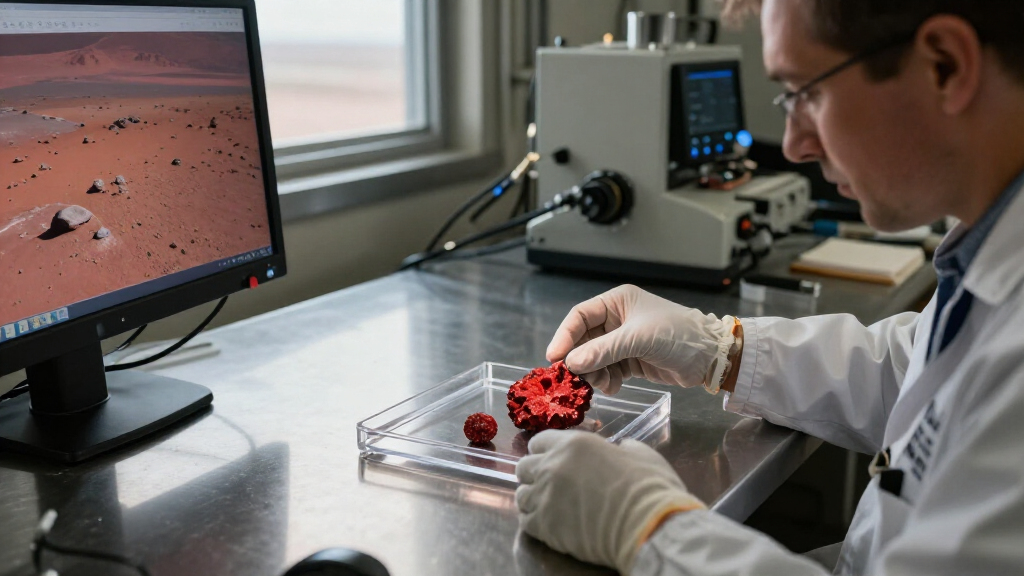
NASA’s Perseverance rover has detected a luminescence signal consistent with chromium in corundum, the mineral whose gemstone variety is ruby. The finding does not mean the rover found collectible rubies: researchers say the small crystals may instead help reveal localized heating from ancient impacts near Jezero crater.
NASA’s Perseverance rover has detected a light signal consistent with chromium-bearing corundum in a Martian rock, a mineral finding related to ruby but not evidence of gemstone-sized rubies. Learn more about Mars’s distinctive terrain. The observation, made with the rover’s SuperCam instrument, could help researchers investigate whether ancient impacts heated rocks near Jezero crater, the site of NASA’s yearlong Mars simulation.
SuperCam recorded narrow luminescence peaks at 692.7 and 694.1 nanometers when its laser struck a light-colored rock. According to Roger C. Wiens, SuperCam’s principal investigator and a Purdue University researcher, the delayed light emission is associated with chromium atoms in a corundum mineral structure. SuperCam measures the timing of the emitted photons, which the team used to identify the source of the signal.
Corundum is the mineral form that, when colored by chromium, can occur as ruby. Wiens stressed that Perseverance has not found collectible gemstones: the report describes small corundum crystals that are useful as clues about the rocks’ formation. The rover’s other instruments, including PIXL and SHERLOC, also study elements and minerals, while SuperCam’s time-resolved luminescence capability provides an additional way to examine selected rocks. The finding comes as NASA’s Mars sample-return plans have changed.
The SuperCam team first observed the strong peaks about two years before the November 2026 NASA Science report. The results were published earlier in 2026 in Geophysical Research Letters, in a paper led by Ann Ollila, according to Wiens. The team has since been making these observations more frequently on light-toned rocks to search for further evidence of impact effects.
How Corundum Could Trace Impacts
The finding matters chiefly as a possible geological clue, not as a discovery of valuable stones. Corundum is associated with metamorphic and pegmatitic settings, and researchers would not generally expect to find it on Mars, which lacks Earth-like plate tectonics. Its presence may point to unusual local conditions that altered the rocks.
Wiens says large meteorite or asteroid impacts can produce localized metamorphism through prolonged heating. Perseverance is exploring very old terrain near the rim of Jezero crater, where impact-related heating may have affected rocks. If the team finds more corundum-bearing material and can connect it to particular geological features, the mineral could help reconstruct how impacts changed the ancient Martian crust. That would add evidence about Mars’ past without establishing that every detection has an impact origin.
Popular right now

De'Longhi Magnifica Duo Automatic Espresso Machine with Milk Frother – Silver

Ninja Foodi Air Fryer 8 Qt DualZone 6-in-1 Grey DZ201

Breville Bambino Espresso Machine, Brushed Stainless Steel
As an affiliate, we earn on qualifying purchases.
A New Use for SuperCam
Perseverance carries several instruments designed to study the chemical and mineral record of Mars. PIXL and SuperCam can detect elements, while SHERLOC, SuperCam and PIXL use different methods to identify minerals, including spectroscopy. SuperCam’s Raman spectroscopy also allows it to measure time-resolved luminescence, an additional capability the team has used to examine the chromium-related signal.
Wiens’s NASA Science account says the team initially used this technique only occasionally. After the unexpected observation, researchers began applying it more often to suitable light-toned rocks. The site’s ancient terrain near Jezero crater makes the investigation particularly relevant: the team expects some evidence of localized metamorphism there, and describes Perseverance as the first mission exploring terrain of this kind.
““While we haven’t found collectable rubies on Mars yet, the little corundum crystals are helping us learn more about Mars’ past.””
— Roger C. Wiens, SuperCam principal investigator and Purdue University researcher
What the Signal Cannot Yet Show
The reported measurements support an identification of chromium in corundum, but the NASA account does not establish how widespread the mineral is, how large the crystals are, or exactly where they formed. It also does not say that the observed corundum can be seen as ruby-like gemstones. The word “ruby” refers here to a gemstone variety of corundum, not a claim about the size or appearance of the Martian crystals.
An impact is a possible explanation for local heating, not a confirmed cause for each observed crystal. The report does not provide a complete geological account linking the signal to a particular impact, nor does it describe a final estimate of the crystals’ age or abundance. More observations and geological comparisons would be needed to clarify those questions.
More Light-Toned Rocks to Examine
The SuperCam team says it is continuing time-resolved luminescence observations on light-toned Martian rocks to look for additional evidence of impact effects. The next useful development would be further detections that researchers can compare with the rocks’ location and geological setting. NASA’s report does not give a date for a specific follow-up analysis or announce a new mission milestone.
For now, the result is a new tool for studying Mars’ deep past: a laser-based signal that can reveal a mineral clue even when the rover has not found visible gemstones. Whether that clue can be tied to particular ancient impacts remains an active research question.
Key Questions
Did Perseverance find rubies on Mars?
Not collectible or gemstone-sized rubies. The rover detected a signal consistent with chromium-bearing corundum, the mineral whose chromium-colored gemstone variety is ruby.
How did the rover detect the mineral?
SuperCam fired a laser at a light-colored rock and measured delayed luminescence. The instrument recorded narrow peaks at 692.7 and 694.1 nanometers, which the team linked to chromium in corundum.
Why are researchers interested in corundum?
Corundum may provide evidence of rock alteration. The team is investigating whether prolonged heating from ancient impacts could have created localized metamorphic conditions near Jezero crater.
Is an ancient impact confirmed as the cause?
No. Impacts are a proposed explanation for local heating, but the report does not establish that a specific impact formed the observed crystals.
What will researchers do next?
The SuperCam team says it is carrying out more time-resolved luminescence observations on light-toned rocks to look for additional evidence of impact effects.
Source: science.nasa.gov