
For most students, the TOMLOV DM301 Pro is the best overall choice in this group, pairing a large 7-inch display with a practical format for shared viewing. The AmScope DM300HD is a stronger fit for students who need a more traditional compound-microscope approach, while the BEAVERLAB Finder favors portability and younger users. The main tradeoff is between a large, easy-to-share screen and a compact setup that is simpler to carry or store. Magnification figures alone do not tell you whether a model suits slides, surface specimens, or classroom demonstrations. Read on for the full breakdown and guidance on matching a microscope to the student’s work.

Prime made for students and young adults
- Fast, free delivery for dorm and study essentials
- Prime Video and Amazon Music included
- Member-only deals
Key Takeaways
- The DM301 Pro leads as a general student pick because its 7-inch screen makes group viewing and focused desk work easier than on the smaller-screen options.
- The AmScope DM300HD serves a different learning need: its compound-microscope design is a better match for students studying prepared slides than surface details such as coins or leaves.
- The BEAVERLAB Finder prioritizes portability and accessibility, but its handheld format is less suited to stable, repeatable classroom observations than a bench-style model.
- The Elikliv EDM4 is the compact-screen alternative; its adjustable LEDs can help with unevenly lit objects, though a 4.3-inch display offers less room for shared viewing than the 7-inch picks.
- The TOMLOV DM4W Max is specialized rather than universal: its built-in scale is useful for measuring coin details, but students focused on biology or prepared slides may prefer a more general-purpose design.
| TOMLOV DM301 Max Digital Microscope with 7-Inch Screen |  | Best Overall for Slide-Based Student Work | Display: 7-inch color IPS screen with adjustable viewing angle | Magnification: Up to 1200X | Lenses: Three achromatic lenses | VIEW LATEST PRICE | See Our Full Breakdown |
| Celestron TetraView LCD Digital Microscope with 180° Swivel Screen |  | Best for Classroom Group Viewing | Display: 4.3-inch color TFT LCD with 180° rotating head | Optical magnification: 40x–400x | Digital zoom: Up to 1600x | VIEW LATEST PRICE | See Our Full Breakdown |
| Elikliv EDM4 4.3-Inch LCD Digital Microscope with Adjustable LED Lights |  | Best Compact Starter | Display: 4.3-inch LCD | Maximum magnification: Up to 1000x; varies with screen size and camera-to-object distance | Image resolution: 720p | VIEW LATEST PRICE | See Our Full Breakdown |
| TOMLOV DM301 Pro Digital Microscope with 7-Inch Screen |  | Best for Connected Presentations | Display: 7-inch IPS screen | Magnification: Up to 1200× | Lenses: Three achromatic lenses | VIEW LATEST PRICE | See Our Full Breakdown |
| TOMLOV DM4W Max 7-Inch Digital Coin Microscope with Built-In Scale |  | Best for Coin and Specimen Measurement | Display: 7-inch screen, 800 × 480 resolution | Video resolution: 2K | Photo resolution: Up to 5440 × 3060 (16MP) | VIEW LATEST PRICE | See Our Full Breakdown |
| BEAVERLAB Finder 4.0-Inch Handheld Digital Microscope for Kids, 100×–1600× |  | Best for Young Beginners | Display: 4.0-inch IPS | Imaging resolution: 1920 × 1080 | Magnification: 100×–1600× | VIEW LATEST PRICE | See Our Full Breakdown |
| AmScope DM300HD Digital Compound Microscope with 7-Inch Display |  | Best for Structured Slide Work | Optical objectives: 4X, 10X, 40X, 100X | Zoom: Up to 20X | Display: 7-inch Full HD | VIEW LATEST PRICE | See Our Full Breakdown |
| digital microscopes for student | Display | Connectivity |
|---|---|---|
| TOMLOV DM301 Max Digital Micro | 7-inch color IPS screen with adjustable viewing angle | Wi-Fi app control; USB and HD connections |
| Celestron TetraView LCD Digita | 4.3-inch color TFT LCD with 180° rotating head | — |
| Elikliv EDM4 4.3-Inch LCD Digi | 4.3-inch LCD | — |
| TOMLOV DM301 Pro Digital Micro | 7-inch IPS screen | Wi-Fi, USB, and HD output |
| TOMLOV DM4W Max 7-Inch Digital | 7-inch screen, 800 × 480 resolution | USB output; compatible with Windows and Mac |
| BEAVERLAB Finder 4.0-Inch Hand | 4.0-inch IPS | Built-in hotspot |
| AmScope DM300HD Digital Compou | 7-inch Full HD | HDMI |
More Details on Our Top Picks
TOMLOV DM301 Max Digital Microscope with 7-Inch Screen
The TOMLOV DM301 Max is my strongest all-around pick for students who need more than a basic screen-and-camera microscope. Its three achromatic lenses and metal X-Y stage give learners control over slide positioning, while the 7-inch IPS display makes shared classroom viewing easier than the smaller screen on the Celestron TetraView. Students can save 8MP images and 1080P video, then share the view through Wi-Fi, USB, or an HD connection. Adjustable top and bottom lighting also helps when switching between opaque objects and slides. The tradeoff is a battery life of up to three hours, and its included slides are a small starter set rather than a broad specimen collection. Choose it over the more portable Elikliv EDM4 when structured slide work matters more than compactness.
Pros:- Large adjustable-angle IPS screen supports group viewing without an external monitor.
- Metal X-Y stage with scale divisions helps students move across a specimen in a controlled way.
- 8MP photos, 1080P video, Wi-Fi, USB, and HD connections support documentation and classroom sharing.
- Top and bottom LED lighting suits both opaque objects and prepared slides.
Cons:- Battery life is limited to up to three hours.
- The included slide set has only five prepared slides and five blanks.
Best for: Students and teachers who want a large shared display, controlled slide positioning, and several ways to save or present observations.
Not ideal for: Learners who need long untethered sessions or a large ready-made specimen library; battery life is limited to up to three hours and the kit includes five prepared slides.
- Display:7-inch color IPS screen with adjustable viewing angle
- Magnification:Up to 1200X
- Lenses:Three achromatic lenses
- Stage:Metal X-Y stage with 1.0 mm scale divisions
- Image and video:8MP images; 1080P video
- Connectivity:Wi-Fi app control; USB and HD connections
- Illumination:Adjustable top and bottom LED lights
- Battery life:Up to 3 hours
- Included slides:5 prepared slides and 5 blank slides
Our verdict“Choose the DM301 Max for student work that combines precise slide handling, a large shared screen, and image capture.”
Celestron TetraView LCD Digital Microscope with 180° Swivel Screen
The Celestron TetraView gives student groups a practical way to watch the same specimen: its 4.3-inch screen rotates 180°, so the display can face classmates without moving the microscope. Its 40x–400x optical range comes from interchangeable objectives, a mechanical stage, and coarse and fine focus, making it a more traditional slide-learning option than the object-focused Elikliv EDM4. The built-in 5MP camera records to removable storage, and the included prepared slides help a class get started. Compared with the larger-screen TOMLOV DM301 Max, the TetraView is less comfortable for a group to see at once, but its rotating head and AA-battery option offer useful flexibility. The digital zoom figure should not be mistaken for optical detail, and the supplied video frame-rate information is inconsistent.
Pros:- 180° rotating screen can face multiple students without repositioning the specimen.
- Interchangeable objectives, mechanical stage, and coarse and fine focus support hands-on slide skills.
- Built-in 5MP camera saves images and video to removable storage.
- Can run from an international AC adapter or four AA batteries.
Cons:- The 4.3-inch display is less suitable for group viewing than the 7-inch screens on the TOMLOV DM301 models.
- Product details conflict on video frame rate, listing both 20 fps and 30 fps.
- AA batteries are not included.
Best for: Teachers and student groups who want to share microscope views and learn objective changes, focus, and slide positioning.
Not ideal for: Students who prioritize a large display, clear video specifications, or strong battery readiness; the screen is 4.3 inches, the frame-rate details conflict, and AA batteries are not included.
- Display:4.3-inch color TFT LCD with 180° rotating head
- Optical magnification:40x–400x
- Digital zoom:Up to 1600x
- Objective lenses:4x, 10x, 20x, and 40x
- Camera:5MP; images up to 3648 × 2048 pixels
- Illumination:Adjustable bottom LED
- Power:International AC adapter or 4 AA batteries (not included)
- Included slides:7 prepared slides
- Warranty:Two-year limited warranty
Our verdict“Pick the TetraView for shared classroom viewing and conventional slide controls, provided its smaller screen and unclear video rate fit your needs.”
Elikliv EDM4 4.3-Inch LCD Digital Microscope with Adjustable LED Lights
The Elikliv EDM4 is a straightforward starter for students exploring coins, leaves, circuit boards, and other objects without first learning a compound microscope’s slide controls. Its built-in 4.3-inch LCD and eight adjustable LEDs provide a self-contained viewing setup, while the adjustable bracket lets students change the camera’s distance and angle. That makes it simpler to set up than the Celestron TetraView, which has interchangeable objectives and a mechanical stage aimed at more structured slide work. The EDM4 can connect to Windows or Mac for a larger view, but its 720p imaging is less detailed than the 8MP capture on the TOMLOV DM301 Max. It also lacks a memory card, so saving photos or videos requires an extra purchase. Treat the stated 1000x maximum as dependent on viewing conditions, not a guarantee of useful detail.
Pros:- Built-in LCD supports standalone viewing without a computer.
- Eight adjustable LEDs help illuminate objects for close inspection.
- Adjustable bracket changes viewing angle and camera-to-object distance.
- Windows and Mac compatibility provides a larger-screen viewing option.
Cons:- A memory card is not included for saving photos and videos.
- 720p imaging offers less capture detail than the 8MP TOMLOV DM301 Max.
- Maximum magnification depends on screen size and camera-to-object distance.
Best for: Students or families seeking a portable, simple screen microscope for observing everyday small objects and connecting to a computer when needed.
Not ideal for: Students focused on prepared-slide lessons, higher-resolution documentation, or saving files straight away; the microscope lacks a memory card and its maximum magnification varies with distance and screen size.
- Display:4.3-inch LCD
- Maximum magnification:Up to 1000x; varies with screen size and camera-to-object distance
- Image resolution:720p
- Lighting:8 adjustable LED lights
- Battery life:Up to 3 hours
- Computer compatibility:Windows and Mac
- Capture functions:Photo and video recording
- Memory card:Not included
- Included components:Adjustable bracket, microscope base, USB cable, and user manual
Our verdict“Choose the EDM4 as an easy, portable introduction to inspecting small objects, not as a high-detail slide documentation tool.”
TOMLOV DM301 Pro Digital Microscope with 7-Inch Screen
The TOMLOV DM301 Pro suits students who need to show observations on a classroom screen or share them through an app, with a 7-inch IPS display available for direct viewing. It captures 8MP photos and 1080p video, and its Wi-Fi, USB, and HD outputs give it more presentation routes than the simpler Elikliv EDM4. Three achromatic lenses and adjustable dual LED lighting make it capable across different specimen types, while the included prepared and blank slides provide a starting point for lessons. Compared with the DM301 Max, the Pro shares the core screen, lens, and capture features but does not list the Max’s metal X-Y stage with scale divisions. That makes the Max the stronger pick for controlled slide positioning; the Pro still makes sense when connectivity and a generous display are the priority. Its battery lasts up to three hours.
Pros:- 7-inch IPS display gives students a large direct-view image.
- Wi-Fi app viewing plus USB and HD output support sharing with devices and displays.
- 8MP photos and 1080p video allow observation records.
- Three achromatic lenses, adjustable dual lighting, and starter slides support varied lessons.
Cons:- Battery life is limited to up to three hours.
- Unlike the DM301 Max, the listed product details do not specify a metal X-Y stage with scale divisions.
Best for: Students and educators who regularly present microscope views on a TV, laptop, or projector and want onboard capture.
Not ideal for: Learners who need a specified precision X-Y stage or extended off-grid sessions; the product data does not list scale divisions, and battery life is up to three hours.
- Display:7-inch IPS screen
- Magnification:Up to 1200×
- Lenses:Three achromatic lenses
- Photo and video:8MP photos; 1080p video
- Connectivity:Wi-Fi, USB, and HD output
- App compatibility:iOS and Android
- Lighting:Adjustable dual LED lighting
- Battery life:Up to 3 hours
- Included slides:5 prepared slides and 5 blank slides
Our verdict“Choose the DM301 Pro for large-screen classroom sharing and flexible connections, but favor the DM301 Max if measured slide positioning is a priority.”
TOMLOV DM4W Max 7-Inch Digital Coin Microscope with Built-In Scale
The TOMLOV DM4W Max takes a different route from slide-first student microscopes: it pairs close-up viewing with a built-in scale for weighing coins, jewelry, and gemstones. Its 0.1 g resolution and four weighing units can turn a collection project into a lesson about mass and classification, while 2K video and 16MP photos offer detailed records. A 7-inch display gives it a more accessible viewing area than the Elikliv EDM4, and USB output supports live viewing on a Windows or Mac computer. The tradeoff is a narrower educational focus: it does not list interchangeable objectives, prepared slides, or stage controls like the Celestron TetraView. Its scale accuracy is ±0.5 g, and coins larger than 32 mm may need repositioning for inspection. This is a specialty tool, not the best pick for general biology lessons.
Pros:- Combines magnified inspection with a built-in scale for hands-on measurement activities.
- Four weighing units suit coins, jewelry, and gemstones.
- 2K video and up to 16MP photos support detailed records of inspected objects.
- USB output enables real-time viewing on Windows and Mac computers.
Cons:- Scale accuracy is ±0.5 g, which may not suit precise measurement tasks.
- Coins larger than 32 mm may need repositioning for full inspection.
- Its coin-and-object focus is less suited to slide-based biology lessons than the Celestron TetraView.
Best for: Students studying coin collecting, jewelry, gemstones, or small-object measurement who want magnified inspection and weighing in one setup.
Not ideal for: Students whose coursework centers on prepared biological slides or who need fine-scale weighing; the scale accuracy is ±0.5 g and the full-view coin size is limited to 32 mm.
- Display:7-inch screen, 800 × 480 resolution
- Video resolution:2K
- Photo resolution:Up to 5440 × 3060 (16MP)
- Full-view coin size:Up to 32 mm
- Scale resolution:0.1 g
- Scale accuracy:±0.5 g
- Weighing units:g, oz, ct, and ozt
- Connectivity:USB output; compatible with Windows and Mac
- Included items:Microscope base, microscope stand, DM4W Max microscope, and 2 USB cables
Our verdict“Pick the DM4W Max for student projects that combine close-up object inspection with weighing, rather than general slide microscopy.”
BEAVERLAB Finder 4.0-Inch Handheld Digital Microscope for Kids, 100×–1600×
For younger students, the BEAVERLAB Finder is the most approachable choice here: its handheld design and 4.0-inch IPS screen let kids inspect leaves, fabric, and other everyday objects without setting up a compound microscope. The eight adjustable lights help when a specimen is dim, while photo and video capture give students a way to revisit or share what they find. Compared with the stationary AmScope DM300HD, this model is easier to carry around but lacks its mechanical stage and prepared slides, so it is less suited to systematic slide work. Its stated 100×–1600× range offers flexibility on paper, though handheld viewing can be harder to keep steady at higher magnification. Phone sharing also depends on the built-in hotspot, and a charging adapter is not included.
Pros:- Handheld form is easy to carry for informal specimen exploration.
- 4.0-inch IPS display and 1920 × 1080 imaging make live viewing and captured images clear at this scale.
- Eight adjustable lights help illuminate specimens with different surfaces.
- Includes an 8 GB TF card and supports photo and video capture.
Cons:- Handheld positioning can make high-magnification viewing less steady than a microscope with a stage.
- Phone sharing relies on the built-in hotspot rather than a simpler direct connection.
- A charging adapter is not included.
Best for: Young students, especially ages 3–8, who want to examine everyday objects on trips or around the home and view results directly on the device.
Not ideal for: Students doing structured slide-based biology work or anyone who needs a stable stage, prepared slides, or a larger shared viewing screen.
- Display:4.0-inch IPS
- Imaging resolution:1920 × 1080
- Magnification:100×–1600×
- Image sensor:2 MP CMOS
- Lighting:8 adjustable lights
- Connectivity:Built-in hotspot
- Storage included:8 GB TF card
- Power:Battery powered; one lithium-ion battery included
- Dimensions:7.4 × 4.5 × 1.59 inches
Our verdict“Choose the BEAVERLAB Finder for young students who value portable, screen-based exploration over stable, formal slide study.”
AmScope DM300HD Digital Compound Microscope with 7-Inch Display
The AmScope DM300HD is the stronger fit for students who need a repeatable way to examine prepared specimens, rather than a handheld viewer for casual finds. Its two-layer mechanical stage helps position slides with more control, and dual incident and transmitted LEDs provide illumination for different kinds of samples. The included prepared and blank slides also make it easier to begin classroom-style exercises than with the portable BEAVERLAB Finder. A built-in 7-inch Full HD display, HDMI output, and on-screen measurement support group viewing and recorded assignments. The tradeoff is a relatively small 2 MP camera, and the display is still modest for a whole classroom. Its compound-microscope setup is less convenient for inspecting large objects than a handheld model.
Pros:- Mechanical stage supports controlled positioning of slides during observation.
- Dual incident and transmitted LED illumination suits a range of specimens.
- HDMI output, photo and video capture, and calibrated on-screen measurements support demonstrations and assignments.
- Includes a 32GB microSD card, carrying case, and prepared and blank slides.
Cons:- The 2 MP camera limits image detail compared with what students may expect from a Full HD display.
- The built-in 7-inch screen may be small for group viewing.
- Compound-microscope format is less suited than the BEAVERLAB Finder to handheld inspection of larger objects.
Best for: Students working through biology labs or slide-based assignments who want controlled specimen positioning, image capture, and a portable rechargeable setup.
Not ideal for: Younger children seeking quick handheld exploration of large everyday objects, or classrooms that need a large shared display without an external monitor.
- Optical objectives:4X, 10X, 40X, 100X
- Zoom:Up to 20X
- Display:7-inch Full HD
- Camera:2 MP CMOS
- Illumination:Dual LED; incident and transmitted
- Stage:Two-layer mechanical stage
- Storage:32GB microSD card included
- Connectivity:HDMI
- Power:Rechargeable battery; USB-C charging
Our verdict“Pick the AmScope DM300HD for guided slide work and measurement features, but choose a handheld model for informal exploration of everyday objects.”
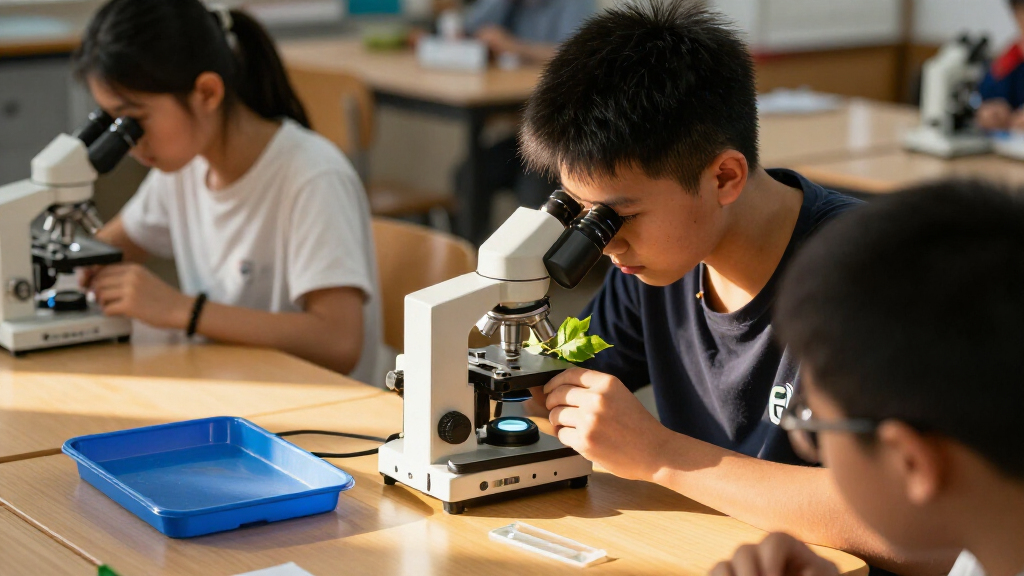
How We Picked
I ranked these digital microscopes for students by how well their designs match common school tasks, not by headline magnification alone. I weighed screen size and viewing comfort, specimen handling and stability, lighting controls, portability, and whether a model’s format supports shared classroom use or individual study. I also looked at how specialized features—such as a built-in scale or handheld construction—help one type of assignment while limiting broader use.
The DM301 Pro ranks first as the most balanced option for general student work, while the DM301 Max and Celestron TetraView offer alternatives for buyers who value different viewing setups. Models with narrower strengths rank lower for general use, even when those strengths are useful for a particular student. The lineup includes no single best choice for every subject: prepared-slide study, surface inspection, measurement, and portable exploration call for different priorities.
| digital microscopes for student | Connectivity |
|---|---|
| TOMLOV DM301 Max Digital Micro | Wi-Fi app control; USB and HD connections |
| Celestron TetraView LCD Digita | — |
| Elikliv EDM4 4.3-Inch LCD Digi | — |
| TOMLOV DM301 Pro Digital Micro | Wi-Fi, USB, and HD output |
| TOMLOV DM4W Max 7-Inch Digital | USB output; compatible with Windows and Mac |
| BEAVERLAB Finder 4.0-Inch Hand | Built-in hotspot |
| AmScope DM300HD Digital Compou | HDMI |
Factors to Consider When Choosing Digital Microscopes For Students
Before choosing a model, start with the work the student will actually do. A microscope that makes small objects easy to view may not be the right tool for studying prepared biological slides, and a portable design may trade away the steadiness needed for careful observation. These factors can help narrow the field beyond screen size or advertised magnification.
Match the Microscope to the Specimens
Students often use the word microscope for two different jobs: viewing prepared slides or inspecting the surface of larger objects. A compound design is generally the more natural fit for thin specimens on slides, while a screen-based digital scope with a working platform often suits coins, plant surfaces, fibers, and classroom objects. Choosing by the assignment list is more useful than choosing by the largest magnification number. If classes span biology and material inspection, check how the sample sits beneath the lens and how easily the focus can be adjusted. A mismatch can make a capable device frustrating, even when its headline specifications sound impressive.
Treat Magnification Claims as Only One Part of Image Quality
High magnification is useful only when the optics, focus, lighting, and display can produce a clear view at that level. A student may learn more from a sharp, well-lit image at moderate magnification than from a highly enlarged image that is dim or difficult to focus. Ask whether the student needs to identify broad structures, compare fine details, or record measurements; those tasks place different demands on the image. Digital zoom can enlarge what appears on screen without adding new optical detail. For school projects, steadiness and repeatable focus often matter more than chasing the largest advertised number.
Choose a Screen That Fits the Learning Setup
A built-in display lets students observe without leaning into an eyepiece and can make it easier for classmates or a parent to follow the same view. A larger screen is helpful for group demonstrations, but it also takes up more desk and storage space. Smaller displays can suit individual work or a shared cart where portability matters, though fine details may be harder to inspect at a glance. If students need to save images or present findings, check the exact capture and connection options rather than assuming every digital model supports the same workflow. Screen convenience should support the lesson, not distract from whether the specimen itself can be viewed clearly.
Prioritize Stable Handling for Younger Students
Handheld microscopes are easier to carry and can bring the lens to objects that do not fit on a stage, but holding one steady while focusing can be difficult for younger learners. A bench-style unit gives a more consistent working position and may make repeated observations less frustrating. Consider who will set up the specimen, adjust focus, and move the microscope between lessons. For a young student working independently, simple controls and a stable base may be more useful than a long list of modes. If portability is the main goal, plan for an adult to help with steadiness when the student needs close, detailed views.
Check Lighting and Specimen Preparation
Lighting can change whether a specimen looks clear or washed out, especially when students move between opaque objects and thin slides. Adjustable illumination gives more control, but it does not replace suitable specimen preparation or careful focus. Before buying, think about whether the student will use transparent samples, reflective surfaces, or a mixture. Reflective objects can produce glare, while slides may need light from below or a suitable prepared sample to show detail. A common mistake is to expect one lighting arrangement to work equally well for every classroom activity.
Pay for Useful Workflow, Not Just Extra Features
Extra functions make sense when they support a recurring assignment: a built-in scale can help with measurement activities, while a larger screen can help with demonstrations. They matter less if the student mainly needs a straightforward way to inspect specimens. Compare setup complexity, storage needs, and how the microscope will be maintained alongside its display and lighting. Specialized features can narrow a device’s usefulness, so think about whether the student’s interests are likely to remain focused on that task. Paying more is most defensible when a feature removes a real classroom obstacle rather than adding a capability the student may rarely use.
Frequently Asked Questions
Should I choose a digital microscope or a traditional compound microscope for biology class?
Start with the specimens and assignments in the course. Prepared slides and lessons centered on cell structures generally favor a compound-microscope format, which is why the AmScope DM300HD stands apart from the screen-first surface inspection models in this lineup. A digital display can make sharing an observation easier, but a large screen alone does not make a microscope better suited to slide work. Check how the unit handles transmitted light, slide placement, and fine focusing. If the course mixes slide study with group presentations, prioritize the model that meets the course’s core lab requirements first.
Is a 7-inch screen worth choosing over a smaller display for a student?
A larger screen is most useful when a student needs to inspect details comfortably or show an observation to classmates without crowding around a small display. It can also make a microscope feel more approachable for learners who find eyepiece viewing awkward. The tradeoff is a larger desk footprint and less convenient transport than a compact unit such as the Elikliv EDM4 or BEAVERLAB Finder. For individual projects in a fixed study area, screen size may matter more than portability. For a student who carries equipment between home and school, compactness may be the better daily benefit.
Can one student microscope handle both prepared slides and coins or other objects?
Some digital microscopes can inspect a range of sample types, but the setup that works well for coins may not be ideal for thin prepared slides. Surface inspection favors space for larger objects and lighting that reveals texture, while slide work calls for a suitable stage and illumination through the specimen. The DM4W Max’s built-in scale gives it a clear role for coin measurement, but that feature does not make it the best all-purpose biology choice. Students with mixed assignments should check sample positioning and lighting before choosing. If one subject dominates the workload, prioritize that use rather than assuming every model is equally versatile.
Is a handheld digital microscope a good choice for an elementary student?
A handheld model can be appealing for a young student because it is portable and can be brought to objects around the classroom or home. The difficulty is maintaining a steady position while adjusting focus, particularly when trying to compare fine details. The BEAVERLAB Finder is the lineup’s portable, kid-oriented option, while a bench-style microscope is more suitable when stable, repeated observations matter. Consider whether an adult will be available to help and whether the student will use it mostly for casual exploration or structured assignments. For independent lab work, stability and simple specimen positioning may outweigh portability.
Which features matter most if the student needs to document observations for a school project?
First check how the microscope captures and transfers images, since a digital screen does not by itself confirm the file workflow a student needs. A clear, repeatable view and stable focus help produce useful records, while a larger screen can make it easier to frame and review an observation. Students who need measurements should also confirm that the scale or measurement method applies to their specimen and task. Ask whether the class requires still images, video, labeled measurements, or simply a live demonstration. Matching the capture workflow to the assignment prevents buying features that do not help complete the project.
Conclusion
For a student who needs one flexible screen-based microscope for regular schoolwork, I recommend the TOMLOV DM301 Pro as best overall. The Elikliv EDM4 is the best value-style choice for buyers who want a more compact setup and adjustable LED lighting, while the Celestron TetraView is the best premium-style alternative for those drawn to its 180° swivel screen. For a beginner who values portability, the BEAVERLAB Finder is the clearest match, though a handheld format may be less steady for detailed assignments. Students focused on coin inspection and measurement should look to the TOMLOV DM4W Max; those centered on prepared slides should give the AmScope DM300HD a closer look. Choose by the specimens and classroom routine first, then weigh screen size, portability, and specialized features.