For most electronics benches, I’d start with the FumeClear FC-2001A: its H13 HEPA and activated carbon filters make it a well-rounded choice for soldering fumes. The KQZ B1 stands out for its stated 168 m³/h airflow, while the FumeClear FC-100A offers a three-stage filtration approach. The main tradeoffs are capture distance, filter type and replacement, noise, and whether you need a compact unit or a model with helping hands. A desktop extractor can reduce exposure near the work, but it is not a substitute for room ventilation or suitable respiratory protection when the task calls for it. Read on for the full comparison and recommendations by workspace and use.

Prime made for students and young adults
- Fast, free delivery for dorm and study essentials
- Prime Video and Amazon Music included
- Member-only deals
Key Takeaways
- The FC-2001A is the most balanced soldering pick in this lineup because it combines H13 HEPA and activated carbon filtration; buyers should still check replacement-filter availability and working distance.
- The KQZ B1 distinguishes itself through its stated 168 m³/h airflow, a useful spec for comparing capture capacity, though airflow alone does not tell you how effectively a unit captures smoke at your bench.
- Several models combine H13 HEPA with activated carbon, but filtration labels do not make the units interchangeable: airflow, filter area, positioning, and maintenance also affect practical use.
- Helping-hands models trade workspace flexibility for extra bulk. The LED-and-helping-hands extractor and WEP 948DQ-I may suit small assembly jobs, while a simpler unit can be easier to place and reposition.
- Laser work calls for a task-matched option. The FC-2002 is specifically identified for laser fume extraction, so I would not assume a soldering-focused desktop unit is suitable for laser-generated emissions.
| Solder Fume Extractor with LED Light & Helping Hands |  | Best for Hands-Free Soldering | Filtration system: Dual-side | Motor speed: 2400–2700 RPM | Power supply: 110V AC | VIEW ON AMAZON | See Our Full Breakdown |
| KQZ B1 Solder Fume Extractor 168m³/h Smoke Absorber with H13 HEPA |  | Best Compact HEPA Pick | Airflow: 168 m³/h | Filter type: H13 HEPA with activated carbon | Pre-filter thickness: 9 mm | VIEW ON AMAZON | See Our Full Breakdown |
| FumeClear FC-100A Fume Extractor with 3-Stage Filtration | 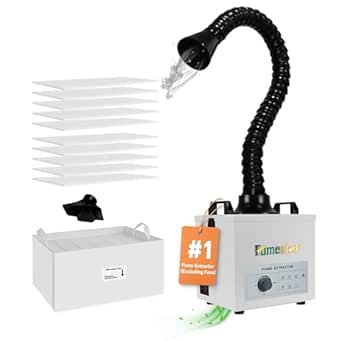 | Best for Multi-Stage Bench Filtration | Model: FC-100A | Maximum no-load power: 100W | Airflow: 118–152 CFM | VIEW ON AMAZON | See Our Full Breakdown |
| KQZ W1 Solder Fume Extractor with H13 HEPA Filter |  | Best Metal-Bodied Compact Extractor | Airflow: 168 m³/h | Filter: H13 HEPA with activated carbon | Pre-filter thickness: 9 mm | VIEW ON AMAZON | See Our Full Breakdown |
| KOTTO Solder Fume Extractor with Activated Carbon Filter |  | Best Simple Desktop Option | Filter: 0.4-inch activated carbon | Fan speed: 3000 RPM | Operating distance: 5–6 inches | VIEW ON AMAZON | See Our Full Breakdown |
| FumeClear FC-2001A Solder Fume Extractor with H13 HEPA and Activated Carbon Filters |  | Best for Adjustable Bench Filtration | Filtration: H13 HEPA and activated carbon | Stated filtration efficiency: 99.97% | Air purification capacity: 120–180 m³/h | VIEW ON AMAZON | See Our Full Breakdown |
| JJ-Z131 Fume Extractor, 2-in-1 H13-HEPA Activated Carbon Filter, Compact |  | Best Compact Pick | Filter type: 2-in-1 H13 HEPA and activated carbon | Filtration efficiency: 99.97% | Particle size: Captures particles down to 0.3 microns | VIEW ON AMAZON | See Our Full Breakdown |
| FumeClear FC-2002 Laser Fume Extractor with H13 Filtration |  | Best for Higher-Airflow Extraction | Suction capacity: 260–300 m³/h | Filtration: Three-stage: pre-filter, HEPA filter, and activated carbon main filter | Particle capture: Below 0.3 microns | VIEW ON AMAZON | See Our Full Breakdown |
| WEP 948DQ-I Solder Fume Extractor with Double Filtration and Helping Hands |  | Best for Soldering and Component Handling | Filtration: Front and rear filtration; six adsorbers included | Voltage: 110–127 V | Wattage: 5 W | VIEW ON AMAZON | See Our Full Breakdown |
| FumeClear FC-2001S Portable Solder Fume Extractor |  | Best Portable Pick | Airflow: 128–168 m³/h | Filtration: Pre-filter, H12 HEPA filter, and activated carbon | Particle capture: Up to 99.99% | VIEW ON AMAZON | See Our Full Breakdown |
| EasyWox Solder Fume Extractor with 3-Stage H13 HEPA and Activated Carbon Filtration |  | Best Compact Three-Stage Pick | Filtration: Pre-filter, H13 HEPA medium filter, activated carbon main filter | Particle efficiency: Listed as 99.97% for particles down to 0.3 microns | Airflow: 75–99 CFM (128–168 m³/h) | VIEW ON AMAZON | See Our Full Breakdown |
| Zericuf Solder Fume Extractor with H13 HEPA and Activated Carbon Filtration |  | Best for a Dedicated Workshop | Motor: 180 W brushless pure-copper motor | Airflow: 320 m³/h | Filtration: Three-stage: pre-filter, H13 HEPA, activated carbon | VIEW ON AMAZON | See Our Full Breakdown |
| YIHUA 948DQ-I Solder Fume Extractor with Tiltable Angle, Dual-filtering |  | Best Simple, Close-Range Pick | Model: YIHUA 948DQ-I | Filtration: Dual-filtering with eight filtration adsorbers | Stand angle: 30° tiltable | VIEW ON AMAZON | See Our Full Breakdown |
| NEETOP NT-M1 Desktop Solder Fume Extractor with H13 HEPA Filter |  | Best for Flexible Desktop Positioning | Model: NT-M1 | Airflow: Up to 168 m³/h | Filter: H13 HEPA with carbon powder and 10 mm pre-filter | VIEW ON AMAZON | See Our Full Breakdown |
| KOTTO Solder Smoke Absorber and Fume Extractor |  | Best Basic Carbon-Filter Absorber | Filter: 0.4-inch activated carbon | Fan speed: 3000 RPM | Voltage: 120 V | VIEW ON AMAZON | See Our Full Breakdown |
| fume extractor | Weight | Dimensions | Airflow | Voltage |
|---|---|---|---|---|
| Solder Fume Extractor with LED | — | — | — | — |
| KQZ B1 Solder Fume Extractor 1 | 4 pounds | 9.06 × 8.7 × 6.26 inches | 168 m³/h | 110–220V |
| FumeClear FC-100A Fume Extract | 19.51 pounds | — | 118–152 CFM | — |
| KQZ W1 Solder Fume Extractor w | — | — | 168 m³/h | 110–220 V |
| KOTTO Solder Fume Extractor wi | 2.2 pounds | 5 × 3 × 5 inches (D × W × H) | — | — |
| FumeClear FC-2001A Solder Fume | 9.03 lb | 11.8 × 10.37 × 12.8 in | — | Description claims 100–240V; technical details list 110V |
| JJ-Z131 Fume Extractor | 3.61 lb | 5.9 × 5.9 × 7.3 in | 50 CFM | — |
| FumeClear FC-2002 Laser Fume E | 30.4 lb | — | — | 110 V AC |
| WEP 948DQ-I Solder Fume Extrac | — | 6.5 × 3.5 × 6.5 in | — | 110–127 V |
| FumeClear FC-2001S Portable So | 3.54 lb | 5 × 5 × 8 in | 128–168 m³/h | 110V listed; universal 110V and 220V support claimed |
| EasyWox Solder Fume Extractor | About 2.64–2.65 lb | — | 75–99 CFM (128–168 m³/h) | — |
| Zericuf Solder Fume Extractor | — | — | 320 m³/h | — |
| YIHUA 948DQ-I Solder Fume Extr | 2.35 lb | 3.54 × 5.71 × 6.46 in | — | 110–127 V |
| NEETOP NT-M1 Desktop Solder Fu | 3 lb (1.4 kg) | 5.1 × 5.1 × 6.3 in | Up to 168 m³/h | — |
| KOTTO Solder Smoke Absorber an | — | 3 × 5 × 5 in (D × W × H) | — | 120 V |
More Details on Our Top Picks
Solder Fume Extractor with LED Light & Helping Hands
This extractor is the most task-focused option here: its dual-side filtration sits alongside an LED light and two helping hands, so it supports both fume capture and small-part work at the bench. Compared with the KOTTO Solder Fume Extractor, which is a simpler, lightweight carbon-filter unit, this model adds useful positioning and lighting aids for detailed soldering. Its adjustable suction and setup are geared toward approachable DIY use rather than a large or demanding workspace. The tradeoff is that the product data gives no airflow figure or filter-efficiency rating, making it harder to compare capture performance with the KQZ B1’s stated 168 m³/h airflow and H13 HEPA filtration. I’d keep it to nearby soldering and small projects; it requires a 110V outlet and isn’t suited to broad-area extraction.
Pros:- Dual-side filtration offers a wider capture arrangement than a basic single-filter desktop absorber.
- Integrated LED light helps illuminate small solder joints.
- Two helping hands support components during bench work.
- Adjustable suction and positioning suit changing small-project setups.
Cons:- No airflow or filtration-efficiency figure is provided for comparing capture performance.
- Requires a standard 110V AC outlet.
- Designed for soldering and DIY tasks, not large-scale fume extraction.
Best for: DIY electronics hobbyists who want a light and helping hands built into a compact soldering station setup.
Not ideal for: People extracting fumes across a large work area or buyers who need a documented airflow or filtration-efficiency rating.
- Filtration system:Dual-side
- Motor speed:2400–2700 RPM
- Power supply:110V AC
- Suction:Adjustable
- Included accessories:LED light and 2 helping hands
- Intended applications:Soldering and DIY projects
Our verdict“Choose this for small soldering jobs where integrated lighting and helping hands matter more than documented high-capacity filtration.”
KQZ B1 Solder Fume Extractor 168m³/h Smoke Absorber with H13 HEPA
The KQZ B1 stands out for combining a stated 168 m³/h airflow with H13 HEPA and activated-carbon filtration in a 4-pound unit. Its 360° gooseneck lets you bring the hood toward the fume source, which is more targeted than the broad dual-side arrangement on the Solder Fume Extractor with LED Light & Helping Hands. The listed filter system and airflow also make its performance easier to evaluate than that of the KOTTO Solder Fume Extractor, whose supplied specifications focus on fan speed and operating distance. The B1 is a fit for compact benches and varied small-workshop tasks, but its stated suitability for welding or 3D printing shouldn’t be confused with industrial extraction capacity. Filter upkeep adds ongoing work, and its compact footprint limits how much area it can serve at once.
Pros:- 168 m³/h airflow is specified, giving buyers a concrete capacity figure.
- H13 HEPA and activated carbon combine particle and odor filtration.
- 360° adjustable gooseneck helps place the hood near the source.
- Compact 4-pound design is easier to move between small workstations.
Cons:- Intended for small workspaces rather than large industrial environments.
- Filters need maintenance and replacement over time.
- Requires electrical power while operating.
Best for: Soldering hobbyists and small-workshop users who want a portable unit with stated airflow and H13 HEPA plus carbon filtration.
Not ideal for: Industrial users or people who need one extractor to cover a large work zone continuously.
- Airflow:168 m³/h
- Filter type:H13 HEPA with activated carbon
- Pre-filter thickness:9 mm
- Voltage:110–220V
- Weight:4 pounds
- Dimensions:9.06 × 8.7 × 6.26 inches
- Power source:DC
- Included components:Duct, extractor, hood, main filter, pre-filter, power cable, and user manual
Our verdict“Pick the B1 if you want a portable, source-aimed extractor with specified airflow and a HEPA-carbon filter combination.”
FumeClear FC-100A Fume Extractor with 3-Stage Filtration
The FC-100A is the lineup’s bench-focused choice for buyers who value a defined three-stage filter setup and included pre-filter supply. Its high-iodine activated-carbon main filter is paired with filtration rated at 99.97% for particles below 0.3 microns, while the package includes 10 pre-filters for larger dust. That gives it a different emphasis from the KQZ B1, which is lighter and lists 168 m³/h airflow with H13 HEPA and carbon filtration. The FC-100A provides a 118–152 CFM airflow range and is designed for small soldering benches, but its 19.51-pound weight makes it less convenient to relocate than the B1’s 4-pound body. Its stated 3,000-hour filter service life is useful planning information, though this model is not intended for large laser engravers.
Pros:- Three-layer filtration combines particle pre-filtration and a high-iodine activated-carbon main filter.
- Specified 99.97% filtration for particles below 0.3 microns.
- Includes 10 pre-filters for routine particle loading.
- Provides a stated 118–152 CFM airflow range for small bench work.
Cons:- At 19.51 pounds, it is heavier to move than the KQZ B1.
- Not intended for large laser engravers.
- The main filter has an expected service life of 3,000 hours and will need replacement.
Best for: Bench solderers who want three filtration layers, fine-particle filtration data, and spare pre-filters included.
Not ideal for: Users needing a light portable extractor or fume capture for a large laser engraver.
- Model:FC-100A
- Maximum no-load power:100W
- Airflow:118–152 CFM
- Filtration efficiency:99.97%
- Particle filtration:Below 0.3 microns
- Filtration system:3 layers
- Included pre-filters:10
- Main filter:High-iodine activated carbon
- Weight:19.51 pounds
Our verdict“Choose the FC-100A for a stationary soldering bench where detailed filtration specs and included pre-filters matter more than portability.”
KQZ W1 Solder Fume Extractor with H13 HEPA Filter
The KQZ W1 pairs a metal body with the same listed 168 m³/h airflow as the KQZ B1, making it a compact alternative for buyers who want a sturdier housing and a source-directed hose. Its 360° gooseneck helps place the 66 mm hose near soldering fumes, while a pre-filter and H13 HEPA activated-carbon filter handle different parts of the filtration job. Compared with the B1, the W1’s listed package includes five pre-filters and an efficiency filter, but it weighs slightly more at 4.2 pounds. The product is also described for light welding, 3D printing, nail studios, and dental labs; those settings still call for keeping the hood close to the source, since the hose opening limits coverage at one time. Replacement filters remain part of ownership.
Pros:- Metal body offers a solid housing in a compact format.
- Specified 168 m³/h airflow with H13 HEPA and activated-carbon filtration.
- 360° adjustable gooseneck helps aim the hood at the work.
- Package includes five pre-filters and an efficiency filter.
Cons:- The 66 mm hose opening limits the area captured at once.
- Filters require replacement over time.
- At 4.2 pounds, it is slightly heavier than the KQZ B1.
Best for: Small-shop and bench users who prefer a metal-bodied extractor with an adjustable hose and included replacement pre-filters.
Not ideal for: People who need broad-area capture, a large hose opening, or a unit without recurring filter replacements.
- Airflow:168 m³/h
- Filter:H13 HEPA with activated carbon
- Pre-filter thickness:9 mm
- Filtration claim:99.99% of fumes, dust, odors, and 0.3 μm particles
- Voltage:110–220 V
- Hose diameter:66 mm
- Hose adjustment:360°
- Material and weight:Metal body; 4.2 lbs
- Included components:Extractor, 5 pre-filters, efficiency filter, tube, hood, power cable, and user manual
Our verdict“Choose the W1 over the lighter B1 if a metal body and included pre-filters matter more than minimizing weight.”
KOTTO Solder Fume Extractor with Activated Carbon Filter
The KOTTO is a straightforward choice for a soldering bench where small size and simple setup matter more than elaborate filtration. Its 0.4-inch activated-carbon filter and 3000 RPM fan are specified for fume removal from 5–6 inches away, and the unit weighs 2.2 pounds with a carrying handle and non-slip feet. Compared with the KQZ B1, it lacks the stated H13 HEPA layer and 168 m³/h airflow figure, so buyers have less information about fine-particle capture and overall capacity. In return, it is much smaller and includes one replacement filter. The limited operating distance is a real constraint: the absorber needs to stay close to the soldering point, and its filter must be replaced as it accumulates fumes.
Pros:- Compact 2.2-pound body is easy to move and position.
- Activated-carbon filter is specified for solder, flux, and chemical fumes.
- Listed 5–6 inch operating distance sets a clear placement range.
- Includes one replacement filter, plus a carrying handle and non-slip feet.
Cons:- Needs to sit close to the source, limiting placement flexibility.
- No HEPA layer or airflow figure is listed, unlike the KQZ B1.
- Filter replacement is required over time.
Best for: Hobbyists who solder at a fixed, compact bench and want a lightweight absorber with a clear near-source operating distance.
Not ideal for: Users seeking H13 HEPA filtration, documented high airflow, or extraction across a large work area.
- Filter:0.4-inch activated carbon
- Fan speed:3000 RPM
- Operating distance:5–6 inches
- Power:120V, 30W, 50/60Hz
- Operating temperature:-20°C to 60°C
- Weight:2.2 pounds
- Dimensions:5 × 3 × 5 inches (D × W × H)
- Included components:1 replacement filter
Our verdict“Pick the KOTTO for simple, close-range soldering at a compact bench, but choose the KQZ B1 if you want stated airflow and HEPA filtration.”
FumeClear FC-2001A Solder Fume Extractor with H13 HEPA and Activated Carbon Filters
The FC-2001A is a good fit for soldering benches where adjustable extraction and a metal housing matter more than portability. Its three speed settings let users tune airflow to the task, while H13 HEPA and activated carbon filtration target both fine particles and odors. The stated 15 cm working range means the hood needs to sit close to the soldering point; it is not a room-wide solution. Compared with the JJ-Z131, this unit is larger and heavier, but its listed 120–180 m³/h capacity gives it a higher stated airflow. Five pre-filters also provide spares for routine changes. One specification needs checking before purchase: the description claims 100–240V support, but the technical details list 110V, so I would verify compatibility with the seller.
Pros:- H13 HEPA and activated carbon filtration address particles and odors.
- Three speed settings allow airflow adjustment for different bench tasks.
- Metal housing offers a sturdier desktop format than the plastic FC-2001S.
- Includes five pre-filters and a 2-in-1 main filter.
Cons:- The stated 15 cm working range requires close placement beside the fume source.
- Voltage information conflicts: the description claims 100–240V support, while technical details list 110V.
- At 9.03 lb, it is less convenient to move than the 3.61 lb JJ-Z131.
Best for: Soldering hobbyists who want adjustable extraction, a metal-bodied desktop unit, and included replacement pre-filters.
Not ideal for: Buyers who need a lightweight extractor to move between work areas or require confirmed broad voltage compatibility without checking the conflicting listings.
- Filtration:H13 HEPA and activated carbon
- Stated filtration efficiency:99.97%
- Air purification capacity:120–180 m³/h
- Working range:15 cm
- Speed settings:3
- Voltage:Description claims 100–240V; technical details list 110V
- Weight:9.03 lb
- Dimensions:11.8 × 10.37 × 12.8 in
Our verdict“Choose the FC-2001A for an adjustable, metal desktop extractor, provided its voltage compatibility is confirmed for your setup.”
JJ-Z131 Fume Extractor, 2-in-1 H13-HEPA Activated Carbon Filter, Compact
The JJ-Z131 suits crowded hobby benches where a small footprint is more useful than high-volume extraction. At 5.9 × 5.9 × 7.3 inches and 3.61 lb, it is easier to place beside a soldering station or move between tasks than the substantially heavier FumeClear FC-2002. Its flexible suction arm helps bring the intake toward a changing work area, while the 2-in-1 H13 HEPA and carbon filter is listed at 99.97% efficiency. The tradeoff is its 50 CFM airflow: that makes it a more modest choice than the FC-2002 for demanding smoke-producing work, and the intake still needs sensible positioning near the source. The stated noise level is below 50 dB, though quiet-room users may still hear it.
Pros:- Small, lightweight body takes up little bench space and is easy to reposition.
- Flexible suction arm supports targeted intake placement.
- 2-in-1 H13 HEPA and activated carbon filter is listed at 99.97% efficiency.
- Includes five pre-filters.
Cons:- Stated 50 CFM airflow is modest for heavy-duty fume extraction.
- Below 50 dB may still be audible in a quiet workspace.
- Effective capture depends on keeping the arm close to the source.
Best for: Hobbyists and small-workspace users who need a lightweight extractor with a flexible arm for soldering or other benchtop tasks.
Not ideal for: Users handling heavy smoke loads or seeking the higher stated airflow of a larger extractor such as the FumeClear FC-2002.
- Filter type:2-in-1 H13 HEPA and activated carbon
- Filtration efficiency:99.97%
- Particle size:Captures particles down to 0.3 microns
- Airflow:50 CFM
- Motor power:30 W
- Noise level:Below 50 dB
- Weight:3.61 lb
- Dimensions:5.9 × 5.9 × 7.3 in
Our verdict“Pick the JJ-Z131 when compact size and adjustable positioning matter more than the stronger stated airflow of larger units.”
FumeClear FC-2002 Laser Fume Extractor with H13 Filtration
For work that produces more smoke than routine soldering, the FumeClear FC-2002 offers the strongest stated airflow in this group: 260–300 m³/h. Its three-stage arrangement uses a pre-filter, HEPA filter, and activated carbon main filter, giving it a more involved filtration setup than the compact JJ-Z131’s 2-in-1 filter. Ten replaceable pre-filters are included, and the listed main-filter life reaches up to 4,000 hours depending on use. That capacity comes with a clear cost in handling: at 30.4 lb, this metal unit is far less portable than the FC-2001S or JJ-Z131. It is also designed to capture pollutants near the hood, not clean a whole room, so placement remains part of the job.
Pros:- Highest stated airflow in this five-product group at 260–300 m³/h.
- Three-stage filtration combines a pre-filter, HEPA filter, and activated carbon main filter.
- Includes ten replaceable pre-filters.
- Stated maximum noise level is under 55 dB.
Cons:- At 30.4 lb, it is much less portable than the JJ-Z131 and FC-2001S.
- Capture is limited to the area near the hood, so placement close to the source matters.
- Main-filter service life varies with usage.
Best for: Laser engraving, cutting, or soldering users who need higher stated airflow and can dedicate a fixed area to a heavier extractor.
Not ideal for: People with small or mobile workstations who need a lightweight unit, or anyone expecting whole-room air cleaning from a benchtop hood.
- Suction capacity:260–300 m³/h
- Filtration:Three-stage: pre-filter, HEPA filter, and activated carbon main filter
- Particle capture:Below 0.3 microns
- Purification rate:99.97%
- Maximum main-filter service life:Up to 4,000 hours, depending on usage
- Maximum noise level:Under 55 dB
- Voltage:110 V AC
- Weight:30.4 lb
Our verdict“Choose the FC-2002 for higher-airflow, fixed-station work if its weight and source-focused capture suit your setup.”
WEP 948DQ-I Solder Fume Extractor with Double Filtration and Helping Hands
The WEP 948DQ-I combines a small extractor with tools for holding and positioning work, making it the most task-integrated option here for hands-on soldering. Its front and rear filtration adsorbers give fumes two filter surfaces, while the 11.8-inch helping hands can steady components without requiring a separate holder. Adjustable tilt and side fenders help direct the unit toward a nearby solder joint. Unlike the FC-2002, this is a compact, low-power bench accessory rather than a higher-airflow extractor for heavier smoke loads; its listed suction is intended for a work area about 10 cm away. It also uses adsorbers rather than the H13 HEPA-and-carbon configuration found in the JJ-Z131. Check the voltage before connecting: the unit is specified for 110–127V, not 220V.
Pros:- Front and rear filtration adsorbers provide double-sided filtration.
- Includes attachable helping hands for positioning components during soldering.
- Adjustable tilt and side fenders help direct capture at the work area.
- Compact 6.5 × 3.5 × 6.5-inch format fits a small bench.
Cons:- Designed for capture about 10 cm from the work area, so it requires close placement.
- 110–127V rating makes it unsuitable for direct connection to a 220V socket.
- Does not list HEPA filtration or an airflow figure comparable to the FC-2002.
Best for: Electronics hobbyists who want local solder-fume capture and attachable helping hands in one compact workstation accessory.
Not ideal for: Users who need high-volume extraction, HEPA filtration, or a unit compatible with 220V power.
- Filtration:Front and rear filtration; six adsorbers included
- Voltage:110–127 V
- Wattage:5 W
- Dimensions:6.5 × 3.5 × 6.5 in
- Helping hands length:11.8 in (30 cm)
- Capture distance:About 10 cm from the work area
- Included components:Extractor, helping hands, and six filtration adsorbers
- Support:1-year USA technical support
Our verdict“Choose the WEP 948DQ-I if you want a compact soldering aid with helping hands, not a high-airflow or HEPA-based extractor.”
FumeClear FC-2001S Portable Solder Fume Extractor
The FC-2001S is the easiest of these five units to move between benches: it weighs 3.54 lb and measures just 5 × 5 × 8 inches. Its extendable hose and hood give it more positioning flexibility than the WEP 948DQ-I, whose compact design is paired with a fixed work-area setup. Three-stage filtration combines a pre-filter, H12 HEPA filter, and activated carbon; the listed particle capture reaches up to 99.99%. Airflow is stated at 128–168 m³/h, below the FC-2002’s 260–300 m³/h, so this is better matched to localized soldering than heavier smoke loads. The nozzle still needs to sit near the source. Its voltage listing is also mixed: universal 110V/220V support is claimed, while the technical voltage field says 110V.
Pros:- Lightweight 3.54 lb design is easy to move between work areas.
- Extendable hose and hood support flexible, localized capture.
- Three-stage filtration combines a pre-filter, H12 HEPA filter, and activated carbon.
- Includes five pre-filters and lists a lifetime warranty.
Cons:- The nozzle must be positioned directly near the smoke source for effective capture.
- Stated airflow is lower than the FC-2002’s 260–300 m³/h.
- Voltage details conflict: universal 110V/220V support is claimed, while technical details list 110V.
Best for: Soldering users who move between workstations and want a lightweight extractor with a hose for more flexible nozzle placement.
Not ideal for: Users handling heavy smoke loads or anyone who needs unambiguous voltage specifications before connecting equipment.
- Airflow:128–168 m³/h
- Filtration:Pre-filter, H12 HEPA filter, and activated carbon
- Particle capture:Up to 99.99%
- Sound level:55 dB
- Voltage:110V listed; universal 110V and 220V support claimed
- Weight:3.54 lb
- Dimensions:5 × 5 × 8 in
- Material:ABS plastic
Our verdict“Pick the FC-2001S for portable, source-directed solder-fume extraction, after confirming the voltage requirement for your location.”
EasyWox Solder Fume Extractor with 3-Stage H13 HEPA and Activated Carbon Filtration
The EasyWox suits a soldering desk where particle filtration and odor reduction matter, but floor space is scarce. Its pre-filter, H13 HEPA medium, and activated carbon layer give it a more layered approach than the KOTTO Solder Smoke Absorber, which relies on an activated-carbon filter alone. Three speeds and airflow listed at up to 99 CFM let users adjust extraction for different small jobs, while the flexible hood can be aimed toward the source. At 2.64 pounds, it is easy to reposition between bench tasks. The tradeoff is scale: this is a personal-workspace extractor, not a choice for broad or busy work areas. The supplied dimensions also conflict with another dimensions listing, so I would check the available desk space before buying.
Pros:- Three-stage filtration combines a pre-filter, H13 HEPA medium, and activated carbon.
- Three speed settings provide some control over airflow for small desktop tasks.
- Lightweight, compact form is easy to move around a personal workspace.
- Flexible hose and hood can be directed toward the fume source.
Cons:- Designed for small-scale work rather than larger work areas.
- Published dimensions differ between the product description and technical details.
Best for: Hobby solderers and small-craft makers who want HEPA and carbon filtration in a lightweight unit with a repositionable hood.
Not ideal for: People extracting fumes across a large bench or workroom, or buyers who need clearly consistent published dimensions before choosing a fixed spot.
- Filtration:Pre-filter, H13 HEPA medium filter, activated carbon main filter
- Particle efficiency:Listed as 99.97% for particles down to 0.3 microns
- Airflow:75–99 CFM (128–168 m³/h)
- Motor:Brushless
- Speed settings:3
- Power:110 V
- Weight:About 2.64–2.65 lb
- Included hose:0.65 m flexible hose with hood
- Warranty:1 year
Our verdict“Choose the EasyWox for a compact desktop setup where three-stage filtration matters more than wide-area coverage.”
Zericuf Solder Fume Extractor with H13 HEPA and Activated Carbon Filtration
The Zericuf is the lineup’s workshop-scale choice: its 180 W motor and 320 m³/h airflow put it in a different class from desktop units such as the NEETOP NT-M1, which is specified at 168 m³/h. A three-stage filter pairs H13 HEPA media with activated carbon, while the articulated arm can rotate through 360 degrees to position the intake near a changing work area. Stepless speed control gives more adjustment than fixed speed settings, and the metal housing, braked casters, and clog alert are useful for a unit that may stay in service through longer sessions. The tradeoff is its greater workshop footprint and a stated capture range of 30 cm or more, which still calls for careful placement. Replacement filters are described as scheduled to become available on October 30, 2026, a practical sourcing concern.
Pros:- 320 m³/h stated airflow is higher than the compact NEETOP NT-M1’s 168 m³/h specification.
- Three-stage filtration combines pre-filter, H13 HEPA, and activated carbon.
- Articulated 360-degree arm and braked casters support flexible positioning.
- Stepless speed control, clog alert, and sound-dampened metal housing add useful workshop controls.
Cons:- The stated capture range of 30 cm or more may constrain placement around the work.
- Replacement filters are described as scheduled to become available on October 30, 2026.
- Larger workshop-oriented design is less suited to a crowded desktop.
Best for: Soldering technicians and serious workshop users who need higher stated airflow, an adjustable extraction arm, and a mobile floor-standing setup.
Not ideal for: Occasional hobbyists with only a small desk, or buyers who need readily confirmed replacement-filter availability.
- Motor:180 W brushless pure-copper motor
- Airflow:320 m³/h
- Filtration:Three-stage: pre-filter, H13 HEPA, activated carbon
- HEPA capture:Listed as 99.997% of 0.3-micron particles
- Noise level:Below 58 dB
- Speed control:Stepless
- Positioning arm:Articulated with 360° rotation
- Mobility:Four swivel casters with front brakes
- Warranty:5 years
Our verdict“Pick the Zericuf for a dedicated workshop that can use its higher airflow and movable arm, provided replacement filters are available when needed.”
YIHUA 948DQ-I Solder Fume Extractor with Tiltable Angle, Dual-filtering
The YIHUA 948DQ-I keeps the setup straightforward: its 30-degree tiltable stand and side fenders help direct airflow around a nearby soldering point, while eight adsorbers are included for its dual-filtering arrangement. That makes it a practical alternative to the EasyWox, which offers a hose and a specified H13 HEPA-plus-carbon stack but is more explicitly aimed at adjustable, compact extraction. The YIHUA’s 2.35-pound weight and small listed dimensions suit a fixed electronics bench where the tool can sit close to the work. Its main limitation is reach: effective extraction is specified at about 10 cm from the source, so it cannot stand in for an articulated-arm unit such as the Zericuf. The listing also gives no airflow figure or detailed filter media specification, which makes performance harder to compare on paper.
Pros:- Tiltable stand and side fenders help aim airflow at a nearby soldering point.
- Dual-filtering design includes eight adsorbers.
- Lightweight, compact footprint fits a small electronics bench.
- Five-blade fan is described as low-noise.
Cons:- Effective extraction range is limited to about 10 cm from the source.
- No airflow or detailed filter-media specification is provided in the supplied product data.
- 110–127 V US power compatibility limits use in other electrical regions.
Best for: Electronics hobbyists who solder at a consistent, close-range bench position and want a compact extractor with included adsorbers.
Not ideal for: Users who need a long-reach hose, published airflow figures, or operation outside the listed 110–127 V US power range.
- Model:YIHUA 948DQ-I
- Filtration:Dual-filtering with eight filtration adsorbers
- Stand angle:30° tiltable
- Fan:5-blade
- Voltage:110–127 V
- Wattage:5 W
- Dimensions:3.54 × 5.71 × 6.46 in
- Weight:2.35 lb
Our verdict“Choose the YIHUA for close, repeatable bench soldering when a tilting compact unit matters more than reach or detailed performance specifications.”
NEETOP NT-M1 Desktop Solder Fume Extractor with H13 HEPA Filter
The NEETOP NT-M1 is a compact choice for people who want to put the intake close to the soldering point without moving the extractor itself. Its 25.6-inch flexible hose bends for positioning, a useful contrast with the YIHUA 948DQ-I, whose stated effective range is about 10 cm and whose stand is designed for close, fixed placement. The NEETOP combines an H13 HEPA filter with carbon powder and a pre-filter, and its adjustable airflow reaches a listed 168 m³/h. That makes it a more adjustable desktop option than a basic carbon-only absorber such as the KOTTO. It remains intended for hobby and everyday DIY work, not industrial extraction. Published dimensions and weight vary between supplied details, so I would verify the unit’s actual footprint before planning a tight workstation.
Pros:- Flexible hose extends up to 25.6 inches for positioning near the fume source.
- H13 HEPA, carbon powder, and pre-filter provide layered filtration.
- Adjustable airflow is listed up to 168 m³/h.
- Compact desktop format and included replacement pre-filters suit routine hobby use.
Cons:- Designed for hobby and everyday DIY work rather than industrial-scale extraction.
- Published dimensions and weight differ between the supplied product details.
Best for: DIY solderers with a small bench who want a flexible hose to reposition the intake while keeping the extractor on the desktop.
Not ideal for: Industrial users needing large-area extraction, or buyers who require consistent published dimensions and weight.
- Model:NT-M1
- Airflow:Up to 168 m³/h
- Filter:H13 HEPA with carbon powder and 10 mm pre-filter
- Hose length:Up to 25.6 in (0.65 m)
- Dimensions:5.1 × 5.1 × 6.3 in
- Weight:3 lb (1.4 kg)
- Power source:DC
- Included pre-filters:5
Our verdict“The NT-M1 fits hobbyists who need a movable intake on a compact desk, but not users seeking industrial capacity or unambiguous sizing data.”
KOTTO Solder Smoke Absorber and Fume Extractor
The KOTTO is the simplest option here: a 0.4-inch activated-carbon filter and 3000 RPM fan create a portable absorber for small soldering jobs. Its carrying handle and non-slip feet make it easier to move between work spots than the heavier, caster-mounted Zericuf, but the KOTTO has neither the Zericuf’s three-stage HEPA filtration nor its stated workshop-scale airflow. The manufacturer specifies fume removal from about 5–6 inches away, so the unit needs to sit close to the soldering point. A replacement filter is included, which is a useful start, though the package’s filter supply remains limited compared with models that include multiple pre-filters. This is a straightforward pick for occasional close-range soldering, not a broad-use extractor for users who want fine-particle filtration details or extended reach.
Pros:- Activated-carbon filter is specified for solder, flux, chemicals, and gases.
- Compact 3 × 5 × 5 in body is easy to place on a small bench.
- Carrying handle and non-slip feet support portable, stable use.
- One replacement filter is included.
Cons:- Specified fume-removal distance is limited to about 5–6 inches.
- Carbon-only filtration lacks the H13 HEPA stage found in the EasyWox and NEETOP models.
- Only one replacement filter is included.
Best for: Occasional solderers who need a small, portable carbon-filter absorber for close-range work and value simple setup.
Not ideal for: Users who want H13 HEPA filtration, a long-reach intake, or extraction across a larger bench or work area.
- Filter:0.4-inch activated carbon
- Fan speed:3000 RPM
- Voltage:120 V
- Power:30 W
- Specified removal distance:5–6 in
- Dimensions:3 × 5 × 5 in (D × W × H)
- Channels:1
- Included filters:Activated-carbon filter and one replacement filter
Our verdict“Choose the KOTTO for simple, portable close-range solder-fume absorption, and skip it if you need HEPA filtration or broader coverage.”

How We Picked
I compared these 15 products as point-of-source fume extractors, rather than treating every fan with a filter as equivalent. The ranking weighs stated filtration, airflow information, intended task, positioning and portability, and practical workspace features such as helping hands or an adjustable angle. I also considered the ownership side: filter stages and types can affect what a unit captures and how often its consumables need attention, while a compact form can make placement easier but may limit coverage.
Ranking reflects fit and available product information, not a claim that a model removes every airborne hazard. The FC-2001A leads as a balanced soldering option with both H13 HEPA and activated carbon filtration; the B1 earns attention for its stated airflow, and the FC-100A for its three-stage setup. Models with a clear specialty, such as the FC-2002 for laser work, rank for that use rather than general versatility. Where specifications do not establish capture performance or filtration scope, I treat that as a reason to check the manufacturer’s documentation before buying.
Factors to Consider When Choosing Fume Extractor
Choosing a fume extractor is less about collecting the longest feature list and more about matching the unit to the emissions, bench layout, and working habits you actually have. I’d settle the following questions before choosing between a compact desktop unit, a higher-airflow model, or one with extra accessories.
Match Filtration to the Work
HEPA and activated carbon address different parts of the filtration job, so check which stages a product actually includes rather than relying on a broad “smoke absorber” label. HEPA media is designed to capture particles; activated carbon is used to adsorb some gases and odors, but its effectiveness depends on the filter design, quantity, and the substances involved. A multi-stage label does not by itself show how much of a particular contaminant is removed. For soldering, compare the stated filter types and replacement parts against the manufacturer’s guidance for your solder, flux, and work rate. For laser processing, do not assume a soldering extractor is suitable: identify the materials being cut or engraved and consult the machine and extractor makers’ requirements. If the emissions are hazardous or the process is frequent, a desktop unit may need to sit alongside room ventilation or a purpose-designed extraction system.
Judge Capture at the Source, Not by Airflow Alone
Smoke capture depends on where the inlet sits as well as the fan’s stated airflow. A higher airflow figure can help compare models, but it does not reveal how much smoke reaches the filter when the inlet is several inches from the solder joint. Think about whether your hands, tools, or a workpiece will block the intake, and whether the unit can be angled toward the source. A wide work area may need a flexible extraction arm or a more dedicated setup, even if a desktop unit has a strong fan. Keep the inlet close enough to catch the plume without making soldering awkward. Avoid choosing on airflow numbers alone when the product does not explain its capture arrangement.
Fit the Extractor to Your Bench
Workspace footprint and positioning can matter more than extra accessories on a crowded electronics bench. Helping hands and an LED can be useful for small assembly work, but they also add components around the work area and may restrict where the extractor sits. A compact unit is easier to move between tasks, though its smaller form does not automatically mean it can cover a larger work zone. Check the unit’s dimensions, intake direction, power connection, and any adjustment range before ordering. If you solder at different points on a large bench, prioritize repositioning and reach over a fixed desktop arrangement. For a dedicated station, a less portable model can be a sensible trade if it keeps the intake consistently near the work.
Plan for Filter Replacement and Maintenance
Filters are consumables, not permanent performance upgrades, so find replacement media before choosing a machine. Check whether the maker lists compatible replacement filters, identifies each filtration stage, and gives a maintenance or replacement schedule tied to usage. A unit with multiple stages may offer broader filtration, but it can also mean more components to inspect and replace. Dust loading, odor breakthrough, and reduced airflow can signal that a filter needs attention, though the manufacturer’s directions should take priority. Do not judge ownership burden from the initial filter alone; ask what the unit requires over a normal working year. If replacement availability is unclear, that uncertainty is a real drawback.
Choose for the Emissions and Duty Cycle
Occasional soldering and continuous production work are different extraction demands. A compact desktop extractor may make sense for short repair sessions, while frequent or long sessions call for closer scrutiny of airflow, filter capacity, and the maker’s duty-cycle guidance. The same distinction applies to laser tasks, which can create emissions tied to the processed material and may need a dedicated system. List the materials you work with and how often you work on them before deciding that one extractor can cover every task. If you expect to switch between soldering and laser use, confirm that the specific unit is rated for both rather than relying on a general-purpose description. When the process or material is outside the product documentation, seek task-specific safety guidance instead of treating the extractor as a complete solution.
Set Realistic Expectations for Noise and Room Ventilation
A tabletop extractor is a local capture tool, not a guarantee of clean room air. Noise can affect whether you leave a unit running throughout a session, so look for published sound information or a way to assess it before committing. Also consider whether the exhaust is filtered and recirculated or routed elsewhere; product descriptions should clarify the intended setup. Keep general room ventilation in mind, especially during longer sessions or when using materials that produce more than ordinary solder smoke. A quiet, convenient unit that sits too far from the source may capture less than a louder unit positioned correctly. Treat filtration claims as one part of your safety setup, not a replacement for material-specific precautions.
Frequently Asked Questions
Is an H13 HEPA filter enough for soldering fumes?
Not by itself for every component of soldering emissions. HEPA media targets airborne particles, while activated carbon is commonly included to adsorb some gases and odors. The lineup includes models with both filter types, such as the FC-2001A, as well as products described primarily by their HEPA filtration. The right choice depends on your materials, work rate, and the extractor’s full design, not just the H13 label. Check the maker’s documentation for the specific emissions it addresses, and keep room ventilation in place where needed.
Should I choose the KQZ B1 because it lists 168 m³/h airflow?
That figure is useful for comparison, but it should not decide the purchase on its own. Airflow ratings do not tell you how effectively smoke is captured at the actual distance between the intake and solder joint. Compare the B1’s stated figure with inlet placement, filter arrangement, and the space available on your bench. If you cannot position the unit close to the plume, a high rating may not translate into reliable capture at the source. I’d treat the specification as one factor and confirm the product’s setup guidance before buying.
Can I use a solder fume extractor for laser engraving?
Do not assume a soldering model is suitable for laser emissions. The materials being processed can change what is released, and the required extraction system can vary with the laser and its enclosure. This roundup includes the FC-2002, which is specifically identified as a laser fume extractor, making it a more task-directed starting point than a general soldering unit. Even then, check the compatible materials, filter specifications, airflow requirements, and machine-maker guidance. Never process a material unless its safety and extraction requirements are known.
How close should the intake be to the soldering work?
Keep the intake near the smoke plume without obstructing your hands or tools. There is no single distance that applies to every extractor because inlet shape, airflow, and bench layout vary. Position the unit so smoke reaches the intake before it crosses your breathing zone, then adjust it if the plume escapes during normal work. A flexible or adjustable arrangement can be easier to place than a fixed desktop intake. Follow the product’s placement guidance, and do not treat a nearby extractor as a substitute for appropriate ventilation.
When is a model with helping hands worth choosing?
Helping hands make the most sense when you often hold small parts during soldering and have enough bench space for the added hardware. They can reduce the need for separate clamps, but may add bulk and limit where the intake can be positioned. If your work is mostly larger boards or you already use a microscope, vise, or fixture, a simpler extractor may leave more room and be easier to reposition. Compare the accessory layout with your usual hand movements before choosing. For beginners doing small repairs, the convenience can be useful if it does not push the extractor too far from the smoke source.
Conclusion
For the best overall soldering fit, I’d choose the FumeClear FC-2001A for its combination of H13 HEPA and activated carbon filtration. The KQZ B1 is my airflow-focused value pick for buyers who want its stated 168 m³/h figure and can verify that the intake arrangement suits their bench; the FC-100A is another sensible value-minded option for its three-stage filtration. For a beginner doing small repairs, the Solder Fume Extractor with LED Light & Helping Hands adds task lighting and part support, though buyers with cramped benches should favor a simpler unit. I’d treat the FC-2001A as the strongest all-around choice in this group rather than a premium industrial system, since the lineup does not establish heavy-duty performance claims. For laser-specific work, start with the FumeClear FC-2002 and confirm compatibility with your materials and laser setup. Whichever model you choose, prioritize source capture, replacement-filter access, and task-specific safety guidance over a feature list alone.