
TL;DR

Get school and study supplies delivered free — and shop member deals
- Fast, free delivery on millions of items
- Access to Prime Big Deal Days deals on October 6–7
- Prime Video, Amazon Music and more included
NASA’s SpaceX Crew-12 is scheduled to return from the International Space Station in early October, concluding a mission that supported a range of research in microgravity. NASA highlighted studies involving pharmaceuticals, bone and cartilage, stem cells, antibiotic resistance, and on-demand manufacturing; the supplied report does not give a specific departure date or mission results.
NASA’s SpaceX Crew-12 mission is nearing its end, with four astronauts and cosmonauts scheduled to leave the International Space Station in early October after supporting experiments on human health, materials, microbes and space manufacturing. NASA’s mission update describes the research but does not provide a specific departure date or report final results from the investigations.
The crew consists of NASA astronauts Jessica Meir and Jack Hathaway, European Space Agency astronaut Sophie Adenot, and Roscosmos cosmonaut Andrey Fedyaev. NASA says they will return from the orbital laboratory after conducting research intended to advance scientific understanding on Earth and help prepare for future human missions beyond low Earth orbit.
The work NASA highlighted spans several fields. Experiments examined how crystals used in cancer-targeting treatments form in microgravity, how ultracold atoms can be studied with the Cold Atom Lab, and how bone scaffolds, cartilage tissue, stem cells and bone-marrow cells respond to space conditions. Other investigations looked at soft materials, including particles suspended in water, and the behavior of antibiotic-resistant bacteria in a spacecraft environment.
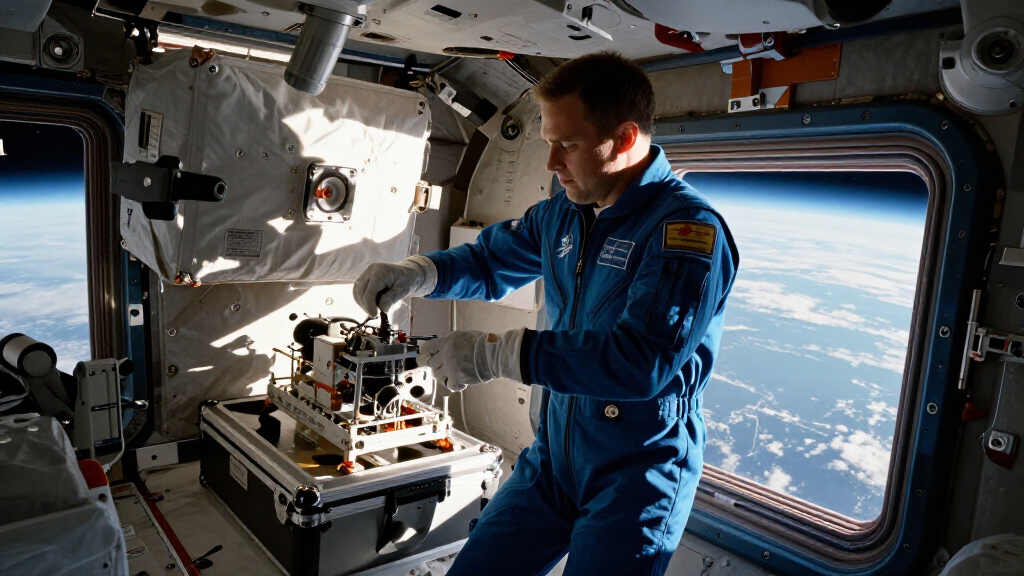
The crew also supported tests of technologies for living and working in space. NASA described a metal 3D printer producing small parts for later evaluation on Earth and a system designed to make intravenous fluid in microgravity. These projects address practical challenges for longer missions, including limited room for spare parts and the weight, storage demands and shelf life of medical supplies. NASA’s report outlines the goals of this work; it does not say that the systems are ready for routine operational use.
Research With Earth and Mission Uses
The station gives researchers a setting where microgravity changes how materials, cells and fluids behave. Comparing results with experiments on Earth can help scientists test questions that are harder to isolate under gravity, though the NASA update does not claim that any single investigation has already produced a treatment or a deployable technology.
Several studies have potential relevance to health care. NASA says research on engineered cartilage could inform the development of tissue that more closely resembles natural cartilage, while stem-cell work examines whether space conditions can support the production of cells relevant to blood and immune-system recovery. The bone-scaffold study addresses bone regeneration, a concern for both patients with bone loss and crews exposed to prolonged microgravity.
The projects also connect laboratory science to the logistics of deep-space travel. On-demand manufacturing and medical supplies could matter on missions where regular resupply is unavailable, while research into resilient microbes could help crews manage health risks in closed habitats. NASA presents these as research aims and possible applications, not confirmed solutions.
microgravity science experiment kits
As an affiliate, we earn on qualifying purchases.
As an affiliate, we earn on qualifying purchases.
What Crew-12 Studied in Orbit
The International Space Station serves as a research platform where crews can install equipment, tend experiments and collect samples for further analysis. In the Crew-12 summary, NASA emphasized investigations using the station’s microgravity environment to study subjects ranging from quantum behavior and crystal growth to tissue development and microbial adaptation.
Some work is designed to inform future analysis on Earth. NASA said small metal components printed aboard the station have been returned for comparison with parts made on the ground. Other studies focus on how microgravity affects biological processes, including bone loss and the development of cartilage and stem cells. Results from such investigations require assessment beyond the description of crew activities provided in the update.
NASA also noted that a Northrop Grumman cargo mission delivered supplies and research hardware to the station, including projects related to space-weather modeling and gut-microbiome stability. The report links that delivery to the broader research program but does not specify which findings, if any, are attributable to Crew-12 or give outcomes for those cargo-delivered investigations.
As an affiliate, we earn on qualifying purchases.
Return Date and Research Results
NASA’s update says the crew is scheduled to return in early October, but does not state the exact departure or landing date, identify the planned return location, or describe any schedule contingencies. The report also does not provide a complete mission timeline or say whether the return plan has changed since publication.
For the experiments, the update chiefly describes research activities and intended applications. It does not present final data, peer-reviewed findings, clinical results or a timetable for publication. In particular, it remains unclear from this material how well the printed metal parts performed after return, whether the fluid-production system has met operational requirements, and what conclusions researchers will draw from the biological studies.
Potential benefits mentioned by NASA—including improved treatments, more resilient medical supplies and better support for deep-space crews—should be understood as research aims. The report does not confirm that these applications are available to patients or ready for use on future missions.
As an affiliate, we earn on qualifying purchases.
Crew Return and Ground Analysis
The next stated milestone is the crew’s planned return to Earth in early October. NASA has not provided a specific date in the supplied update, so the departure and landing schedule remains subject to later agency announcements.
After the crew returns, researchers can continue evaluating experiment samples and hardware. NASA specifically describes printed metal parts being assessed against ground-produced parts; the agency has not set out a results-release schedule in this report. Further findings from the biological and materials investigations may be reported separately as analyses progress.
For readers tracking the mission, the clearest distinction is between completed in-orbit activity and future conclusions: the crew has supported the studies described by NASA, while their return remains scheduled and the scientific and practical outcomes are still to be established.
As an affiliate, we earn on qualifying purchases.
Key Questions
Who is returning from the space station with Crew-12?
The crew named by NASA is Jessica Meir, Jack Hathaway, Sophie Adenot and Andrey Fedyaev. Meir and Hathaway are NASA astronauts, Adenot is an ESA astronaut, and Fedyaev is a Roscosmos cosmonaut.
When is Crew-12 scheduled to return?
NASA says the crew is scheduled to return in early October. The supplied mission report does not give a specific date or landing location.
What kinds of research did the crew support?
NASA highlighted studies of pharmaceutical crystals, ultracold atoms, bone and cartilage, stem cells, soft materials and antibiotic-resistant bacteria. The crew also supported tests of metal 3D printing and intravenous-fluid production in microgravity.
Did NASA report confirmed medical or technology breakthroughs?
No. The update describes research goals and possible applications, but does not provide final findings or confirm that the work has produced an approved treatment or technology ready for routine use.
Why conduct these experiments in space?
NASA says microgravity lets researchers study how cells, crystals and other materials behave under conditions different from those on Earth. The research may inform Earth-based science and help address challenges for long-duration space missions, but the outcomes remain under evaluation.
Source: primary
Fall Picks
fall essentials
As an affiliate, we earn on qualifying purchases.