
To interpret a painting like a story, start by trusting your immediate emotional reactions—notice what feelings or questions it stirs in you. Then, observe the colors, symbols, and composition to uncover deeper meanings and clues about the scene. Consider the cultural and historical background that might influence the artwork’s message. By asking questions and imagining the story behind what you see, you can uncover layers of storytelling—if you keep exploring, you’ll discover even richer insights.
Key Takeaways
- Trust your initial emotional reactions to guide your understanding of the painting’s mood and story.
- Focus on visual elements like colors, composition, and symbols to uncover underlying messages.
- Identify focal points and visual hierarchy to follow the narrative flow within the artwork.
- Consider cultural and historical context to deepen your interpretation of symbols and themes.
- Ask questions about characters, objects, and setting to engage imaginatively with the story behind the painting.
Observe the First Impression and Emotions

Have you ever looked at a painting and immediately felt a surge of emotion? That’s your personal reaction, your initial feelings surfacing without overthinking. When you first gaze at artwork, pay attention to what you experience emotionally. Do you feel joy, sadness, curiosity, or unease? These initial feelings are essential clues to understanding the story behind the painting. Don’t analyze too much at first—just notice how it makes you react. Your emotional response is like a doorway into the artist’s intent and the scene’s mood. Recognizing your personal reactions helps you connect more deeply, making the painting resonate on a visceral level. Trust your instincts and let your initial feelings guide your exploration of the artwork’s narrative. For a deeper understanding, consider how the style and techniques used by the artist influence your perception and emotional response. Additionally, paying attention to the visual elements can deepen your connection to the story being told. Exploring the artistic context can also enhance your interpretive skills and appreciation. Recognizing the impact of cultural background can further enrich your understanding of the artwork’s meaning. Embracing the power of impactful quotes about art can also inspire your appreciation and interpretive skills, enriching your experience.
Notice the Colors and Their Meanings

Colors in a painting aren’t just decorative—they carry powerful meanings and convey emotions that deepen your understanding of the scene. By noticing color symbolism, you can uncover hidden messages and the artist’s intentions. Warm colors like reds, oranges, and yellows often evoke feelings of passion, energy, or warmth, while cool colors like blues and greens tend to create a sense of calm, serenity, or melancholy. Recognizing these choices helps you grasp the emotional impact the artist aimed to evoke. Pay attention to how colors interact and contrast—their relationships can reveal underlying themes or mood shifts. Overall, understanding the significance of colors enhances your connection to the story the painting is telling and enriches your viewing experience. Exploring color symbolism can also provide insights into cultural influences and historical context behind the artwork.
Pay Attention to Composition and Focus
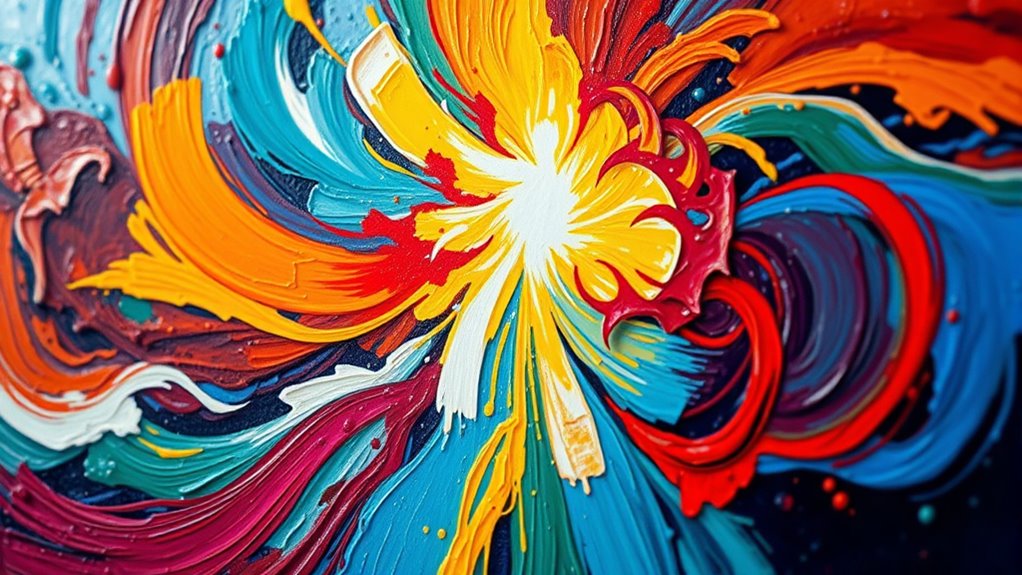
The way an artist arranges elements within a painting guides your eye and shapes your understanding of the scene. Pay attention to the focal points, which are the areas that immediately attract your attention. Notice how the artist creates a visual hierarchy by emphasizing certain elements over others. To analyze this, consider:
- Where your eyes are drawn first.
- How the focal points lead your gaze across the painting.
- The use of size, color, or contrast to highlight key areas.
- How the composition directs your focus to tell a story or evoke emotion. Additionally, understanding the contrast ratio in a painting can reveal how depth and dimension are achieved, influencing your perception of realism and mood. Recognizing how attention to detail guides the viewer can deepen your appreciation of the artist’s storytelling techniques. Paying attention to visual hierarchy can help you see how the artist intentionally guides your interpretation of the scene. Being aware of the composition techniques used can further enhance your ability to “read” a painting like a story, especially when considering how these elements contribute to the overall narrative and emotional impact.
Look for Symbols and Their Possible Significance

Look for symbols in the painting that can reveal deeper meanings or hidden messages. Recognize common symbols like animals, objects, or colors, and consider what they might represent. Interpreting these symbols helps you understand the story the artist is telling.
Recognize Common Symbols
Have you ever wondered what a simple object or gesture in a painting might symbolize? Recognizing common symbols helps you understand the story behind the artwork. Artists often use iconography themes and recurring motifs to convey deeper meaning. To spot these, look for:
- Objects or animals that appear repeatedly, hinting at specific ideas or virtues.
- Colors that hold symbolic significance, like white for purity or red for passion.
- Gestures or body language that express emotion or character traits.
- Settings or backgrounds that reinforce themes, such as a storm symbolizing turmoil.
Interpret Symbolic Meanings
Interpreting symbolic meanings requires you to analyze the objects, colors, and gestures within a painting to uncover their deeper significance. Look for metaphorical imagery that suggests ideas beyond their literal appearance, such as a storm symbolizing turmoil or hope. Pay attention to cultural symbolism, which can reveal the artist’s intended message or societal beliefs. For example, certain flowers or animals may carry specific meanings rooted in cultural traditions. Consider how the composition and details work together to convey themes or narratives. By examining these symbols carefully, you can access the story behind the artwork and gain a richer understanding of its message. This process transforms a visual experience into a meaningful connection with the artist’s intent and cultural context.
Consider the Context and Background Story

To truly understand a painting, you need to consider the artist’s life and the era they lived in. These details reveal why certain themes or styles emerged and what messages might have been important at the time. Recognizing the historical significance helps you see the painting as part of a larger story. Additionally, understanding the artistic context can deepen your appreciation and interpretation of the artwork, as it often reflects prevailing symbolism and cultural influences of the period. Exploring the artistic techniques used can also provide insight into the artist’s intentions and the work’s overall meaning. Being aware of art movements and their characteristics can further enhance your understanding of the artist’s influences and goals.
Artist’s Life & Era
Understanding an artist’s life and era provides essential insight into their paintings, revealing how personal experiences and historical events shape their work. Your knowledge of their background helps you interpret artistic techniques and artist influences more accurately. Consider these points:
- The artist’s social status and education often affect their artistic techniques.
- Major events during their era, like wars or revolutions, influence themes and mood.
- Personal experiences, such as travels or relationships, can shape subject choices.
- Artistic trends of the time, like realism or Impressionism, reflect broader cultural influences.
- Awareness of artistic movements and styles can deepen your understanding of their work’s context and significance.
- Additionally, the prevalence of traditional techniques and materials, such as Indonesian masks crafted with traditional techniques, can offer further clues about the artist’s influences and cultural background.
- Recognizing how contemporary societal conditions impacted artists’ perspectives can also enhance your interpretation of their work.
- Examining the artistic environment in which the artist created their work can reveal how external factors like economic conditions or technological innovations affected their artistic choices.
Historical Significance
Have you ever considered how the historical context surrounding a painting can deepen its meaning? When you explore the time and events behind a piece, you gain insight into the artist’s intentions and the message they conveyed. Artistic techniques often reflect cultural influences of the era, revealing societal values or tensions. Recognizing the cultural influences of the era helps you see beyond the surface, connecting the painting to pivotal moments or cultural shifts. Understanding these factors helps you see beyond the surface, connecting the painting to pivotal moments or cultural shifts. Recognizing its historical significance turns a visual scene into a story about the time it was created, making the artwork more meaningful and engaging. It’s like uncovering a hidden chapter in a fascinating story. Additionally, knowing about home theatre projectors can enhance your appreciation for how modern innovations influence creative expression and cultural documentation.
Ask Questions and Imagine the Narrative

When you look closely at a painting, asking questions sparks your imagination and brings the scene to life. It turns a static image into a form of visual storytelling that deepens emotional engagement. To do this effectively, consider these steps:
- Who are the characters, and what might they be feeling?
- What’s happening outside the frame that could influence the scene?
- Why are certain colors or objects emphasized?
- How might the setting or background hint at a larger story?
- Paying attention to visual elements can reveal hidden meanings or symbolic messages within the artwork.
- Incorporating content quality and topical authority principles can help you interpret the story more effectively, as understanding context and significance enhances your insights.
- Recognizing narcissistic traits in artwork or subjects can offer deeper insight into underlying themes or emotional states.
- Observing the artistic style and technique can also provide clues about the artist’s intent and the story they wish to tell.
- Remember that aesthetic maintenance of the artwork can influence how details are perceived, helping you notice subtleties that reveal the narrative more clearly.
Frequently Asked Questions
How Do Personal Experiences Influence My Interpretation of a Painting?
Your personal experiences shape how you interpret a painting by triggering emotional responses and memory associations. When you see certain colors, shapes, or scenes, they remind you of moments or feelings from your life. These connections influence your understanding and appreciation of the artwork, making your interpretation unique. So, your background and experiences become an essential part of how you read and connect with a painting like a story.
Can Understanding Art History Enhance My Storytelling When Viewing Art?
Understanding art history acts like a map, guiding your storytelling through visual cues. When you recognize artistic techniques, such as chiaroscuro, you deepen emotional responses, making your narrative richer. Imagine uncovering a hidden story in a painting’s composition—knowing its historical context helps you craft compelling tales. This knowledge transforms simple viewing into an immersive experience, enabling you to weave stories that resonate, much like a storyteller who knows every chapter’s background.
What Mistakes Should I Avoid When Trying to Read a Painting?
When reading a painting, avoid projection errors by not assuming the artist’s intent or story without evidence. Don’t overgeneralize pitfalls by applying your personal experiences as universal truths, which can distort the artwork’s meaning. Stay curious and observe details carefully instead of jumping to conclusions. Remember, interpretations are personal, but grounding them in visual clues helps you understand the story more accurately without missteps.
How Do Cultural Differences Affect the Way I Perceive Artwork?
Cultural differences shape how you perceive artwork by influencing your perception filters and biases. Your background, beliefs, and experiences color what stands out or resonates with you, making your interpretation unique. Recognizing these cultural biases helps you approach art with openness, understanding that others may see the same piece differently. Embracing diverse perspectives enriches your appreciation and deepens your connection to the artwork’s story across cultures.
Is There a Universal Way to Interpret Symbols Across Different Artworks?
Imagine symbols as universal keys, revealing shared human experiences across artworks. While some symbols, like a heart for love, have symbol universality, many are shaped by cultural context. To interpret them, consider both the common meaning and the culture that influences its use. By blending these perspectives, you deepen your understanding, recognizing that symbols can connect us, yet still reflect unique cultural stories behind each piece.
Conclusion
As you step back, let your eyes gently wander across the painting’s gentle whispers and subtle gestures. Imagine the silent stories woven into each hue and shape, like a quiet lullaby unfolding in a quiet room. Embrace the gentle dance of symbols and shadows, allowing your mind to drift into a soft, dreamlike world. With patience and curiosity, you’ll find yourself softly cradled by the artwork’s tender, unspoken narrative, inviting you into its quiet embrace.