TL;DR

Get school and study supplies delivered free — and shop member deals
- Fast, free delivery on millions of items
- Access to Prime Big Deal Days deals on October 6–7
- Prime Video, Amazon Music and more included
NASA’s Astronomy Picture of the Day for October 3, 2026, features a Curiosity rover selfie from the south rim of Vera Rubin Ridge on Mars. The panorama combines 61 images taken on January 23, 2018, and NASA notes that Curiosity had gained 1 kilometer in elevation on its Mount Sharp route by August 26, 2026.
NASA’s Astronomy Picture of the Day on October 3, 2026, features a selfie of the Curiosity rover at the south rim of Vera Rubin Ridge on Mars. The image was assembled from 61 exposures taken on January 23, 2018, during the rover’s 1,943rd Martian day, and NASA’s accompanying description notes that Curiosity reached a total elevation gain of 1 kilometer on its Mount Sharp climb by August 26, 2026.
The panorama was recorded by Curiosity’s Mars Hand Lens Imager (MAHLI), a camera mounted at the end of the rover’s robotic arm. NASA says the final mosaic combines 61 exposures. Frames showing the camera arm were edited out to create the assembled selfie, while the extended background was photographed separately by the rover’s Mastcam on sol 1903.
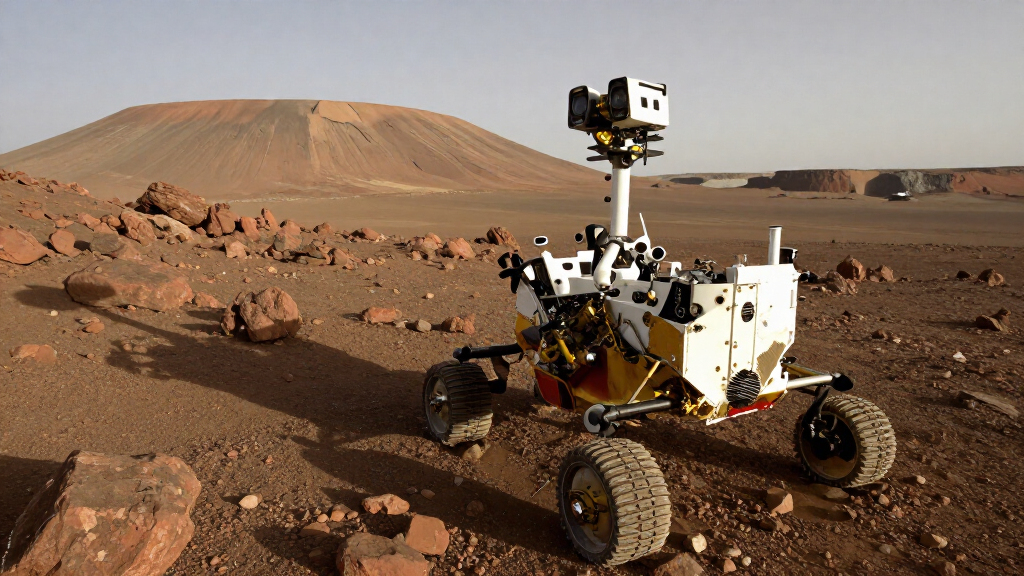
NASA dates the selfie to sol 1943, which corresponds to January 23, 2018, on Earth. A sol is a Martian solar day, roughly 40 minutes longer than an Earth day. In the image, the rover’s mast rises above the deck; the housing for ChemCam, an instrument that fires a laser to examine targets, obscures the distant summit of Mount Sharp.
The APOD entry also supplies a later mission marker: NASA says Curiosity had accumulated 1 kilometer of total elevation gain during its journey from the floor of Gale Crater up Mount Sharp’s slope as of August 26, 2026. That figure is a cumulative climb, not a statement that the rover traveled one kilometer in a straight line or gained that height in a single day.
A Long Climb Captured in One Panorama
The featured image ties a specific moment in Curiosity’s fieldwork to the rover’s longer traverse. A stitched selfie offers a view of the vehicle and the terrain around it, while the accompanying mission figure places that scene within a climb that has taken the rover from Gale Crater’s floor toward higher ground on Mount Sharp. The two dates matter: the panorama is from 2018, while the elevation total reported in the entry is from 2026.
For readers, the APOD is both a visual record and a compact mission update, but it does not announce a new landing, discovery or change in operations. Its value lies in making the rover’s route and scale easier to grasp. The image also shows how rover photographs are built: multiple camera exposures and images from different instruments can be combined to depict the vehicle in its setting.
As an affiliate, we earn on qualifying purchases.
From Gale Crater to Vera Rubin Ridge
Curiosity is a NASA rover exploring Gale Crater on Mars and climbing the lower slopes of Mount Sharp, the central mountain within the crater. Vera Rubin Ridge is one location along that route. NASA’s APOD description places the rover at the ridge’s south rim when it took the selfie, on sol 1943.
The image is not a single unaltered camera frame. MAHLI took the close-range exposures used for the rover mosaic, and the camera arm was removed from frames in the assembled view. NASA says the panorama’s extended background came from Mastcam images made on sol 1903—40 sols before the selfie date. The APOD credit lists NASA, JPL-Caltech and MSSS for the image, and Andrew Bodrov for the panorama. NASA identifies the APOD authors and editors as Jerry Bonnell, Cecilia Chirenti, Robert Nemiroff and Keighley Rockcliffe.
As an affiliate, we earn on qualifying purchases.
Limits of the APOD Update
The APOD entry does not provide a new operational status report, a detailed route map or a breakdown of how Curiosity’s elevation gain was calculated. It also does not say how far the rover traveled horizontally, how much of the 1-kilometer gain occurred after the 2018 selfie, or what specific science results were obtained at the pictured location. The elevation figure is presented as a total recorded by August 26, 2026; further measurement details are not supplied in the source.
The entry describes the image and its component exposures but does not provide additional technical specifications, such as the panorama’s full dimensions or the editing workflow beyond removing arm-containing frames and using a separate Mastcam background. Those details should not be inferred from the picture alone.
As an affiliate, we earn on qualifying purchases.
Curiosity’s Route Beyond the Ridge
NASA’s APOD post does not announce a specific next stop or timetable for Curiosity. The rover’s broader mission remains focused on exploring Gale Crater and the slopes of Mount Sharp, but the source material gives no new schedule or target associated with this image. Future NASA mission updates would be needed to confirm subsequent route milestones, science activities or changes in the rover’s status.
For now, the next step for readers interested in the image is to view the APOD panorama, including its interactive 360-degree presentation, and distinguish the 2018 capture date from the 2026 elevation update. The post is a retrospective image feature with a later mission note, rather than a report that the selfie itself was taken recently.
As an affiliate, we earn on qualifying purchases.
Key Questions
When did Curiosity take the Vera Rubin Ridge selfie?
The rover captured the images on sol 1943, which NASA gives as January 23, 2018, on Earth.
How was the rover selfie assembled?
NASA says the panorama combines 61 MAHLI exposures. Frames that showed the camera arm were edited out, and the extended background came from Mastcam images taken on sol 1903.
What does the 1-kilometer elevation figure mean?
NASA says Curiosity had gained 1 kilometer in total elevation on its trek from Gale Crater’s floor up Mount Sharp’s slope by August 26, 2026. The entry does not give a horizontal distance or a detailed calculation.
Is this a newly taken image?
No. The featured selfie dates to January 2018. NASA published it as its Astronomy Picture of the Day on October 3, 2026, alongside the later elevation milestone.
Source: primary
Fall Picks
fall essentials
As an affiliate, we earn on qualifying purchases.