TL;DR

Get school and study supplies delivered free — and shop member deals
- Fast, free delivery on millions of items
- Access to Prime Big Deal Days deals on October 6–7
- Prime Video, Amazon Music and more included
Science-themed Halloween costumes turn astronomy, biology, chemistry, physics, and technology into recognizable looks, from cardboard rockets to colorful DNA strands. Start with clothes or supplies you already own, add one strong visual clue, and check comfort, visibility, and prop safety before heading out.
A cardboard box can become a spaceship before dinner—and, with a paper control panel and a few foil stars, everyone at the door knows what you are. That is the small magic of science-themed Halloween costumes: a good idea can look vivid without a pricey store-bought suit.
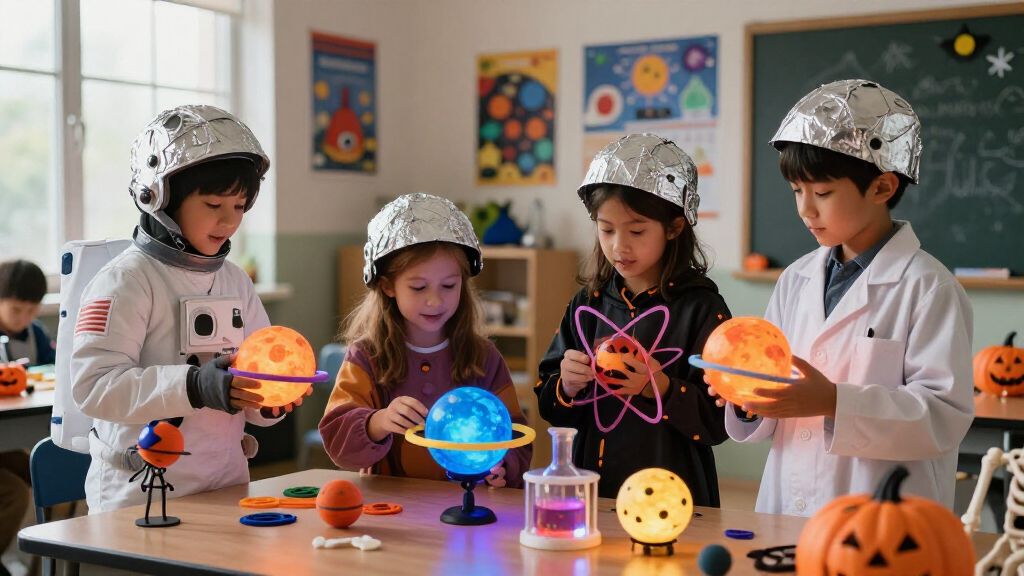
Science-themed Halloween costumes combine dress-up with ideas from astronomy, biology, chemistry, physics, and technology. You can go for a recognizable astronaut, a grinning dinosaur, or a playful DNA strand; you can also build a group look around planets or a food web. The easiest costumes usually start with something already in your closet and add one strong visual cue.
This guide helps you choose an idea, make it readable, keep costs and construction time in check, and avoid common comfort and safety snags. You will also find ways to make a solo outfit work for a school event, a neighborhood party, or a whole family photo.
Choose one bold visual clue—a lab coat, starry cape, molecule badge, or cardboard panel—so people recognize your idea quickly.
Build from clothes and craft supplies you already own, then spend only on a feature the costume truly needs.
For group outfits, give each person a distinct role and tie the costumes together with shared colors or labels.
Test the full costume for visibility, movement, warmth, and easy removal before wearing it to an event.
Use battery-powered lights as directed, keep props lightweight, and label abstract ideas with a short, accurate explanation.
Choose a science costume people recognize at a glance
Science-themed Halloween costumes work best when one bold visual clue tells people what you are within a few seconds. A white coat suggests a scientist, a silver helmet points to an astronaut, and a dark shirt dotted with glowing stars reads as a night sky. Give the idea a clear shape before you add little details.
That quick recognition matters in a noisy hallway or a dim trick-or-treat line. Imagine a child wearing black clothes with a paper spiral pinned down the front: the look may be intended as DNA, but guests could mistake it for a ribbon. Add a large sign reading “DNA,” or build the spiral from two colored ribbons joined by short paper strips. One small cue turns a puzzle into a costume.
Abstract ideas can still make memorable outfits. A person dressed as gravity could wear a shirt with a felt apple falling toward a cardboard Earth; a family member can hold a sign with a short, accurate explanation. Keep the joke easy to read and the explanation short enough to say between doorbells.
- Use a familiar base: a lab coat, dark clothes, or a plain jumpsuit.
- Add one standout prop: a paper planet, molecule badge, or cardboard control panel.
- Label unusual ideas: a short sign can make a pun or scientific concept click.
Science inspiration can come from many places, from fields such as astronomy and biology to films and museum displays. The source matters less than the visual translation: if someone can guess the idea before you explain it, the costume is doing its job.
As an affiliate, we earn on qualifying purchases.
Build a strong costume from clothes and craft supplies
You can make a science costume at home by starting with everyday clothes, choosing one theme, and adding a few lightweight craft details. This keeps the project affordable and gives you room to personalize it. For example, a white shirt becomes a scientist outfit with a homemade name badge, paper goggles worn on a headband, and a notebook marked “observations.”
Try this simple order so you do not spend an hour gluing decorations that disappear under a coat:
- Pick the idea: choose something you can show clearly, such as an astronaut, planet, robot, or bee.
- Check your closet: find the base layers first—dark leggings, a silver top, or a plain shirt.
- Make the main cue: cut a cardboard control panel, paper rocket fins, or a bright planet ring.
- Try it on: walk, sit, and raise your arms before attaching the final pieces.
- Finish with a label or prop: use a short sign if the concept needs explaining.
A robot costume is a good example. A cereal box can become a chest panel, bottle caps can look like buttons, and two strips of shiny tape can suggest metal joints. Keep the box light, cut large arm openings, and avoid covering the wearer’s face. A robot that can bend its elbows is more fun than one that looks perfect on a hanger.
Reuse is part of the charm. A cardboard panel can be recycled afterward, while a lab coat or dark shirt can return to everyday use. The costume does not need expensive electronics to feel inventive; a bright color, an oversized shape, and a convincing little detail can carry the whole idea.
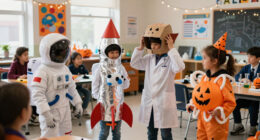
kids astronaut costume with helmet
As an affiliate, we earn on qualifying purchases.
As an affiliate, we earn on qualifying purchases.
Match your idea to your budget, time, and skill
The right science costume is the one you can finish, afford, and comfortably wear—not the one with the most complicated build. A store-bought astronaut suit may save time, while a homemade planet outfit can cost very little if you already have a dark base layer and cardboard. Neither choice is automatically better; it depends on your schedule and what you enjoy making.
For a last-minute school event, put on dark clothes, pin on paper stars, and carry a planet cutout. For a weekend craft project, make a more detailed cardboard rover with a chest panel and large paper wheels. If you love sewing, a soft felt cell costume might suit you; if hot glue makes you nervous, paper, tape, and safety scissors can do plenty.
| Approach | Good fit | Tradeoff |
|---|---|---|
| Closet-based DIY | Small budgets and short timelines | May need a label to clarify the idea |
| Crafted from cardboard | Robots, rockets, and control panels | Needs careful fitting for movement |
| Store-bought costume | Convenience and familiar characters | Can cost more and fit less personally |
| DIY with lights | Night events and futuristic looks | Needs secure wiring and battery care |
Each approach shifts effort to a different part of the project. Closet-based costumes save money and assembly time, but may rely more on a label or prop to explain the idea. Cardboard lets you control the shape and create a more dramatic silhouette, while adding fitting and storage challenges. A purchased outfit can be convenient and recognizable, though it may cost more and need adjustments for comfort. Lights can improve visibility and add atmosphere, but they also introduce batteries, wires, and a new item to check before the event. Choosing with these tradeoffs in mind helps prevent spending time or money on complexity that does not improve the costume.
Before buying anything, set a simple limit: “I’ll use what we have and spend up to ten dollars on the one missing feature.” That could cover a sheet of colored cardstock or a pack of battery-powered lights. A focused budget protects the fun from turning into a last-minute shopping scramble. It also encourages a useful design question: what single addition will make the idea clearer or easier to wear? If a purchase does neither, it is probably optional.
Trends change from year to year, so do not assume one science look will dominate this Halloween. Space exploration, robots, artificial intelligence, and futuristic inventions offer lasting inspiration, but check current films or science news if you want a timely reference. A homemade costume can feel fresh without chasing whatever happens to be popular.
As an affiliate, we earn on qualifying purchases.
Make a group costume that tells one big science story
A group science costume works when every person has a distinct role and the outfits share one easy-to-spot theme. The solar system is a natural fit: one person can be the Sun, others can represent planets, and a child can be a tiny comet with a ribbon tail. Each costume stands alone, yet the group makes sense together.
For a classroom or family, choose a theme with enough parts for everyone. A food web might include a plant, caterpillar, frog, snake, and hawk; the colors and shapes help younger children recognize each role. A periodic-table group can give each person an element symbol, though a bold letter-and-number card is clearer than a tiny printed label in a crowded room.
Before you make the outfits, agree on the shared visual style. Perhaps everyone wears black and carries a bright paper symbol, or each planet gets one color and a simple ring or badge. That consistency makes a group photo look intentional, like a little moving mural rather than a collection of unrelated costumes.
- Give everyone a clear role: avoid assigning two people the same character unless you mean to.
- Use matching labels or colors: make the theme readable from across a room.
- Plan for different ages: give toddlers soft, simple pieces and older kids the craftier props.
When you are up with ideas but cannot settle on one, start with the people in the group: who enjoys being the center of attention, and who wants a simple T-shirt costume? A child who dislikes masks can be a brightly colored planet, while an adult can take the elaborate cardboard spaceship role. The best shared theme leaves room for everyone to feel comfortable.
group science-themed Halloween costumes
As an affiliate, we earn on qualifying purchases.
As an affiliate, we earn on qualifying purchases.
Keep the costume comfortable, visible, and safe
A science costume should let you see, breathe, walk, and sit without wrestling with it all night. That sounds basic, but a helmet that slips over the eyes or a cardboard rocket that catches on every doorway can quickly spoil the fun. Try the full outfit at home and walk through the same kinds of spaces you expect at the event.
For children, check whether the costume works with a warm layer underneath; late-October air can feel sharp while waiting outdoors. Keep hems short enough to avoid tripping, secure loose parts, and choose props that are light rather than sharp or awkward to carry. A paper telescope is more comfortable in a busy school hallway than a long, heavy plastic tube.
Lights can add a lovely glow to a planet or robot, but use purpose-made, battery-powered accessories according to the product directions. Secure wires so they cannot snag, protect battery compartments, and check that lights do not block vision. Skip open flames and improvised chemical effects—bright paper, reflective tape, and LEDs can create plenty of drama without them.
Quick test: If the wearer cannot see clearly, move freely, or remove the costume easily, simplify it before the event.
Accuracy also deserves a little care. A playful simplification is fine—your cardboard “black hole” does not need a graduate-level diagram—but avoid presenting a false claim as a fact. If you dress as a real scientist or draw on a culture’s scientific traditions, check the person’s work and represent it respectfully. A small accurate detail can make the costume more interesting, not less fun.
Turn a simple costume into a conversation starter
A costume becomes more memorable when it gives people an easy question to ask. A child dressed as a bee can explain how pollinators help plants, while an astronaut can point to a cardboard Moon and say what they would pack for a trip. The explanation does not need to be a lecture; one curious sentence is enough to bring the idea to life.
Try adding a short fact card to a less familiar costume. Someone dressed as a DNA strand could include a note saying it carries biological instructions; someone dressed as a comet could explain that its bright tail is part of the display that makes it recognizable. Keep the words simple, readable, and matched to the wearer’s age.
Let the costume do most of the talking. A large model cell with a few color-coded parts is easier to understand than a shirt covered in tiny labels. If you are making a science-fiction robot, you can still explain which parts are invented and which borrow from real technology. That distinction keeps the look playful without blurring fact and fiction.
Science museums, astronomy resources, nature guides, classroom topics, and science-fiction stories can all spark ideas. If you are using a current product or a recent film reference, check what is actually available and popular this season rather than relying on an old trend list. For a family party, the most useful result may be the conversation at the snack table: “Why does your planet have rings?” is a fine opening for a little science.
Frequently Asked Questions
What are easy science-themed Halloween costumes to make at home?
Try a scientist with a white shirt and handmade badge, an astronaut with a cardboard control panel, or a planet made from dark clothes and paper stars. A strong visual cue helps people understand the idea without an elaborate build.
How can I make a science costume on a small budget?
Begin with clothes and craft supplies you already have, then make just one standout feature from cardboard or paper. A cereal box can become a robot panel, and a sheet of cardstock can turn a plain outfit into a molecule or planet costume.
What are good science costumes for kids?
Astronauts, dinosaurs, bees, planets, and friendly robots are familiar options that can be built with simple shapes. Choose a design that stays comfortable, gives the child a clear view, and does not drag or snag while they walk.
How do I make a science-themed group or family costume?
Pick one shared idea, such as the solar system, a food web, or the periodic table, and give each person a distinct role. Matching colors or simple labels help the group read as one theme, even when each outfit has a different shape.
How can I make an abstract science costume recognizable?
Use a bold shape or prop, then add a short label if the concept is not familiar. A bright spiral and a “DNA” sign, for example, communicate the idea more quickly than tiny details alone.
Are science costumes suitable for school events?
Often, yes, but check the school event’s rules before building the outfit. Keep props lightweight and non-disruptive, and make sure the wearer can see, move, and sit comfortably indoors.
How can I add glowing lights safely?
Choose purpose-made, battery-powered lights and follow their directions. Secure wires, keep battery compartments protected, and make sure the lights do not block vision or restrict movement; skip open flames and improvised chemical effects.
Conclusion
Make the idea clear, then make it comfortable. A paper planet, a cardboard rocket, or a lab coat with a clever badge can turn familiar supplies into a costume people remember. You do not need a perfect build or an expensive kit; you need one vivid cue and enough room to move.
Start with what is already in your closet, add one bright piece of science, and test the outfit before the doorbell rings. The best costume is the one that gets you out into the crisp night smiling—and leaves someone asking, “How did you make that?”
Halloween Picks
halloween
As an affiliate, we earn on qualifying purchases.