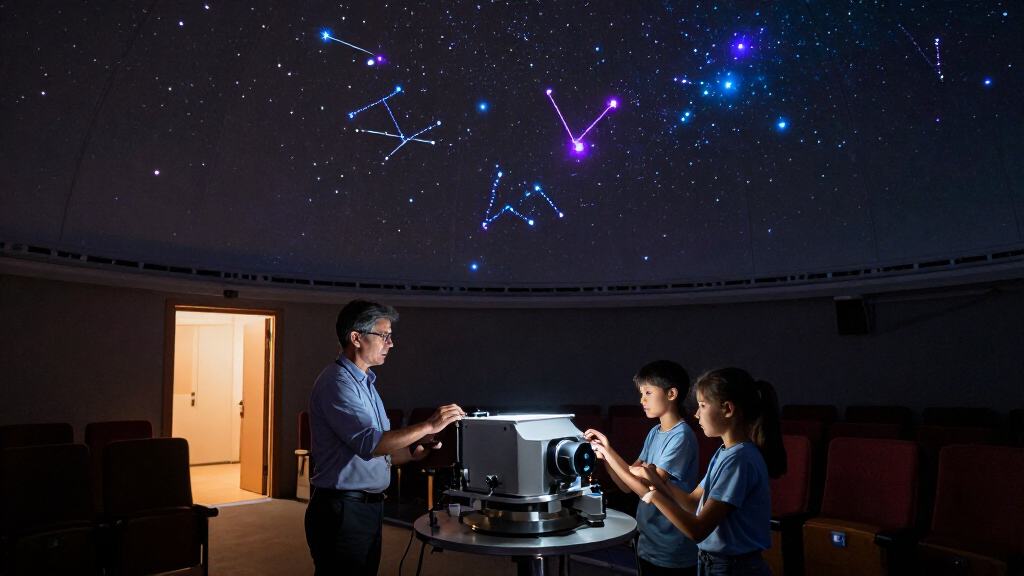

Astronomy planetarium projectors range from disc-based star and planet displays to colorful room lights with music and sound effects. My best overall pick is the Galaxy Projector Pro with 25 Planetarium Discs, which stands out for offering more themed projections than the 13-disc models. The Thames & Kosmos Planetarium Projector is a more astronomy-focused choice, while the Govee Galaxy Light Star Projector 2 Pro suits buyers who want a feature-rich ambient display. The main tradeoff is between recognizable celestial subjects and flexible mood lighting, with ease of positioning and room fit mattering too. Read on for the full breakdown and guidance on choosing the right projector for your space.

Prime made for students and young adults
- Fast, free delivery for dorm and study essentials
- Prime Video and Amazon Music included
- Member-only deals
Key Takeaways
- The 25-disc Galaxy Projector Pro stands apart on projection variety: it offers more slide subjects than the several 13-disc models, though buyers should still check whether its subjects match the astronomy they want to display.
- Disc-based models and app-driven lights serve different goals: Thames & Kosmos and the projector-disc options lean toward themed celestial projections, while Govee and Bluetooth/app models emphasize customizable room atmosphere.
- Many products share a 13-in-1 format: FlyLily appears twice, so buyers should compare the exact listing and included accessories rather than assume every similarly named version is identical.
- Extra audio features are not a substitute for sky detail: white noise, Bluetooth speakers, and soothing sounds may help create a bedtime setting, but they do not make a projection more astronomy-focused.
- Positioning and controls can matter as much as the image menu: rotation, adjustable knobs, timers, remotes, and rechargeable power address different room and routine needs.
| Galaxy Projector Pro with 25 Planetarium Discs and 360° Rotation |  | Best for Scene Variety | Disc count: 25 | Display resolution: Maximum 4K pixels | Maximum throw distance: 16.4 feet | VIEW LATEST PRICE | See Our Full Breakdown |
| 13-in-1 Galaxy Projector Night Light, White |  | Best for Flexible Bedtime Timers | Projection scenes: 13 | Projection distance: Up to 16.4 ft; 9.84 ft or less recommended | Projection coverage: 135–754 sq ft | VIEW LATEST PRICE | See Our Full Breakdown |
| FlyLily 13-in-1 Galaxy Projector with 360° Rotation |  | Best for Quiet Space-Themed Bedtime | Display scenarios: 13 | Maximum projection distance: 16.4 ft | Optimal projection distance: 9.84 ft | VIEW LATEST PRICE | See Our Full Breakdown |
| 3D Galaxy Projector with Bluetooth Speaker, App Control, and 60 Scenes |  | Best for Feature-Rich Room Atmosphere | Scenes: 60 moving scenes | Connectivity: Bluetooth 5.3 | Controls: App and remote control | VIEW LATEST PRICE | See Our Full Breakdown |
| POCOCO Rechargeable Galaxy Star Projector with 5K Discs |  | Best Compact Rechargeable Astronomy Pick | Lens: 2 megapixels | Included discs: 2 replacement optical film discs | Light source: LED | VIEW LATEST PRICE | See Our Full Breakdown |
| FlyLily 13-in-1 Galaxy Projector with 360° Rotation |  | Best for Wide-Room Coverage | Display scenes: 13 | Rotation: 360° with two speeds | Maximum projection distance: 16.4 ft | VIEW LATEST PRICE | See Our Full Breakdown |
| Galaxy Projector Pro Planetarium Star Projector with 13 Film Discs |  | Best for Adjustable Positioning | Film discs: 13 replaceable discs | Stand rotation: 360° adjustable | Focus: Adjustable | VIEW LATEST PRICE | See Our Full Breakdown |
| Galaxy Projector Pro with 13 Space Slides |  | Best for Educational Scene Variety | Projection scenes: 13 space slides | Maximum throw distance: 16.4 ft | Ideal viewing distance: Up to 9.84 ft | VIEW LATEST PRICE | See Our Full Breakdown |
| Galaxy Projector Pro for Bedroom, 13-in-1 Planetarium Star Projector with Solar System & Constellation, Night Light, 360° Rotating with Timer and Adjustable Knob |  | Best for Bedroom Night-Light Use | Projection discs: 13 interchangeable discs | Light source: LED | Rotation: 360° | VIEW LATEST PRICE | See Our Full Breakdown |
| Thames & Kosmos Planetarium Projector |  | Best for Hemisphere Star Maps | Recommended age: 8 years and up | Image disks: 4 | Projection modes: Rotating star maps and space images | VIEW LATEST PRICE | See Our Full Breakdown |
| Galaxy Projector Pro with 13 Space Discs |  | Best for Educational Variety | Space slides: 13 | Maximum throw distance: 16.4 ft | Ideal viewing distance: Up to 9.84 ft | VIEW LATEST PRICE | See Our Full Breakdown |
| Galaxy Projector with White Noise Machine, 10 Film Slides and 28 Soothing Sounds |  | Best for Bedtime Sounds | Projection slides: 10 | Sound options: 28 non-looping sounds | Projection coverage: Up to 255 sq. ft. | VIEW LATEST PRICE | See Our Full Breakdown |
| Govee Galaxy Light Star Projector 2 Pro |  | Best Smart-Controlled Pick | Lens resolution: 4 megapixels | Coverage: Up to 301 sq. ft. | Light output: 230 lumens | VIEW LATEST PRICE | See Our Full Breakdown |
| Ainael Galaxy Projector with HD Star and Meteor Effects |  | Best for Meteor Effects | Model: SKE-TKQ01 | Projection angle: 180° adjustable | Coverage: Over 20 m² | VIEW LATEST PRICE | See Our Full Breakdown |
| Galaxy Projector Night Light with 16 HD Projection Scenes, 29 Soothing Sounds, Bluetooth Speaker, Remote and Timer |  | Best All-in-One Bedside Setup | Projection scenes: 16 HD scenes, including space and dinosaur subjects | Soothing sounds: 29 | Bluetooth: Version 5.3 | VIEW LATEST PRICE | See Our Full Breakdown |
More Details on Our Top Picks
Galaxy Projector Pro with 25 Planetarium Discs and 360° Rotation
The 25 interchangeable discs make this the strongest choice here for households that want more than a small set of space views. Its collection also includes marine and wildlife imagery, so it can serve as a general room projector as well as an astronomy-themed one. Compared with the 13-in-1 Galaxy Projector Night Light, it offers nearly twice as many discs, while keeping adjustable focus, 360° rotation, and a similar stated maximum throw distance. The tradeoff is that the extra variety does not remove the need to set up a viewing space: the recommended distance is about 9.84 feet, and bright rooms can make projected images harder to see. It is lightweight and USB-powered, but needs a USB power source nearby. Two timer settings cover basic bedtime shutoff, though they offer fewer choices than some alternatives.
Pros:- Includes 25 discs spanning celestial, marine, and wildlife imagery
- Adjustable focus and stand help aim and sharpen the projection
- 360° rotation adds motion to the projected scenes
- Lightweight design and USB power make it easy to move between rooms
Cons:- Requires a USB power supply, limiting placement away from outlets or power banks
- Recommended viewing distance of about 9.84 feet may not suit small rooms
- Only offers 1-hour and 2-hour auto-off settings
Best for: Families who want a broad mix of astronomy and non-space projection discs and have a suitable USB power source.
Not ideal for: Buyers who want cordless placement, a small bedside projection distance, or a projector with more than two timer options.
- Disc count:25
- Display resolution:Maximum 4K pixels
- Maximum throw distance:16.4 feet
- Recommended viewing distance:9.84 feet
- Projection area:135–754 sq ft
- Rotation:360°
- Timer options:1 hour and 2 hours
- Power and mounting:USB; tabletop
Our verdict“Choose this for the widest disc selection in this group, provided you have room to project from the recommended distance.”
13-in-1 Galaxy Projector Night Light, White
This 13-scene projector suits buyers who want basic space imagery with bedtime controls that can run for 1, 2, or 4 hours. That longer timer choice sets it apart from the Galaxy Projector Pro with 25 Planetarium Discs, which offers only two shutoff durations, though the Pro has a much larger disc library. Here, two rotation speeds let you choose between slower movement and a livelier effect, while adjustable focus helps sharpen the image at different distances. The stated maximum projection distance reaches 16.4 feet, but 9.84 feet or less is recommended, so its broad coverage figure should not be mistaken for a promise of crisp results in every room. It runs on USB-C, but the required 5V/2A adapter is not included. Bright rooms also reduce clarity, making this a better fit for dim bedtime settings than daytime use.
Pros:- Three timer settings include a 4-hour option for longer wind-down routines
- Two rotation speeds provide some control over scene movement
- Adjustable focus supports sharper projection at different distances
- Includes 13 discs, a USB-C cable, cleaning cloth, and manual
Cons:- The required 5V/2A adapter is not included
- Bright ambient light can reduce projection clarity
- Its 13 scenes offer less variety than the 25-disc Galaxy Projector Pro
Best for: Bedside users who want a modest astronomy scene selection, quiet operation, and a 4-hour auto-off option.
Not ideal for: Buyers without a USB-C power adapter or anyone who needs clear projections in a room that cannot be darkened.
- Projection scenes:13
- Projection distance:Up to 16.4 ft; 9.84 ft or less recommended
- Projection coverage:135–754 sq ft
- Rotation:360°, 2 speeds
- Timer:1, 2, or 4 hours
- Power:USB-C, 5 V DC; 5V/2A adapter required, not included
- Wattage:10 W
- Dimensions and weight:5.7 × 5.7 × 4.33 in; 1.2 lb
Our verdict“Pick this over the 25-disc Pro if timer flexibility matters more to you than a larger collection of scenes.”
FlyLily 13-in-1 Galaxy Projector with 360° Rotation
FlyLily keeps its pitch focused on 13 space scenes—including planets, constellations, nebulae, and auroras—rather than mixing astronomy with animals or ambient audio. Like the 13-in-1 Galaxy Projector Night Light, it has two rotation speeds, adjustable focus, quiet operation, and 1-, 2-, or 4-hour timers. The specifications are also similar on projection distance and coverage, so the key distinction is a straightforward space-only presentation rather than a wider feature set. That simplicity may suit a bedroom routine, but it does not add a battery: this projector needs a corded USB connection. Its two rotation speeds also give less fine-grained control than a variable-speed system might. The table-mount format and compact footprint make placement manageable, though the 9.84-foot optimal distance still calls for some room between the unit and the viewing surface.
Pros:- Scenes center on astronomy subjects such as planets, constellations, and auroras
- Quiet operation is suited to bedroom use
- Adjustable focus and two rotation speeds help tailor the projection
- 1-, 2-, and 4-hour auto-off options support different sleep routines
Cons:- Requires a corded USB power connection
- Rotation offers only two speed settings
- The 9.84-foot optimal distance may be awkward in a compact bedroom
Best for: People seeking a quiet, space-focused bedtime projector with adjustable focus and several sleep timer choices.
Not ideal for: Anyone who needs a cordless projector, many rotation-speed choices, or a distinctive feature beyond the standard 13-scene format.
- Display scenarios:13
- Maximum projection distance:16.4 ft
- Optimal projection distance:9.84 ft
- Coverage area:135–754 sq ft
- Rotation:360°; 2 speeds
- Auto-off timer:1, 2, or 4 hours
- Light source and power:LED; corded USB power
- Dimensions and weight:5.03 × 4.64 × 5.9 in; 1.4 lb
Our verdict“Choose FlyLily for a quiet, astronomy-led bedtime setup, but skip it if you need cordless use or more scene variety.”
3D Galaxy Projector with Bluetooth Speaker, App Control, and 60 Scenes
This is the broadest all-in-one entertainment option in the group: 60 moving scenes cover space alongside oceans, animals, and seasonal themes, and a Bluetooth 5.3 speaker adds audio. Compared with the POCOCO Rechargeable Galaxy Star Projector, it offers far more scene variety and integrated sound, but it is a room-atmosphere device rather than a portable, disc-led astronomy projector. App and remote controls, five brightness levels, and a 270° manual tilt give more ways to aim and tune the display than the simpler disc projectors. Its tradeoff is that the experience depends on a dim room and smooth surface, and the remote needs a clear line of sight from 4–5 m. The broad scene library also includes plenty beyond astronomy, so buyers seeking a focused star or constellation display may prefer a dedicated optical-disc model.
Pros:- 60 moving scenes include astronomy plus ocean, animal, and seasonal themes
- Bluetooth 5.3 speaker combines projected visuals with audio
- App and remote controls provide multiple ways to operate the unit
- Five brightness levels and 270° manual tilt help tailor placement and output
Cons:- Projection is best in a dim room on a smooth surface
- Remote control requires 4–5 m line of sight
- Its wide-ranging themes are less focused on astronomy than disc-based options such as POCOCO
Best for: Buyers who want a multipurpose room projector with astronomy scenes, ambient audio, Bluetooth playback, and remote or app controls.
Not ideal for: Astronomy purists who want disc-based star and constellation imagery, or users who cannot darken the projection room.
- Scenes:60 moving scenes
- Connectivity:Bluetooth 5.3
- Controls:App and remote control
- Aiming:270° manual tilt; horizontally rotating base
- Brightness:5 levels, 10%–100%
- Sleep timer:1, 2, or 4 hours
- Recommended projection distance:3–5 m
- Image coverage:15–60 m²
Our verdict“Choose this for a feature-packed audiovisual room atmosphere, not for the most astronomy-focused projection.”
POCOCO Rechargeable Galaxy Star Projector with 5K Discs
POCOCO is the most portable astronomy-led choice here, pairing a rechargeable battery rated for up to six hours with optical discs for starry skies, constellations, and planetary scenes. That makes it easier to place away from an outlet than the corded FlyLily 13-in-1 Galaxy Projector, though FlyLily offers 13 scenes and 360° projection rotation, while POCOCO’s supplied details emphasize its disc format and adjustable angle. A 2-megapixel lens and 5K discs are the stated imaging components, but those figures alone do not establish how sharp a projection will look in a particular room. Its soft 1-watt LED output suits a gentler night-sky effect rather than a bright, room-filling display. Timer information is inconsistent in the supplied details, so buyers should verify the available settings before relying on a specific shutoff duration.
Pros:- Rechargeable battery is rated for up to 6 hours of use
- Projects astronomy subjects including constellations and planetary scenes
- Adjustable 30° angle and disc rotation support flexible positioning
- Can run on battery or USB power
Cons:- Supplied product details conflict on timer durations
- Its 1-watt soft light may not suit buyers seeking a bright, room-filling projection
- The provided information lists two replacement optical film discs but does not clarify the total included disc selection
Best for: Bedside users who want a rechargeable, astronomy-focused projector that can be placed without staying plugged into USB power.
Not ideal for: Buyers who need a clearly documented timer schedule, wide-area brightness, or a large variety of projection scenes.
- Lens:2 megapixels
- Included discs:2 replacement optical film discs
- Light source:LED
- Light output:1 watt soft light
- Battery life:Up to 6 hours
- Timer:15, 30, or 60 minutes listed; product details conflict
- Adjustable angle:30 degrees
- Power source:Battery or USB
Our verdict“Pick POCOCO for cordless bedside placement and a gentle astronomy display, but confirm its timer details before buying.”
FlyLily 13-in-1 Galaxy Projector with 360° Rotation
For buyers who want interchangeable astronomy scenes to spread across a sizable room, the FlyLily 13-in-1 is a strong fit. Its stated coverage range of 135–754 sq. ft. and 360° rotation make it better suited to broad ceiling or wall projections than the Thames & Kosmos Planetarium Projector, which puts more emphasis on hemisphere star maps and a shorter nightlight timer. The 13 discs provide variety, while adjustable focus and two rotation speeds let you tune the display without adding complicated controls.
The tradeoff is that this is a USB-corded projector, not a battery-powered option, and its rotation is limited to two speeds. I’d choose it for room-scale atmosphere, not for a detailed, hands-on astronomy lesson. Compared with the Galaxy Projector Pro with 13 Film Discs, it also offers a longer stated throw and more timer choices, but shares the manual-disc format.
Pros:- Thirteen space-themed discs offer more scene variety than the four image disks in the Thames & Kosmos model.
- Stated coverage of 135–754 sq. ft. suits broad wall and ceiling projections.
- Adjustable focus and two rotation speeds help tailor the display to room size.
- Quiet operation and 1-, 2-, or 4-hour timers suit bedtime use.
Cons:- Requires a USB power connection, limiting placement away from an outlet or power source.
- Only two rotation speeds are offered, so motion control is limited.
- A large stated coverage area does not replace the need for a suitably dark room.
Best for: Families or bedroom users who want rotating space scenes to cover a large ceiling and can keep the projector near USB power.
Not ideal for: Buyers who need battery-powered placement, fast rotation choices, or astronomy content organized as a guided lesson.
- Display scenes:13
- Rotation:360° with two speeds
- Maximum projection distance:16.4 ft
- Optimal projection distance:9.84 ft
- Coverage area:135–754 sq. ft.
- Light source:LED
- Power:Corded USB
- Auto-off timer:1, 2, or 4 hours
- Dimensions and weight:5.03 × 4.64 × 4.72 in; 1.4 lb
Our verdict“Choose the FlyLily if broad, quiet, rotating projections matter more than battery portability or astronomy instruction.”
Galaxy Projector Pro Planetarium Star Projector with 13 Film Discs
The standout here is its adjustable 360° stand, which gives buyers a straightforward way to aim scenes at a wall or ceiling. With 13 replaceable discs, focus control, and a built-in meteor effect, it combines familiar astronomy subjects such as the Solar System, Milky Way, and Moon with a little extra motion. Compared with the FlyLily 13-in-1, its stated projection reach and coverage are smaller, and its timer stops at two hours; in return, the adjustable stand makes repositioning a central part of the design.
This is a USB-powered tabletop model with push-button controls, not a self-contained portable unit. Its listed LCoS and resolution figures don’t establish how crisp the interchangeable film-disc images will appear in a real room, so I’d prioritize the focus control and room setup over those numbers. The discs also need to be changed manually, making it less convenient for quick scene changes than a projector with built-in electronic effects.
Pros:- Adjustable 360° stand offers flexible aiming.
- Thirteen replaceable discs cover celestial and themed scenes.
- Focus control helps adapt projection to the chosen surface and distance.
- Built-in meteor effect adds motion beyond the static disc imagery.
Cons:- Projection area is stated at up to 135 sq. ft., less than the 135–754 sq. ft. range listed for the FlyLily 13-in-1.
- Discs must be switched manually to change scenes.
- Timer choices are limited to one or two hours.
Best for: Buyers who want a tabletop projector they can aim precisely at a ceiling or wall and enjoy swapping among physical astronomy discs.
Not ideal for: People who need broad room coverage, longer timers, or automatic scene changes without handling discs.
- Film discs:13 replaceable discs
- Stand rotation:360° adjustable
- Focus:Adjustable
- Projection distance:Up to 3 m
- Projection area:Up to 135 sq. ft.
- Display type:LCoS
- Listed resolution:3840 × 2160
- Connectivity and controls:USB; push-button control
- Timer:1 or 2 hours
Our verdict“Pick this model if precise tabletop aiming and a built-in meteor effect matter more than maximum coverage or longer timer settings.”
Galaxy Projector Pro with 13 Space Slides
The brief introductions paired with its 13 astronomy slides give this projector a more learning-oriented angle than the FlyLily 13-in-1, whose listing focuses on scene selection and room coverage. Solar System, nebula, and galaxy imagery can make this a useful prompt for casual family conversations, while adjustable focus and two rotation speeds help tailor the display to the room. Its stated reach of 16.4 feet and coverage of 135–754 sq. ft. match the FlyLily’s broad-room positioning.
The limitation is practical: the room needs to be dark for clearer images, and the required 5V/2A adapter is not included. That makes setup less complete out of the box than the Galaxy Projector Pro for Bedroom, which is also USB-C powered but is described as a night light as well as a disc projector. I’d favor this option when the educational framing and three timer settings matter, rather than when included power hardware is the priority.
Pros:- Thirteen space slides include brief introductions, adding an educational cue beyond imagery alone.
- Adjustable focus, projection angle, and two rotation speeds support flexible setup.
- Three timer choices include a four-hour setting.
- Stated 135–754 sq. ft. coverage suits larger projection areas.
Cons:- A 5V/2A power adapter is required but not included.
- A dark room is needed for the clearest image.
- Like the FlyLily 13-in-1, it relies on slides rather than a fully electronic scene library.
Best for: Parents and caregivers who want space-themed slides with brief introductions for casual, screen-free astronomy conversations.
Not ideal for: Buyers who expect a complete power setup in the box or need clear projections in a lit room.
- Projection scenes:13 space slides
- Maximum throw distance:16.4 ft
- Ideal viewing distance:Up to 9.84 ft
- Projection coverage:135–754 sq. ft.
- Rotation:360° with two speeds
- Power:10 W, 5 V via USB Type-C
- Adapter requirement:5V/2A adapter required; not included
- Focus and mounting:Adjustable focus; tabletop
- Timer:1, 2, or 4 hours
Our verdict“Choose this projector for introductory space scenes and broad coverage if you already have a compatible 5V/2A adapter.”
Galaxy Projector Pro for Bedroom, 13-in-1 Planetarium Star Projector with Solar System & Constellation, Night Light, 360° Rotating with Timer and Adjustable Knob
This model is aimed at people who want astronomy imagery to double as bedroom mood lighting. Its 13 interchangeable discs include the Solar System, nebulae, and superclusters, while 360° rotation and a focus knob provide basic control over how those scenes appear on a wall or ceiling. The 1-, 2-, and 4-hour timer options give it more bedtime flexibility than the Galaxy Projector Pro Planetarium Star Projector with 13 Film Discs, which offers only one- or two-hour settings.
The listing also states coverage up to 754 sq. ft., but supplies no projection-distance figures, so first-time buyers have less guidance on where to place it than with the FlyLily 13-in-1. It is USB-C powered and corded, with no battery option, and a dark room is needed for the best results. I’d choose it for a bedroom ambience role rather than for users seeking a guided star map or a specified educational feature set.
Pros:- Thirteen interchangeable discs provide a range of celestial scenes.
- 360° rotation and adjustable focus help aim and sharpen the projection.
- One-, two-, and four-hour timer choices offer flexible bedtime shutoff.
- LED source and stated coverage up to 754 sq. ft. support room-filling ambience.
Cons:- USB-C corded power means it cannot be placed independently of a power source.
- Best performance requires a dark room.
- Projection distance details are not provided, making placement less predictable than with the FlyLily 13-in-1.
Best for: Adults or families seeking a USB-C-powered bedroom projector with interchangeable space scenes and several auto-off choices.
Not ideal for: Buyers who need battery operation, clear placement guidance, or a star map designed for astronomy study.
- Projection discs:13 interchangeable discs
- Light source:LED
- Rotation:360°
- Power:Corded USB-C
- Wattage:13 W
- Mounting:Table mount
- Material:ABS
- Weight:0.62 kg
- Timer:1, 2, or 4 hours
Our verdict“Choose this bedroom-focused model if you want rotating space imagery and flexible timers, but not if battery power or precise setup guidance is a must.”
Thames & Kosmos Planetarium Projector
Unlike the other four picks, the Thames & Kosmos Planetarium Projector includes rotating star maps for both the northern and southern hemispheres. That makes it the clearest choice here for buyers who want a recognizable sky map, rather than a broad set of interchangeable galaxy scenes. Its second mode projects space images, and the included poster gives families another way to connect the display with astronomy. The FlyLily 13-in-1 offers more scene discs and a much longer maximum throw, so it is the better fit for room-filling variety; Thames & Kosmos puts its emphasis on star maps and age-guided learning.
There are only four image disks, fewer than the 13-disc alternatives, and the nightlight timer tops out at 60 minutes. It also needs a darkened room for projection. Tabletop placement or wall hanging gives it more mounting flexibility than the other listed tabletop-focused models, though it still requires USB-C power.
Pros:- Projects star maps for both northern and southern hemispheres.
- Includes a separate mode for space-themed images.
- Can sit on a tabletop or hang on a wall.
- Color educational poster supports family learning beyond the projection.
Cons:- Four image disks provide less scene variety than the 13-disc projectors in this roundup.
- Auto-off choices stop at 60 minutes, shorter than the timer options on the FlyLily 13-in-1.
- Requires a darkened room for projections.
Best for: Families with children aged eight and up who want northern and southern hemisphere star maps alongside space-image projections.
Not ideal for: Buyers seeking many interchangeable scenes, long bedtime timers, or broad stated coverage for large rooms.
- Recommended age:8 years and up
- Image disks:4
- Projection modes:Rotating star maps and space images
- Power connection:USB-C
- Auto-off timer:15, 30, or 60 minutes
- Placement:Tabletop or wall-hung
- Included learning materials:Two star maps and color poster
Our verdict“Pick Thames & Kosmos for hemisphere star maps and family learning, not for the broadest scene selection or longest timer.”
Galaxy Projector Pro with 13 Space Discs
With 13 space slides and brief introductions to their subjects, this is the clearest pick here for buyers who want a projector to prompt questions about planets, nebulae, and galaxies—not just add bedroom ambience. Its adjustable focus and 360° positioning make it easier to aim at different walls or ceilings, while two rotation speeds let you choose between slow motion and a livelier display. Compared with the Galaxy Projector Night Light with 16 HD Projection Scenes, this model puts more emphasis on educational context and offers a similar broad coverage range, but it lacks built-in sounds and Bluetooth audio. The quiet operation and timed shutoff suit bedtime; the tradeoffs are a power adapter sold separately and an image that is clearest in a dark room.
Pros:- 13 space slides include brief educational introductions
- Adjustable focus and 360° projection angle help with flexible placement
- Two rotation speeds and three timer settings support bedtime use
- Quiet operation is suited to bedrooms
Cons:- Required 5V/2A power adapter is not included
- Image clarity is best in a dark room
Best for: Parents or curious beginners who want labeled space subjects to help start conversations about astronomy.
Not ideal for: Buyers who want sound playback, Bluetooth, or a ready-to-use wall adapter included.
- Space slides:13
- Maximum throw distance:16.4 ft
- Ideal viewing distance:Up to 9.84 ft
- Projection coverage:135–754 sq. ft.
- Projection angle:360° adjustable
- Rotation speeds:2
- Timer:1, 2, or 4 hours
- Power:10 W; 5 V USB-C; 5V/2A adapter required and not included
Our verdict“Choose this projector for a quiet, slide-based introduction to space, provided you already have a compatible power adapter.”
Galaxy Projector with White Noise Machine, 10 Film Slides and 28 Soothing Sounds
This projector is a practical match for households that want space images and sleep audio in one corded device. Its 10 slides cover familiar subjects such as Earth, the Moon, and Saturn, while 28 non-looping sounds offer more variety than a basic projector without audio. The timer and memory for sound and volume make nightly setup simpler, although that memory only holds while power remains connected. Compared with the Galaxy Projector Night Light with 16 HD Projection Scenes, this model has fewer image scenes and no listed Bluetooth speaker, but its non-looping sound selection is a distinct advantage for listeners who dislike repeating audio. Its coverage reaches 255 sq. ft.; buyers should still plan around a corded outlet and a focus range of 6.56–9.84 feet.
Pros:- 28 non-looping sound options pair with space projections
- Slides include the Solar System, Earth, Moon, and Saturn
- Timer offers four durations for bedtime routines
- Memory retains volume and sound selection while power stays connected
Cons:- Requires a corded power source
- Memory does not retain settings when continuous power is interrupted
Best for: Caregivers seeking a corded bedtime projector with familiar solar-system images and a varied selection of non-looping sounds.
Not ideal for: Buyers who need portable operation, Bluetooth playback, or settings that persist after power is disconnected.
- Projection slides:10
- Sound options:28 non-looping sounds
- Projection coverage:Up to 255 sq. ft.
- Focus range:6.56–9.84 ft.
- Timer:0.5, 1, 2, or 4 hours
- Light source:LED
- Power:Corded electric; 5 V DC, 2 A
- Dimensions:6.22 × 4.91 × 5.71 in.
Our verdict“Pick this one if non-looping sleep sounds matter more than having the largest selection of astronomy scenes.”
Govee Galaxy Light Star Projector 2 Pro
The Govee is the strongest fit for buyers who want a smart-home-controlled astronomy display rather than a simple slide projector. Its 4-megapixel lens, 20-plus scenes, and coverage up to 301 sq. ft. give it a more feature-rich presentation than the Galaxy Projector Pro with 13 Space Discs, while app, voice, and physical controls offer several ways to operate it. Eight film discs and more than 21 white-noise options add variety, though the app ecosystem is the main differentiator—not a substitute for a curated educational guide to the sky. The flexibility comes with real constraints: it is a large, corded unit weighing 2.01 kg, and its scenes are best viewed in a dark room. The listed auto-off is fixed at two hours, unlike models with multiple timer choices.
Pros:- 4-megapixel lens and 20-plus scenes offer detailed variety
- Coverage reaches up to 301 sq. ft.
- Supports Govee Home App, SmartThings, Matter, Alexa, and Google Assistant
- Includes physical controls and more than 21 white-noise options
Cons:- Requires corded power
- At 2.01 kg, it is less convenient to move than smaller tabletop models
- Auto-off timer is limited to two hours
Best for: Smart-home users who want app or voice control, broad scene variety, and a large projection area in a fixed bedroom setup.
Not ideal for: Buyers seeking a lightweight portable projector, a multi-duration timer, or operation without a cord.
- Lens resolution:4 megapixels
- Coverage:Up to 301 sq. ft.
- Light output:230 lumens
- Film discs:8
- Scenes:20+
- White-noise options:21+
- Controls:Govee Home App, SmartThings, Matter, Alexa, Google Assistant, and physical button
- Power and timer:Corded electric; 15 W; 2-hour auto-off
Our verdict“Choose the Govee for smart controls and a feature-rich fixed setup, not for portability or a simple multi-setting timer.”
Ainael Galaxy Projector with HD Star and Meteor Effects
The Ainael earns its place through meteor effects and ambient lighting, giving it a more decorative look than the slide-focused Galaxy Projector Pro with 13 Space Discs. Its adjustable 180° angle and coverage over 20 m² make ceiling or wall placement flexible, while two rotation speeds and a quiet operating level under 30 dB suit a bedroom display. Four gradient modes plus warm and cool lighting let it act as an ambient light as well as a star projector. The tradeoff is that its strongest distinction is atmospheric rather than educational: the supplied data does not specify a scene count or describe astronomy introductions like the Galaxy Projector Pro does. It also needs corded power, and replacement or additional disc sets are sold separately.
Pros:- Two meteor effects add motion beyond a standard static star display
- Four gradient modes plus warm and cool ambient lighting
- Adjustable 180° angle and coverage over 20 m²
- Quiet operation under 30 dB with one- and two-hour timers
Cons:- Requires corded electric power
- Additional projection disc sets are sold separately
Best for: Bedroom users who want moving meteor effects and adjustable ambient lighting alongside a ceiling or wall projection.
Not ideal for: Astronomy learners seeking a clearly specified catalog of educational scenes, or anyone who needs cordless operation.
- Model:SKE-TKQ01
- Projection angle:180° adjustable
- Coverage:Over 20 m²
- Projection effects:Two meteor effects
- Ambient lighting:Four gradient modes, plus warm and cool lighting
- Rotation speeds:2
- Noise level:Under 30 dB
- Power and timer:Corded electric; 10 W; 1- or 2-hour timer
Our verdict“Pick the Ainael for meteor motion and mood lighting, but choose a slide-led model if astronomy content is your priority.”
Galaxy Projector Night Light with 16 HD Projection Scenes, 29 Soothing Sounds, Bluetooth Speaker, Remote and Timer
For buyers who want a projector to handle more than astronomy display, this model combines 16 space and dinosaur scenes with 29 soothing sounds, Bluetooth 5.3 audio, and a remote. That makes it a more versatile bedside device than the Galaxy Projector Pro with 13 Space Discs, which focuses on space slides and quiet operation rather than speaker functions. The 360° rotation, adjustable focus, and coverage listed at 135–754 sq. ft. support flexible positioning, while three timer choices make shutoff straightforward. The tradeoff is that the scene collection includes dinosaurs, so not every projection is astronomy-related, and only one projection card comes pre-installed. It is USB-powered, but the supplied product data does not specify the adapter requirements, so buyers should check their available USB power source.
Pros:- Combines 16 projection scenes with 29 soothing sounds
- Bluetooth 5.3 supports audio playback from a compatible device
- Remote, adjustable focus, and 360° rotation simplify bedside use
- Three auto-off timer settings
Cons:- Only one projection card is pre-installed
- Requires USB power, and adapter details are not specified
- Some scenes are dinosaurs rather than astronomy subjects
Best for: Families wanting one USB-powered bedside device for space scenes, soothing audio, and Bluetooth playback from a phone.
Not ideal for: Astronomy purists who want every scene to be celestial, or buyers who need confirmed adapter specifications and a built-in power supply.
- Projection scenes:16 HD scenes, including space and dinosaur subjects
- Soothing sounds:29
- Bluetooth:Version 5.3
- Rotation:360°
- Maximum projection distance:16.4 ft
- Optimal projection distance:9.84 ft
- Coverage area:135–754 sq. ft.
- Power and timer:USB-powered; 1-, 2-, or 4-hour auto-off
Our verdict“Choose this as a multifunction bedside projector if audio and remote control matter as much as its space scenes.”
How We Picked
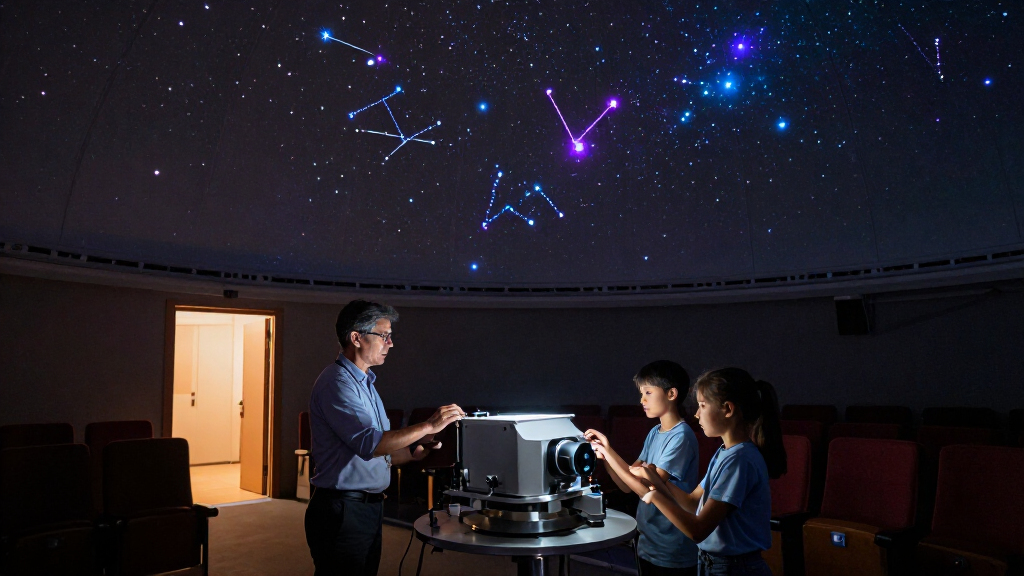
I ranked these astronomy planetarium projectors by how clearly their formats serve different buyer goals: projecting celestial subjects, creating a flexible starry atmosphere, or adding a bedtime sound-and-light setup. I weighed stated projection media and scene variety, rotation and aiming controls, power and timer details, and the practical role of extras such as apps, speakers, and white noise. A larger slide count can add choice, but it does not automatically mean better astronomy content, so I treated subject matter and usability as separate factors.
The ranking gives priority to products whose described format and controls provide a clear reason to choose them for a planetarium-style display, then distinguishes ambient-light and sleep-oriented alternatives by their strengths. Models with similar names or repeated configurations are not treated as automatically superior; buyers should verify the exact included discs, controls, and power setup for the listing they select. Since the available product information does not provide directly comparable brightness, focus, or projection-accuracy measurements, I do not claim one model produces the sharpest or most realistic sky.
Factors to Consider When Choosing Astronomy Planetarium Projectors
Before choosing, decide what you want the projector to do: show celestial scenes, wash a room in moving light, or support a bedtime routine. That single choice helps filter out extras that sound appealing but may not improve the experience you care about.
Choose celestial slides or ambient effects
A disc-based projector presents a finite set of images or themes, while app-controlled and scene-based models tend to focus on changing colors and atmosphere. If you want planet, constellation, or space-themed subjects, inspect the named slides rather than relying on a large total count. A high scene count can include many variations of lighting rather than distinct astronomical subjects. Ambient effects can be more flexible for everyday room use, but they may be less suited to someone seeking a planetarium-style display. Decide which experience matters before comparing feature lists.
Check image placement and room conditions
Projection depends on where the unit can sit, how far it is from the target surface, and whether that surface is clear of bright competing light. A rotating head or adjustable angle can help aim an image without moving the entire projector, but rotation alone does not tell you how much of a ceiling or wall it can cover. Before buying, check the listing for projection distance, focus adjustment, and recommended room conditions. Treat claims about a large display area cautiously when no distance or setup guidance is given. A dark, uncluttered room usually makes subtle star projections easier to see.
Match the controls to your routine
Think about whether you will adjust the projector once or change settings often. A remote or app can be useful when the unit sits across the room, while a simple knob may be quicker for straightforward aiming or brightness changes. Timers can prevent a light from running all night, but check whether they shut off the projection, audio, or both. App features can add flexibility and setup steps, so they are not automatically an upgrade for every household. If the projector is for a child’s room or shared space, simple controls may be more useful than a long menu of modes.
Separate astronomy features from sleep extras
Speakers, soothing sounds, and white noise can make a projector serve as part of a bedtime setup, yet they do not improve the astronomical content of its slides. If audio matters, check how it connects and whether the sound feature can run independently from the light. Buyers who mainly want to learn or display celestial subjects may get more value from useful slides and easy aiming than from bundled sounds. Those who want one device for nighttime ambience may welcome the combination. Avoid choosing by the number of bundled functions alone; consider which ones you will actually use.
Verify the exact discs, power, and package
Similar product names can describe different bundles, and repeated models may appear with varying included media. Confirm the exact number and subjects of discs, whether they can be swapped, and what accessories come in the box. Rechargeable power can make placement easier, while a corded setup may be simpler for a projector that stays in one spot; check the stated power arrangement rather than inferring it from photos. Also confirm whether batteries, adapters, or other needed items are included. These details often separate two listings that otherwise sound nearly identical.
Frequently Asked Questions
Are astronomy planetarium projectors suitable for learning about the real night sky?
They can make celestial themes easier to explore visually, but a decorative projector should not automatically be treated as an accurate sky simulator. Check whether the included slides name specific stars, constellations, or planets and whether the manufacturer describes them as educational or atmospheric. A changing galaxy effect may look appealing without showing the sky in a scientifically useful way. For structured learning, pair a projector with a star chart or astronomy reference. That gives you a way to check what a projection represents.
Should I choose a model with more discs or one with app and scene controls?
Choose more discs when you want a library of themed images and prefer selecting a slide over adjusting effects in an app. Choose app or scene controls when changing colors, movement, and room ambience matters more than swapping specific celestial subjects. Counts are not directly comparable: discs may contain different space themes, while scene totals can include lighting variations. Read the included subject list and control details before deciding. The better fit depends on whether variety means more astronomy topics or more ways to change the room’s look.
Can I use a planetarium projector in a bedroom with some light on?
It depends on the projection style and how much ambient light reaches the wall or ceiling. Dimmer star and disc images are generally easier to see in a darker space, while colorful room-light effects may remain noticeable under more varied conditions. Product descriptions do not always provide comparable brightness measurements, so a promise of vivid projection is not enough to predict performance in your room. Consider whether you can turn off nearby lamps and aim the projector at a relatively clear surface. If you need a night light as well as a sky effect, check for separate light controls.
Do rotating projectors need to run continuously to create a good display?
No, rotation is a movement feature rather than a requirement for projecting a visible image. A stationary display may suit someone who wants a calmer scene, while motion can make the room feel more atmospheric. Check whether rotation can be turned off or adjusted, since product descriptions may not make the control behavior clear. Timers are useful if you want the projector to stop after a set period, but confirm what the timer controls. Think about your intended use—viewing, background ambience, or sleep—before treating movement as a must-have.
What should I check when two listings have nearly the same projector name?
Compare the exact model name, included disc or slide count, control method, power source, and accessories. This roundup includes repeated FlyLily 13-in-1 listings, so a shared name does not prove that every bundle or listing is identical. Look for whether a remote, adapter, rechargeable battery, or specific sound features are actually included. Product images and short titles can leave out package differences. Use the full specifications and included-items list for the specific listing you plan to buy.
Conclusion
For the clearest all-around case among these options, I’d start with the Galaxy Projector Pro with 25 Planetarium Discs: its larger stated disc selection gives it a distinctive range of themed projections. For a more astronomy-oriented direction, compare it with the Thames & Kosmos Planetarium Projector and check the subject matter that fits your needs. The 13-in-1 models are the value-minded route when their included slides cover what you want; the 3D Galaxy Projector with app control or Govee Galaxy Light Star Projector 2 Pro better suit buyers who prioritize customizable ambience. Beginners may prefer a straightforward disc model with simple aiming, while sound-focused bedtime buyers should look at the white-noise and soothing-sound options. Before choosing, verify the exact package and prioritize the feature you will use most: celestial subjects, flexible lighting, or bedtime convenience.