A heavy-duty video tripod needs to support your full camera setup while keeping pans and tilts controlled. My best overall pick is the COMAN FF16LS, which pairs a fluid head with a stated 22-pound load capacity; the SmallRig AD-01S stands out as a straightforward tall aluminum option, while the SIRUI AM-25S is worth a closer look for buyers prioritizing a more robust support system. The main tradeoffs are load capacity and rigidity versus packed weight, setup speed, and cost. Maximum height alone does not tell you how stable a tripod will feel with a long lens or accessories attached. Read on for the full breakdown, selection criteria, and advice on matching a tripod to your rig.

Prime made for students and young adults
- Fast, free delivery for dorm and study essentials
- Prime Video and Amazon Music included
- Member-only deals
Key Takeaways
- COMAN FF16LS leads for stated capacity: Its 22-pound rating gives buyers a concrete starting point for comparing support, though the complete rig still needs to stay within the head and tripod limits.
- Many picks cluster around 74 inches: The COMAN, SmallRig AD-01 and AD-01S, CAMBOFOTO TA60, and NEEWER TP74 offer similar maximum-height territory, so head movement, setup, and packed size may matter more than a few inches.
- Taller models serve specific framing needs: The Mactrem 82-Inch, NEEWER 79-Inch, and K&F Concept 80-Inch can help when shooting above crowds or obstacles, but maximum height alone does not indicate rigidity.
- SmallRig has options at several levels: The AD-01, AD-01S, AD-14, and carbon-fiber AD-100 FreeBlazer address different rigs and portability priorities; compare their included heads and full-system specifications before choosing by brand alone.
- Camera and phone compatibility is not the same as video support: The VICTIV and JOILCAN listings emphasize camera or phone versatility, while dedicated video tripod options foreground fluid heads; buyers planning frequent pans should check head design and load limits.
| COMAN FF16LS Heavy-Duty Video Tripod with Q6 Fluid Head, 74-Inch, 22 lb Load Capacity |  | Best for Heavier Camera Rigs | Material: Aluminum alloy | Maximum load capacity: 22.04 lb (10 kg) | Maximum height: 74 in | VIEW ON AMAZON | See Our Full Breakdown |
| SmallRig AD-01S Heavy-Duty Video Tripod with Fluid Head, 73.6 in / 187 cm |  | Best for Mixed Terrain and Plate Compatibility | Material: Aluminum alloy | Adjustable height: 85–187 cm (34–74 in) | Fluid head load capacity: 6 kg (13.2 lb) | VIEW ON AMAZON | See Our Full Breakdown |
| VICTIV 75-Inch Camera Tripod with Carrying Bag |  | Best for Camera and Phone Content | Height range: 21.65–75 inches | Mount: Standard 1/4-inch screw | Horizontal movement: 360° | VIEW ON AMAZON | See Our Full Breakdown |
| Cayer BV30L Video Tripod with K3 Fluid Head |  | Best for a Stable Two-Stage Setup | Material: Aluminum | Maximum load: 13.2 lb | Height range: 33.4–72.5 in | VIEW ON AMAZON | See Our Full Breakdown |
| NEEWER 79 in (200 cm) Heavy-Duty Aluminum Video Tripod with Fluid Head | 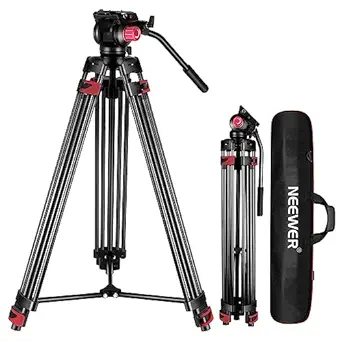 | Best for Extra Height | Material: Aluminum alloy | Maximum height: 78.7 in (200 cm) | Minimum height: 34.6 in (88 cm) | VIEW ON AMAZON | See Our Full Breakdown |
| JOILCAN 74-Inch Camera and Phone Tripod |  | Best for Lightweight Camera and Phone Setups | Maximum height: 74 inches | Minimum height: 19 inches | Folded length: 18 inches with pan head removed | VIEW ON AMAZON | See Our Full Breakdown |
| SmallRig AD-01 Heavy-Duty Video Tripod with Fluid Head, 73.2 in / 186 cm |  | Best for Gimbal and Tripod Switching | Material: Aluminum alloy | Height range: 85–186 cm (33–73 in) | Maximum load: 8 kg (17 lb) | VIEW ON AMAZON | See Our Full Breakdown |
| CAMBOFOTO TA60 74-Inch Heavy-Duty Video Tripod with Fluid Head |  | Best for Uneven Terrain | Maximum height: 74 inches | Minimum height: 36 inches | Load capacity: 20 lb | VIEW ON AMAZON | See Our Full Breakdown |
| NEEWER TP74 74-Inch Aluminum Video Tripod with Fluid Head |  | Best for Plate Compatibility | Material: Aluminum alloy | Height range: 34–74 inches (86–187 cm) | Folded length: 36 inches (91 cm) | VIEW ON AMAZON | See Our Full Breakdown |
| SIRUI AM-25S Heavy-Duty Video Tripod with Fluid Head, 74.8 in |  | Best for Heavier Camera Rigs | Material: Aluminum alloy | Maximum load: 22 lb (10 kg) | Height range: 36.06–74.8 inches (91–190 cm) | VIEW ON AMAZON | See Our Full Breakdown |
| Mactrem 82-Inch Heavy-Duty Video Tripod with Fluid Head |  | Best for Heavy Camera Rigs | Material: Aluminum alloy | Maximum height: 82 in (210 cm) | Weight: 9.8 lb (4.45 kg) | VIEW ON AMAZON | See Our Full Breakdown |
| NEEWER TP75 Video Tripod with Adjustable Fluid Head |  | Best for Gimbal Switching | Model: TP75 | Material: Aluminum alloy | Height range: 35–74 in (89–189 cm) | VIEW ON AMAZON | See Our Full Breakdown |
| K&F Concept 80-Inch Video Tripod with Fluid Head |  | Best for Compact Storage | Material: Aluminum alloy | Maximum load capacity: 17.6 lb | Height range: 34.6–79.5 in | VIEW ON AMAZON | See Our Full Breakdown |
| SMALLRIG AD-14 Heavy-Duty Aluminum Video Tripod with Fluid Head, 186 cm |  | Best for Lighter Field Kits | Model: AD-14 (5440) | Material: Aluminum alloy | Maximum load: 8 kg (18 lb) | VIEW ON AMAZON | See Our Full Breakdown |
| SmallRig AD-100 FreeBlazer Heavy-Duty Carbon Fiber Tripod System, 78-Inch |  | Best for Fast Carbon-Fiber Setup | Material: Carbon fiber | Height range: 37–78 in (94–197 cm) | Folded length: 39 in (99 cm) | VIEW ON AMAZON | See Our Full Breakdown |
| video tripod heavy duty | Material | Height range |
|---|---|---|
| COMAN FF16LS Heavy-Duty Video | Aluminum alloy | — |
| SmallRig AD-01S Heavy-Duty Vid | Aluminum alloy | — |
| VICTIV 75-Inch Camera Tripod w | — | 21.65–75 inches |
| Cayer BV30L Video Tripod with | Aluminum | 33.4–72.5 in |
| NEEWER 79 in | Aluminum alloy | — |
| JOILCAN 74-Inch Camera and Pho | — | — |
| SmallRig AD-01 Heavy-Duty Vide | Aluminum alloy | 85–186 cm (33–73 in) |
| CAMBOFOTO TA60 74-Inch Heavy-D | — | — |
| NEEWER TP74 74-Inch Aluminum V | Aluminum alloy | 34–74 inches (86–187 cm) |
| SIRUI AM-25S Heavy-Duty Video | Aluminum alloy | 36.06–74.8 inches (91–190 cm) |
| Mactrem 82-Inch Heavy-Duty Vid | Aluminum alloy | — |
| NEEWER TP75 Video Tripod with | Aluminum alloy | 35–74 in (89–189 cm) |
| K&F Concept 80-Inch Video Trip | Aluminum alloy | 34.6–79.5 in |
| SMALLRIG AD-14 Heavy-Duty Alum | Aluminum alloy | 33–73 in (85–186 cm) |
| SmallRig AD-100 FreeBlazer Hea | Carbon fiber | 37–78 in (94–197 cm) |
More Details on Our Top Picks
COMAN FF16LS Heavy-Duty Video Tripod with Q6 Fluid Head, 74-Inch, 22 lb Load Capacity
I’d put the COMAN FF16LS first for buyers whose camera setup needs more support than the lighter-duty options here. Its 22.04 lb load capacity is the highest specified in this batch, giving it more headroom than the NEEWER TP-M200 at 17.6 lb or the Cayer BV30L at 13.2 lb. The 60 mm bowl, mid-level spreader, and flip locks suit a stable, quick-to-adjust studio or location setup, while the Q6 head’s full pan and broad tilt range accommodate varied framing. A safety-button quick-release plate adds reassurance when swapping equipment. The tradeoff is portability: its robust aluminum construction is less appealing for long walks than a lighter kit, and its 74-inch maximum height falls just short of the NEEWER’s 78.7 inches.
Pros:- Highest stated load capacity among these five options at 22.04 lb
- Q6 fluid head offers 360° panning and -75° to +90° tilt
- Safety-button quick-release plate helps guard against accidental release
- Flip locks and mid-level spreader support quick setup and stable legs
Cons:- Robust construction may be inconvenient to carry over long distances
- 74-inch maximum height is lower than the NEEWER TP-M200’s 78.7 inches
Best for: Videographers using heavier camera-and-lens rigs who want substantial stated load capacity and fast leg adjustments
Not ideal for: Traveling creators who prioritize a lightweight carry, or shooters who need the greatest maximum height
- Material:Aluminum alloy
- Maximum load capacity:22.04 lb (10 kg)
- Maximum height:74 in
- Fluid head:Q6
- Pan range:360°
- Tilt range:-75° to +90°
- Bowl diameter:60 mm
- Quick-release screws:1/4 in and 3/8 in
Our verdict“Choose the COMAN FF16LS if your heavier rig needs more stated load capacity than the other tripods in this batch.”
SmallRig AD-01S Heavy-Duty Video Tripod with Fluid Head, 73.6 in / 187 cm
The AD-01S earns a distinct spot for videographers who move between different ground surfaces and camera support systems. Its switchable spiked feet can help on softer terrain, while the 75 mm bowl and bubble level make leveling the head more straightforward. The head accepts DJI RS Series and 501PL plates, a useful fit for crews who already own compatible gear. Compared with the COMAN FF16LS, though, the AD-01S has a much lower stated head capacity: 6 kg versus 10 kg. Its counterbalance is also specified only up to 4 kg at a 55 mm center-of-gravity height, so rig balance matters. This is a practical system for moderate setups, but I’d choose the COMAN for heavier payloads and the NEEWER TP-M200 for a taller maximum reach.
Pros:- Switchable spiked feet suit a wider range of shooting surfaces
- Compatible with DJI RS Series and 501PL plates
- 75 mm bowl and bubble level aid leveling
- Includes a storage bag, pan bar, and built-in wrench
Cons:- 6 kg fluid-head capacity is well below the COMAN FF16LS’s 10 kg rating
- Counterbalance limit depends on the specified 55 mm center-of-gravity height
Best for: Small production crews using compatible DJI RS or 501PL plates who shoot across floors, dirt, or other varied surfaces
Not ideal for: Operators with rigs above 6 kg or setups that need counterbalance beyond the stated 4 kg conditions
- Material:Aluminum alloy
- Adjustable height:85–187 cm (34–74 in)
- Fluid head load capacity:6 kg (13.2 lb)
- Counterbalance capacity:Up to 4 kg at a 55 mm center-of-gravity height
- Bowl diameter:75 mm
- Tilt range:+90°/-75°
- Pan:360°
- Quick-release compatibility:DJI RS Series and 501PL
Our verdict“Pick the AD-01S if compatible plates and adaptable feet matter more than maximum payload capacity.”
VICTIV 75-Inch Camera Tripod with Carrying Bag
The VICTIV is the most flexible pick here for creators who want one tripod to handle a camera and a phone. Its included universal phone holder, remote, handle, and spare quick-release plate make it a ready-to-go kit, and the head supports horizontal, tilt, and portrait positioning. At up to 75 inches, it reaches slightly higher than the COMAN FF16LS, though the COMAN is the clearer choice for heavy video rigs because it specifies a 22.04 lb capacity and a dedicated Q6 fluid head. VICTIV provides no stated load capacity or tripod weight, which makes it harder to judge for larger cameras or demanding video work. I’d treat it as a versatile creator setup rather than a confirmed heavy-duty support system; that uncertainty is its main tradeoff.
Pros:- Included phone holder supports smartphone use alongside camera mounting
- Head offers 360° horizontal movement, 180° tilt, and portrait positioning
- Extends to 75 inches
- Includes a carrying bag, remote, handle, and spare QR plate
Cons:- No load capacity is specified, limiting confidence for heavier rigs
- No tripod weight is provided to help buyers judge carrying effort
Best for: Phone-and-camera creators who want included accessories for casual indoor and outdoor shooting
Not ideal for: Videographers with heavy camera rigs who need a published load limit to confirm safe support
- Height range:21.65–75 inches
- Mount:Standard 1/4-inch screw
- Horizontal movement:360°
- Tilt:180°
- Portrait positioning:90°
- Included accessories:Carrying bag, handle, universal phone holder, remote, spare QR plate, 3 non-slip pads
- Color:Black
Our verdict“Choose the VICTIV for an accessory-rich phone-and-camera kit, but look to the COMAN FF16LS for a specified heavy-rig capacity.”
Cayer BV30L Video Tripod with K3 Fluid Head
The Cayer BV30L is a grounded choice for video work where stable twin-tube legs and a spreader matter more than maximum payload. The mid-level spreader helps brace the two-stage aluminum legs, and its 75 mm flat-base head pans 360° with tilt from -70° to +90°. It carries up to 13.2 lb, placing it below the NEEWER TP-M200 at 17.6 lb and well below the COMAN FF16LS at 22.04 lb. That makes the BV30L a better fit for moderate camera builds than heavy cinema rigs. It also includes two quick-release plates, which can reduce interruptions when changing supported cameras. The cost of this stable setup is bulk: it folds to 35 inches, so the NEEWER’s similar folded length does not give it a portability advantage, and its capacity remains limited.
Pros:- Twin-tube aluminum legs and mid-level spreader support a braced setup
- 75 mm flat-base fluid head pans 360° and tilts -70° to +90°
- Includes two quick-release plates with 1/4-20 and 3/8-16 screws
- Two-year warranty is specified
Cons:- 13.2 lb capacity is lower than the NEEWER TP-M200 and COMAN FF16LS
- 35-inch folded length takes up substantial storage space
Best for: Videographers with moderate camera builds who value braced twin-tube legs and spare quick-release plates
Not ideal for: Operators with heavy cinema rigs or anyone who needs a compact tripod for frequent travel
- Material:Aluminum
- Maximum load:13.2 lb
- Height range:33.4–72.5 in
- Folded length:35 in
- Fluid head base:75 mm flat base
- Pan:360°
- Tilt:-70° to +90°
- Quick-release plates:2, with 1/4-20 and 3/8-16 screws
Our verdict“The BV30L suits moderate rigs that benefit from braced legs and an extra plate, while heavier setups call for the COMAN.”
NEEWER 79 in (200 cm) Heavy-Duty Aluminum Video Tripod with Fluid Head
The NEEWER TP-M200 is the tallest option in this batch, reaching 78.7 inches while still folding to 35.8 inches and including a carrying bag. That added reach can help when framing over people or working from a higher camera position. Its 17.6 lb capacity gives it more room than the Cayer BV30L’s 13.2 lb rating, though the COMAN FF16LS remains the stronger match for heavier rigs at 22.04 lb. The fluid head supports full panning and a broad tilt range, and rubber feet plus a bubble level help with setup on hard surfaces. The main compromise is that it is not the load leader, and its 35.8-inch folded length still calls for meaningful storage space. I’d favor it when height matters more than maximum payload.
Pros:- 78.7-inch maximum height is the tallest among these five products
- 17.6 lb capacity exceeds the Cayer BV30L’s 13.2 lb rating
- Fluid head provides 360° pan and -70° to +90° tilt
- Includes a carrying bag, bubble level, and rubber feet
Cons:- Load capacity is below the COMAN FF16LS’s 22.04 lb rating
- 35.8-inch folded length remains relatively long for transport
Best for: Videographers who need extra camera height for elevated framing and use rigs within the 17.6 lb limit
Not ideal for: Heavy-rig operators who need more load headroom, or travelers seeking a short-folding support
- Material:Aluminum alloy
- Maximum height:78.7 in (200 cm)
- Minimum height:34.6 in (88 cm)
- Folded length:35.8 in (91 cm)
- Maximum load capacity:17.6 lb (8 kg)
- Head movement:360° pan; -70° to 90° tilt
- Quick-release plate screws:1/4 in and 3/8 in
- Warranty:1 year
Our verdict“Choose the TP-M200 when maximum working height is the priority and your rig stays within its 17.6 lb capacity.”
JOILCAN 74-Inch Camera and Phone Tripod
The JOILCAN is the most portable choice here for buyers who need a tall stand for a camera or phone but do not need a dedicated fluid video head. Its 15 lb stated capacity is below the CAMBOFOTO TA60 and SIRUI AM-25S, so I’d reserve it for lighter kits rather than heavier cinema rigs. The included phone mount, two quick-release plates, and 3-way head make it more adaptable for mixed shooting than those video-first alternatives. A stability hook and non-slip feet help on uneven ground, though they do not replace the wider, heavier support of the TA60. At 3.15 lb, it is easier to carry than the specialist tripods, but that weight still may feel substantial on long walks, and the head must be removed to reach its stated 18-inch folded length.
Pros:- Extends from 19 to 74 inches for low and elevated framing
- Includes a phone mount and two quick-release plates
- Stability hook and non-slip feet support steadier placement
- At 3.15 lb, it is lighter than the dedicated heavy-duty video options here
Cons:- The 15 lb stated capacity is lower than the CAMBOFOTO TA60 and SIRUI AM-25S
- A 3-way head is not a fluid head for controlled video pans
- The head must be removed to reach the stated 18-inch folded length
Best for: Traveling creators who switch between a phone and a lightweight camera and want a tall, versatile tripod.
Not ideal for: Videographers using heavier rigs or needing fluid camera movement; its listed 15 lb capacity and 3-way head are less suited to that work.
- Maximum height:74 inches
- Minimum height:19 inches
- Folded length:18 inches with pan head removed
- Weight:3.15 lb
- Maximum load:15 lb
- Head:3-way pan head with 360° rotation
- Mount:Standard 1/4-inch screw
- Warranty:2 years
Our verdict“Choose the JOILCAN for a portable, phone-ready tripod with broad height adjustment, provided your camera kit is light and fluid video movement is not a priority.”
SmallRig AD-01 Heavy-Duty Video Tripod with Fluid Head, 73.2 in / 186 cm
The SmallRig AD-01 suits operators who want a video tripod that can work with compatible DJI gimbals as well as conventional camera plates. Its dual-mode quick-release mount is the main distinction from the CAMBOFOTO TA60, whose supplied data describes quick-release plates but not the same gimbal compatibility. The AD-01 supports up to 8 kg and reaches 186 cm, giving it a useful working range for a substantial but not exceptionally heavy camera package. Its 75 mm bowl and fluid head support controlled framing adjustments, while the carrying bag helps with transport. Compared with the lighter JOILCAN, this is a more video-focused platform, but its heavy-duty build is less convenient to carry, and the compatibility details supplied are limited to select DJI models.
Pros:- Supports loads up to 8 kg (17 lb)
- Fluid head provides 360° horizontal and +90°/-60° vertical movement
- Dual-mode quick-release mount includes compatibility with select DJI RS gimbals
- 75 mm bowl and carrying bag are included
Cons:- Heavy-duty aluminum construction is less convenient to carry than the JOILCAN
- Quick-release compatibility information is limited
- The listed vertical movement does not cover as wide a range as the NEEWER TP74
Best for: Video operators who move a compatible DJI RS gimbal setup between a gimbal and a 75 mm bowl tripod.
Not ideal for: Travelers prioritizing low carry weight or buyers who need clearly documented compatibility across a broad range of plates and gimbals.
- Material:Aluminum alloy
- Height range:85–186 cm (33–73 in)
- Maximum load:8 kg (17 lb)
- Fluid head movement:360° horizontal; +90°/-60° vertical
- Bowl diameter:75 mm
- Quick-release:Dual mode, including DJI RS 2, RS 3, and RS 3 Pro compatibility
- Included accessories:Carrying bag, 1/4-20 screw, 3/8-16 screw, and user manual
Our verdict“Pick the AD-01 if you need a sturdy video platform with select DJI gimbal compatibility and can accept the carrying burden and limited compatibility detail.”
CAMBOFOTO TA60 74-Inch Heavy-Duty Video Tripod with Fluid Head
For outdoor video work, the CAMBOFOTO TA60 puts stability and load capacity ahead of easy transport. Its 20 lb capacity exceeds the SmallRig AD-01 and NEEWER TP74, leaving more room for a heavier camera and accessories, while rubber pads and ball pins are designed to grip soft or uneven ground. The hydraulic head pans 360° and tilts from -70° to 90°, with 30° bowl adjustment to help level the camera without repositioning every leg. That terrain-ready setup comes at a clear cost: at 9.1 lb, the TA60 is much heavier than the JOILCAN, and its 36-inch minimum height limits low-angle shots compared with the JOILCAN’s 19-inch minimum. I’d favor it for a field location where load support matters more than a light pack.
Pros:- 20 lb load capacity exceeds the SmallRig AD-01 and NEEWER TP74
- Hydraulic fluid head supports 360° panning and -70° to 90° tilt
- 30° bowl adjustment helps level the head on sloped ground
- Rubber pads and ball pins suit soft and uneven terrain
Cons:- At 9.1 lb, it is substantially heavier than the JOILCAN
- 36-inch minimum height restricts low-angle framing
- The added load capacity and terrain features make it less appealing for frequent carry
Best for: Field videographers who use heavier camera builds and set up on grass, soft ground, or uneven outdoor locations.
Not ideal for: Travel creators who carry gear over long distances or need very low camera angles; it weighs 9.1 lb and starts at 36 inches.
- Maximum height:74 inches
- Minimum height:36 inches
- Load capacity:20 lb
- Weight:9.1 lb
- Head type:Hydraulic fluid head
- Head movement:360° pan; -70° to 90° tilt
- Bowl adjustment:30°
- Mounting screws:3/8-inch and 1/4-inch
Our verdict“Choose the TA60 for heavier outdoor video setups that need terrain-gripping feet and bowl leveling, and skip it if low weight or low shooting height matters more.”
NEEWER TP74 74-Inch Aluminum Video Tripod with Fluid Head
The NEEWER TP74 stands out for buyers who need a fluid-head tripod that works with both listed Manfrotto plates and compatible DJI RS gimbals. That dual quick-release compatibility gives it a broader documented handoff between setups than the SmallRig AD-01, whose supplied compatibility details name DJI models but provide less plate information. Its 8 kg capacity matches the AD-01, while tandem legs, a mid-level spreader, and non-slip feet help keep the platform supported. The head offers a broad -75° to +90° tilt range, and the 34-inch minimum height is slightly lower than the AD-01’s 33-inch figure only when using different units as listed; practically, their ranges are close. At 36 inches folded, it is manageable for a video tripod but nowhere near the JOILCAN’s compact stated length.
Pros:- Quick-release modes support listed DJI RS and Manfrotto plate systems
- Fluid head tilts from -75° to +90° and pans 360°
- Tandem legs, a mid-level spreader, and non-slip feet support stable placement
- Adjusts from 34 to 74 inches
Cons:- 8 kg (17.6 lb) capacity is below the CAMBOFOTO TA60 and SIRUI AM-25S
- 36-inch folded length is much longer than the JOILCAN’s stated 18 inches
- Flip-lock tension may need adjustment with the included hex keys
Best for: Videographers who alternate between compatible DJI RS gimbals and Manfrotto 501PL or 504PL plate setups.
Not ideal for: People needing a very compact travel tripod or carrying a rig heavier than the 8 kg capacity.
- Material:Aluminum alloy
- Height range:34–74 inches (86–187 cm)
- Folded length:36 inches (91 cm)
- Maximum load:17.6 lb (8 kg)
- Head movement:360° pan; -75° to +90° tilt
- Bowl base diameter:75 mm
- Mounting screws:1/4-inch and 3/8-inch
- Quick-release compatibility:DJI RS2, RS3, RS3 Pro; Manfrotto 501PL and 504PL
Our verdict“Pick the TP74 when documented DJI and Manfrotto plate compatibility matters more than maximum load or compact packing.”
SIRUI AM-25S Heavy-Duty Video Tripod with Fluid Head, 74.8 in
The SIRUI AM-25S is the strongest fit in this group for buyers whose camera build pushes beyond the 8 kg limit of the SmallRig AD-01 and NEEWER TP74. Its 22 lb capacity gives it a modest but useful advantage over the CAMBOFOTO TA60’s 20 lb rating, while the fluid head, 75 mm bowl, and built-in bubble level support controlled framing and leveling. Retractable metal spikes can bite into suitable ground, and rubber feet offer a more floor-friendly option, making it adaptable across locations. The tradeoff is that the aluminum build may be heavier than lighter alternatives, and no weight or folded length is provided in the supplied specifications. Compared with the TA60, the SIRUI’s higher stated load capacity is appealing, but its transport burden is harder to judge before purchase.
Pros:- 22 lb capacity is the highest listed among these five products
- Fluid head pans 360° and tilts from -75° to +90°
- Retractable spikes and rubber feet adapt to different surfaces
- Built-in bubble level and 75 mm bowl aid leveling
Cons:- Aluminum construction may be heavier to carry than lighter tripod designs
- Weight and folded length are not specified
- Its 36.06-inch minimum height does not suit very low-angle shooting
Best for: Videographers with camera rigs near the 20 lb range who need a fluid head and feet suited to both hard and soft surfaces.
Not ideal for: Travelers who need a known pack weight or folded length before choosing a tripod, or creators with lightweight phone and camera setups.
- Material:Aluminum alloy
- Maximum load:22 lb (10 kg)
- Height range:36.06–74.8 inches (91–190 cm)
- Leg sections:3
- Fluid head movement:360° horizontal; -75° to +90° vertical
- Bowl diameter:75 mm
- Mounting screws:1/4-inch and 3/8-inch
- Feet and level:Retractable metal spikes, rubber feet, built-in bubble level
Our verdict“Choose the AM-25S for a heavier video rig that benefits from a 22 lb rating and adaptable feet, provided its unspecified carry weight and folded length fit your plans.”
Mactrem 82-Inch Heavy-Duty Video Tripod with Fluid Head
The Mactrem has the highest stated payload in this group at 33 lb, giving larger camcorders and accessorized camera rigs more headroom than the NEEWER TP75 or SmallRig AD-100, each rated for 22 lb. Its fluid head supports 360° pans, broad tilt movement, and adjustable drag, so it suits controlled moves with heavier setups. The reversible handle is useful when the camera position or operator stance changes. At 82 inches, it also reaches higher than those two alternatives. The tradeoff is a 9.8 lb aluminum build, and the supplied details do not list a folded length. Buyers who need a known compact pack size or prioritize lower carry weight may prefer the SMALLRIG AD-14, though its stated payload is much lower.
Pros:- 33 lb stated load capacity suits heavier camera setups
- Fluid head offers 360° panning, broad tilt, and adjustable drag
- Reversible pan handle accommodates different operating positions
- Carrying bag is included
Cons:- At 9.8 lb, it adds noticeable weight to a mobile kit
- Folded length is not specified in the supplied product data
Best for: Camcorder operators and filmmakers with heavier camera rigs who need a high stated payload and extended working height.
Not ideal for: Traveling shooters who need a specified folded length or want to keep carried tripod weight low.
- Material:Aluminum alloy
- Maximum height:82 in (210 cm)
- Weight:9.8 lb (4.45 kg)
- Load capacity:33 lb (15 kg)
- Pan rotation:360°
- Tilt range:+90°/-70°
- Quick-release plate screws:1/4-20 and 3/8-16
- Package includes:Tripod, carrying bag, 3/8-16 screw, user manual
Our verdict“Choose the Mactrem for heavier rigs that benefit from its 33 lb capacity and 82-inch reach, provided its weight and unspecified folded length fit your setup.”
NEEWER TP75 Video Tripod with Adjustable Fluid Head
The TP75 is the clearest fit here for operators who move between a tripod and a compatible DJI gimbal. Its dual-mode quick-release plate supports the listed RS2, RS3, RS3 Pro, RS4, and RS4 Pro models, which can reduce re-rigging between setups. Separate pan and tilt drag controls let the operator tune movement, while the 35–74 inch height range covers varied shooting positions. Compared with the SmallRig AD-100, it has a lower maximum height but weighs less according to the supplied data, making it the more practical pick for buyers who value compatibility over reach. Its 22 lb capacity is substantial for many kits, but it trails the Mactrem’s 33 lb rating, and the specified gimbal compatibility does not include the RS5.
Pros:- Dual-mode plate supports the listed DJI RS2, RS3, and RS4 gimbals
- Separate adjustable drag controls for pan and tilt
- Height adjusts from 35 to 74 inches
- Bubble level, anti-slip feet, and carrying bag are included
Cons:- 22 lb maximum load is below the Mactrem’s 33 lb rating
- Specified gimbal compatibility does not include DJI RS5
Best for: Video operators using a listed DJI RS gimbal who want to switch between stabilized and tripod shooting with less plate swapping.
Not ideal for: Owners of DJI RS5 gimbals or users with rigs near or above its 22 lb maximum load.
- Model:TP75
- Material:Aluminum alloy
- Height range:35–74 in (89–189 cm)
- Maximum load:22 lb (10 kg)
- Pan:360°
- Tilt:+90°/-75°
- Quick-release compatibility:DJI RS2, RS3, RS3 Pro, RS4, RS4 Pro
- Warranty:1 year
Our verdict“Pick the TP75 if switching between a compatible DJI RS gimbal and tripod matters more than maximum payload or extra height.”
K&F Concept 80-Inch Video Tripod with Fluid Head
The K&F Concept stands out for giving buyers a stated pack length: it folds to 36.2 inches, useful when storage space or transport dimensions matter. Its legs extend to 79.5 inches, close to the SmallRig AD-100’s 78-inch maximum, while folding shorter than that model’s listed 39 inches. The tradeoff is a 17.6 lb load limit, below both the AD-100 and NEEWER TP75 at 22 lb, so this is better matched to a moderate camera setup than a heavily accessorized rig. The fluid head pans 360° and tilts through a broad range; the detachable handle and standard 1/4-inch and 3/8-16 plate screws add setup flexibility. Buyers prioritizing payload should look to the Mactrem instead, but will carry a heavier tripod.
Pros:- Folds to a specified 36.2 inches for storage and transport
- Extends to 79.5 inches
- Fluid head supports 360° pan and -70° to +90° tilt
- Plate accepts 1/4-inch and 3/8-16 screws
Cons:- 17.6 lb maximum load is lower than the 22 lb NEEWER TP75 and SmallRig AD-100
- Aluminum construction may be less appealing to buyers seeking a lighter material
Best for: DSLR and camcorder shooters with moderate-weight kits who need a long-reaching tripod with a known folded length.
Not ideal for: Operators with heavy cinema rigs or accessories that could push the setup beyond 17.6 lb.
- Material:Aluminum alloy
- Maximum load capacity:17.6 lb
- Height range:34.6–79.5 in
- Folded length:36.2 in
- Leg sections:3
- Pan:360°
- Tilt:-70° to +90°
- Quick-release plate screws:1/4 in and 3/8-16
Our verdict“Choose the K&F Concept when a known folded length and tall working height matter more than carrying a rig above 17.6 lb.”
SMALLRIG AD-14 Heavy-Duty Aluminum Video Tripod with Fluid Head, 186 cm
At 6.8 lb, the AD-14 is the lightest option among these five with a stated tripod weight, making it easier to move between locations than the 9.8 lb Mactrem or 11 lb SmallRig AD-100. It still supports up to 18 lb and reaches 73 inches, a sensible fit for a compact camera or camcorder kit rather than a heavy cinema build. Its fluid head has adjustable tilt drag and fits Manfrotto 501PL plates, while two 1/4-20 accessory mounts give room for add-ons. The included phone clamp is useful for monitoring or a secondary device. Compared with the NEEWER TP75, the AD-14 carries less, but its stated folded height of 34 inches makes its transport dimensions easier to plan around.
Pros:- 6.8 lb tripod weight is lower than the Mactrem and SmallRig AD-100
- Folds to a specified 34 inches
- Fluid head has adjustable tilt drag and fits Manfrotto 501PL plates
- Includes a phone clamp and two 1/4-20 accessory mounts
Cons:- 18 lb maximum load is below the NEEWER TP75 and SmallRig AD-100
- Maximum height of 73 inches is less than the Mactrem and K&F Concept
Best for: Location shooters with a lighter camera kit who want a manageable carry weight, a stated folded size, and accessory mounting points.
Not ideal for: Operators using heavy, fully accessorized cameras or requiring more than 18 lb capacity.
- Model:AD-14 (5440)
- Material:Aluminum alloy
- Maximum load:8 kg (18 lb)
- Tripod weight:3.1 kg (6.8 lb)
- Height range:33–73 in (85–186 cm)
- Folded height:34 in (88 cm)
- Fluid head tilt range:+85° to -78°
- Bowl mount:65 mm
Our verdict“The AD-14 suits mobile shooters with lighter rigs who value a known folded size and accessory mounts over high payload capacity.”
SmallRig AD-100 FreeBlazer Heavy-Duty Carbon Fiber Tripod System, 78-Inch
The AD-100 pairs carbon fiber legs with a one-step locking system, a combination aimed at operators who need to set up quickly and want a different material from the aluminum builds here. The leg locks make deployment straightforward, while adjustable fluid-head damping supports controlled pans and tilts. Its quick-release mount works with the listed DJI RS gimbals and an MFT plate, giving it some of the workflow flexibility found in the NEEWER TP75. The AD-100, however, is rated for 22 lb and weighs 11 lb, so carbon fiber does not make this a lightweight carry choice. Its 39-inch folded length is also longer than the K&F Concept’s 36.2 inches. It makes most sense for a fixed or vehicle-supported kit where fast setup matters more than minimizing bulk.
Pros:- One-step leg locking supports quick setup
- Carbon fiber construction
- Adjustable fluid-head damping with 360° pan
- Quick-release mount supports listed DJI RS gimbals and an MFT plate
Cons:- 11 lb weight makes it a substantial carry
- 22 lb maximum safe load is lower than the Mactrem’s 33 lb capacity
- 39-inch folded length is longer than the K&F Concept’s stated folded length
Best for: Video crews who want fast leg deployment, carbon-fiber construction, and compatibility with the listed DJI RS gimbals.
Not ideal for: Hikers and frequent travelers seeking a light, compact tripod, or users whose rig exceeds 22 lb.
- Material:Carbon fiber
- Height range:37–78 in (94–197 cm)
- Folded length:39 in (99 cm)
- Tripod weight:11 lb (5 kg)
- Maximum safe load:22 lb (10 kg)
- Pan range:360°
- Tilt range:+90°/-60°
- Bowl diameter:75 mm
Our verdict“Choose the AD-100 for quick setup and its specified gimbal plate compatibility when its 11 lb weight and 22 lb capacity suit your kit.”

How We Picked
I ranked these 15 options around what makes a tripod useful for demanding video work: support for the complete rig, a head suited to controlled pans and tilts, practical height, setup stability, and portability. Where a listing names a capacity, height, material, or included fluid head, I treated it as a comparison point rather than proof of performance; buyers should verify the manufacturer’s current specifications, including whether a load rating applies to the head, legs, or whole system.
The order favors products with clearer video-oriented specifications and a more convincing match to heavier camera setups. That puts the COMAN FF16LS first for its stated 22-pound capacity, followed by established fluid-head systems and options with distinct advantages in height or portability. General camera and phone tripods rank lower for heavy video use because broad compatibility does not establish smooth movement or dependable support under a loaded rig. I also considered who might reasonably skip each pick: a tall tripod may be cumbersome for travel, and a heavy-duty label cannot replace checking capacity, bowl or plate fit, and included accessories.
| video tripod heavy duty | Material |
|---|---|
| COMAN FF16LS Heavy-Duty Video | Aluminum alloy |
| SmallRig AD-01S Heavy-Duty Vid | Aluminum alloy |
| VICTIV 75-Inch Camera Tripod w | — |
| Cayer BV30L Video Tripod with | Aluminum |
| NEEWER 79 in | Aluminum alloy |
| JOILCAN 74-Inch Camera and Pho | — |
| SmallRig AD-01 Heavy-Duty Vide | Aluminum alloy |
| CAMBOFOTO TA60 74-Inch Heavy-D | — |
| NEEWER TP74 74-Inch Aluminum V | Aluminum alloy |
| SIRUI AM-25S Heavy-Duty Video | Aluminum alloy |
| Mactrem 82-Inch Heavy-Duty Vid | Aluminum alloy |
| NEEWER TP75 Video Tripod with | Aluminum alloy |
| K&F Concept 80-Inch Video Trip | Aluminum alloy |
| SMALLRIG AD-14 Heavy-Duty Alum | Aluminum alloy |
| SmallRig AD-100 FreeBlazer Hea | Carbon fiber |
Factors to Consider When Choosing Video Tripod Heavy Duty
Before choosing a heavy-duty video tripod, I would match the whole support system to the way I shoot. A high load figure or maximum height can look persuasive while concealing a head mismatch, awkward setup, or poor fit for travel. These checks help narrow the field before brand names or feature lists take over.
Add Up the Weight of the Complete Rig
Count the camera, lens, cage, monitor, microphone, battery, and any follow focus or matte box you plan to use together. Then compare that total with the stated limit for both the head and legs, since a system is only as capable as its weakest component. A rating close to your working load leaves less room for accessories and may make balancing harder. Keep some headroom, especially if you change lenses or build up the camera later. Check whether the maker specifies a safe working load or only a maximum static load. A tripod that carries a camera still may not control it well during a pan.
Choose a Head for the Moves You Make
A fluid head matters most when your shots include pans, tilts, or repeated reframing. Check that the head supports your camera’s weight and offers the controls you need, such as adjustable drag, a counterbalance setting, or a long pan handle. A fixed or photo-oriented head can hold a camera securely but may not produce the controlled movement you expect for video. Think about whether you regularly change between horizontal and vertical framing, and confirm how the plate attaches. Quick release is useful only if the plate is compatible with your camera cage or other support gear. For locked-off interviews, head smoothness may matter less than a firm lock and a stable base.
Treat Maximum Height as Only One Part of Stability
A tall tripod can clear an audience or let you frame over a set, but height can increase wobble when the center column or leg sections are extended. Compare the minimum working height as well, since low product shots and seated interviews may need a compact stance. Look for the stated leg-section count and whether the center column is raised in the advertised maximum. More sections can make packing easier, yet thin lower sections may feel less rigid under a heavy setup. On uneven ground, independent leg adjustment and reliable locks can matter more than extra height. Match the working height you need to how much stability you are willing to give up.
Account for Carrying, Setup, and the Shooting Location
Aluminum systems can suit studio or vehicle-based work where carrying weight is a smaller concern. Carbon fiber can reduce what you carry, but the material alone does not establish capacity or resistance to twisting; compare the full tripod and head specifications. Check folded length, total system weight, and whether the supplied bag fits the assembled head and handle. Fast-spread or one-step legs can save time between shots, though the mechanism should still lock securely. If you move between locations on foot, a taller model may become a burden before you reach the set. For permanent or semi-permanent setups, a heavier tripod may be a reasonable trade for less packing.
Check Compatibility Before You Buy
Confirm whether the tripod includes a bowl, flat base, or another mounting interface, and make sure it works with the head you plan to use. A supplied fluid head is convenient, but its plate, handle position, and adjustment range may not suit every camera cage. Phone holders and camera adapters can broaden use, though they do not replace a video head built for controlled movement. Verify that the included head is part of the stated load rating and identify any accessories sold separately. If you already own a head or quick release system, compatibility can save more trouble than a small difference in advertised height. These checks are especially useful when comparing products with similar names or versions.
Frequently Asked Questions
How much load capacity should I leave above my camera’s weight?
Start with the weight of the complete setup rather than the camera body alone, including lens, cage, monitor, microphone, and batteries. I would leave a meaningful margin so the head is not operating at its limit during movement or after an accessory change. Check the limits for the head and legs separately when the manufacturer lists them. A high static capacity does not automatically mean the head will balance or move smoothly with your rig. If the rating is unclear, confirm it with the manufacturer before relying on the tripod for costly equipment.
Can I use a heavy-duty camera tripod for smooth video pans?
It depends on the head, not just the legs or the heavy-duty label. A fluid head designed for video is generally the better fit for controlled pans and tilts, while a photo head may be intended mainly to lock a camera in place. Look for clear information about drag, counterbalance, handle position, and supported load. Also check whether the head is included, since some listings describe a tripod system while others emphasize general camera compatibility. For mostly static filming, a secure head may be enough; for motion, head behavior should guide the choice.
Is an 80-inch tripod more useful than a 74-inch model?
Only if the extra working height solves a real framing problem, such as clearing a crowd or placing a camera above a set. Greater maximum height can mean longer legs or more extended sections, and those factors may affect rigidity and packed length. Compare how the maximum is achieved, including whether a center column is raised. Also check the minimum height and the tripod’s load limits, since a tall specification says little about stability under a heavy rig. For most shoots, a well-matched head and stable stance may be more useful than several extra inches.
Should I choose carbon fiber for a heavy camera setup?
Carbon fiber is worth weighing when you carry a tripod over long distances or move frequently between locations. It can reduce carrying weight, but material alone does not tell you how much load the whole system can support or how rigid it will feel. Compare the stated capacity, leg design, included head, and total system weight. The SmallRig AD-100 FreeBlazer is the carbon-fiber option in this lineup, while several aluminum models may suit stationary or vehicle-based work. Choose based on your actual transport and support needs rather than the material label by itself.
Will one tripod work with both my phone and a cinema camera?
It may, if the tripod and head support the heavier camera rig and you have the correct phone holder or adapter. A phone-compatible listing does not establish that the supplied head can manage a large lens, cage, or monitor. Check the maximum load for the head and legs, along with the mounting plate and balance range. Adapters are often easy to change, but frequent swapping can slow down a shoot if the plates are not compatible. If you plan regular camera moves, prioritize the video head and treat phone support as an accessory question.
Conclusion
For the best overall starting point, I would choose the COMAN FF16LS because its stated 22-pound capacity gives heavier rigs a clearer specification to work from. The SmallRig AD-01S is a sensible value-oriented option for buyers seeking a tall, dedicated fluid-head system, while the SmallRig AD-100 FreeBlazer fits buyers willing to prioritize a carbon-fiber system for carrying. Beginners should compare the AD-01S or NEEWER TP74 for a more direct video-tripod setup, while first checking head controls and rig capacity. For extra reach, look at the Mactrem 82-Inch, NEEWER 79-Inch, or K&F Concept 80-Inch; for phone and camera flexibility, consider VICTIV or JOILCAN only after verifying video-head suitability. The right pick is the one whose head, support rating, and packed form match your actual rig and locations.