
TL;DR

Prime made for students and young adults
- Fast, free delivery for dorm and study essentials
- Prime Video and Amazon Music included
- Member-only deals
NASA Science announced Overlap Zoo on Sept. 30, 2026, inviting online volunteers to check images of apparent overlapping galaxies and record their features. The resulting catalog is intended to help astronomers study dust in foreground galaxies; the project’s scientific outcomes will depend on later analysis of the volunteer classifications.
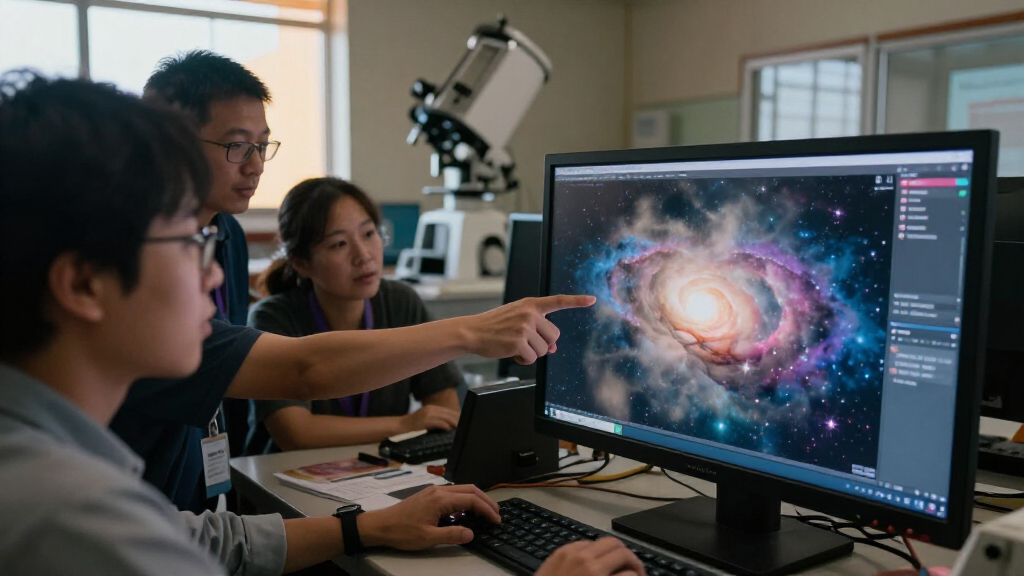
NASA Science announced Overlap Zoo on Sept. 30, 2026, asking members of the public to inspect images and identify galaxies that appear to overlap from Earth’s perspective. The project aims to assemble a catalog of these pairs so astronomers can use their alignments to study dust in distant galaxies and how it affects passing starlight.
In an apparent overlap, a more distant galaxy lies behind a nearer one along the same line of sight. Light from the background galaxy can pass through the foreground galaxy, making its dust appear as dark silhouettes against the brighter light. Researchers can use those patterns to investigate where dust is distributed and how it blocks or scatters starlight.
According to NASA Science’s project announcement, volunteers will review images that Galaxy Zoo participants have already flagged as possible overlapping pairs. Overlap Zoo participants will be asked to verify the pairs, classify features of the galaxies and mark their outlines. The project says people can work through as many images as they like and do not need prior astronomy experience.
NASA says the effort is intended to create a large-scale catalog of galaxy pairs suitable for dust research. The project describes it as the first catalog of that scale for this purpose, but the announcement does not provide a target number of images, a completion date or a schedule for publishing results.
How Galaxy Shadows Trace Dust
Dust affects how light travels through space: it can absorb, block or scatter starlight, changing how galaxies and other distant objects appear to observers. Overlapping galaxies offer a way to study this material because the background galaxy acts as a source of light shining through the foreground one. The resulting contrast can reveal features that may be difficult to study directly.
NASA’s announcement also says measurements of dust’s effects on light can help refine estimates of distances to faraway objects. That is a potential research application, not a result reported by the project at launch. Researchers will first need a useful catalog and subsequent analysis to establish what the classifications show and how they can inform measurements.
The project also addresses a practical workload: astronomers have many candidate pairs to classify as observations accumulate, project lead Trevor Butrum said. Public participation can help researchers screen images and organize candidates, though the announcement does not specify how volunteer results will be checked or how classifications will be combined.
As an affiliate, we earn on qualifying purchases.
From Galaxy Zoo to Overlap Zoo
The project builds on work by Galaxy Zoo volunteers, who identified images containing possible overlapping galaxies. Overlap Zoo narrows the task to checking those candidates and recording details relevant to dust studies. This two-stage approach means participants are not being asked to search every galaxy image from scratch, according to NASA’s description.
Galaxy pairs that appear to overlap are a matter of perspective: the galaxies need not be physically touching or colliding. Rather, they lie at different distances but line up in the image as seen from Earth or a space telescope. The foreground galaxy’s dust can then be studied against the light of the background object, creating what NASA describes as a cosmic backlighting effect.
The NASA Science article, published Sept. 30, 2026, presents Overlap Zoo as an open, online activity for anyone with an internet-connected computer. It says volunteers will receive guidance on verifying pairs, classifying features and outlining galaxies as they participate.
astronomy binoculars for stargazing
As an affiliate, we earn on qualifying purchases.
As an affiliate, we earn on qualifying purchases.
Catalog Results Still Ahead
The announcement describes the project’s aims but does not report how many images are available, how many volunteers have joined, or how long classification is expected to take. It also does not specify the procedures researchers will use to assess agreement among volunteers or validate the final catalog.
No new measurements of dust or revised distance estimates are reported in the launch article. Those are potential outcomes of later research using the catalog, so the scale and scientific findings of the work remain unknown. NASA’s description does not set out a publication timetable or say when results may be released.
As an affiliate, we earn on qualifying purchases.
Volunteer Classifications and Analysis
Interested participants can access Overlap Zoo online and begin reviewing candidate images. The stated tasks are to confirm apparent galaxy pairs, classify key features and mark galaxy outlines; NASA says no prior experience is needed.
After volunteers contribute classifications, researchers can use the resulting catalog for further analysis of galaxy dust. NASA has not announced a date for that analysis or a specific milestone for reporting findings, so the next public update will depend on the project’s progress and any subsequent research releases.
As an affiliate, we earn on qualifying purchases.
Key Questions
What is Overlap Zoo?
Overlap Zoo is a NASA Science citizen-science project in which volunteers check images of possible overlapping galaxies and record features for research into cosmic dust.
What will volunteers do?
Participants will verify whether candidate images show an apparent galaxy pair, classify features of each galaxy and mark their outlines. NASA says the activity is online and requires no prior experience.
Why do overlapping galaxies help researchers study dust?
When a background galaxy appears behind a foreground one, its light can pass through the nearer galaxy. Dust in the foreground can show up as dark patterns against that light, helping astronomers investigate how dust is distributed and affects starlight.
Has Overlap Zoo already produced new findings?
No findings are reported in the Sept. 30 announcement. NASA describes the project’s goals and volunteer tasks; scientific conclusions would require analysis of the classifications and are not yet detailed.
When will researchers publish results?
NASA’s announcement does not provide a results timetable or a target date for completing the catalog. The schedule for later analysis and publications remains unclear.
Source: primary
Fall Picks
fall essentials
As an affiliate, we earn on qualifying purchases.