
TL;DR

Prime made for students and young adults
- Fast, free delivery for dorm and study essentials
- Prime Video and Amazon Music included
- Member-only deals
Science experiment kits for kids work best when their activities match a child’s interests, reading and coordination skills, and need for adult help. Before buying, check safety instructions, required household supplies, explanations of the science, and whether activities can be repeated; then turn each project into an investigation by asking what your child predicts and notices.
A volcano can fizz across the kitchen counter and still teach very little if a child only watches the foam. The same experiment becomes more memorable when they predict what will happen, notice how much foam forms, and ask what would change with a different amount of baking soda.
Science experiment kits for kids can supply the tools and structure for that kind of hands-on discovery. They give children a way to test ideas in chemistry, physics, biology, engineering, and earth science—and can make abstract concepts easier to see and talk about.
This guide shows you how to choose a kit that suits your child, what to check before opening the box, and how to make a simple activity feel like real science. You will also learn why an unexpected result is not a failure; sometimes it is the most interesting part.
Match a kit to your child’s interests, reading ability, coordination, and sensory preferences—not only its age label.
Read the safety directions and contents list before starting; check for required household supplies, batteries, protective equipment, and disposal instructions.
Favor clear explanations and prompts to predict, observe, compare, or test over a large experiment count.
Reusable tools can support repeated testing, while one-time activities can still be a good fit when their topic excites the child.
When an experiment surprises you, discuss conditions and possible changes instead of treating the expected result as the only correct one.
What a good science kit gives your child beyond a fun reaction
A good science kit gives your child a practical way to ask a question, test an idea, and notice what happens. It supplies structure and materials, but the learning comes from connecting the steps to a reason: a fizz, a shadow, or a wobbly bridge becomes more than a spectacle when your child can explain what they saw.
Try a simple example: before starting a growing-crystal activity, ask your child to predict what the crystals will look like tomorrow. They might draw a tiny sketch in a notebook, then compare it with the real result. That one-minute prediction turns waiting into observation and gives them something specific to discuss.
Look for instructions that explain the science and ask children to predict, observe, compare, or test a variation. “Build a paper helicopter” is an activity; “change the blade length and see how long it stays in the air” adds an investigation. A box marked “educational” does not prove that it explains anything, so flip through the instructions or product details before you buy.
The core idea is simple: a kit is a launchpad, not a lesson by itself. If a child sees a reaction that differs from the picture on the box, help them describe what happened before reaching for the expected answer. Clear observations build stronger scientific habits than a perfectly staged result.
As an affiliate, we earn on qualifying purchases.
Match the kit to your child, not just the age printed on the box
Choose a science kit by matching its reading, coordination, and supervision demands to the child who will use it—not by relying on the age label alone. Age guidance is a useful first filter, but two children the same age may differ in how comfortably they follow written steps, handle small parts, or wait for a slow result.
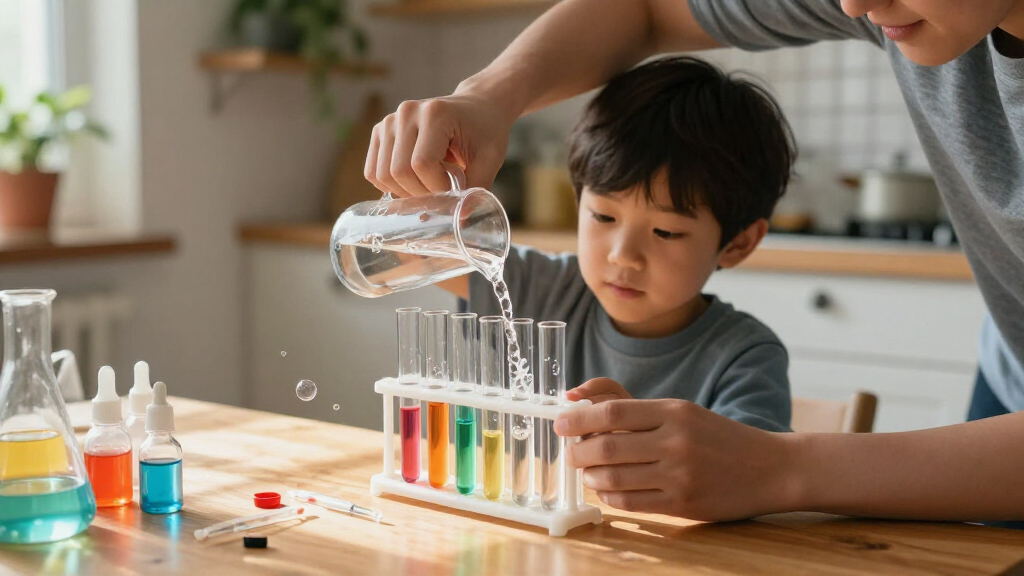
For instance, a child who loves building may happily spend an afternoon assembling a small motor, while a confident reader may prefer a kit with written challenges and a lab notebook. If a younger child wants to join in, an adult can handle tricky measuring while the child pours water, spots color changes, or records a drawing. Let the child do the thinking wherever they can.
Before choosing, picture the actual activity at your table: tiny screws, several written steps, a two-day wait, or sticky cleanup. Consider reading level, fine-motor demands, patience, sensory preferences, and accessibility. A kit with strong smells, gritty textures, or fiddly tools may not suit every child—even if its topic sounds perfect.
Use these checks to find a better fit:
- Interest: Pick a subject the child already talks about, such as insects, space, plants, or machines.
- Skills: Check the instruction style, part size, and any cutting, pouring, or assembly.
- Support: Work out whether a caregiver needs to read, measure, supervise, or clean up.
- Access: Look for large-print instructions, simple controls, or activities that can adapt to the child’s physical needs.
A well-matched kit lets a child own more of the experiment. That often beats buying an impressive box that an adult has to run from start to finish.
As an affiliate, we earn on qualifying purchases.
Check safety and supplies before the first experiment
Read the kit’s safety guidance and contents list before you start, and plan adult supervision around the activity—not just the child’s age. Pay special attention to experiments involving heat, chemicals, sharp tools, electricity, or small parts; follow the manufacturer’s instructions and never let children taste experiment materials.
Imagine opening a colorful chemistry set on a rainy afternoon, only to discover that the first activity needs batteries and protective gear that are not in the box. A quick check of the contents list avoids that disappointment. Look for household items you must provide, such as water, paper towels, dish soap, or a glass jar, along with any consumables that run out after one use.
Supervision should match the task. A child might independently sort leaves or build a paper tower, while an adult should stay close for a hot-water activity or a project with small components. Set up a clear work area, keep food and drinks away, and follow the printed disposal directions. If the instructions are vague about safe use, that is a reason to pause and seek clearer guidance.
Before you begin, run through this short check:
- Read the warnings and confirm the activity suits the child.
- Gather supplies listed as extras, including batteries or protective equipment.
- Choose a workspace that is easy to clean and away from meals.
- Agree on adult help for setup, handling, and cleanup.
- Follow disposal instructions and store leftover materials safely.
These small steps make the activity calmer and safer. They also help children learn that good experiments include careful preparation, not just a dramatic result.
As an affiliate, we earn on qualifying purchases.
Compare kits by learning, repeat use, and setup—not the experiment count
Compare science kits by what children can learn and repeat, not by the biggest number printed on the package. A kit with six well-explained, reusable activities may offer more lasting value than one with twenty short reactions that use up their materials in a single afternoon.
For example, a basic circuit kit with reusable wires and bulbs can support several rounds of testing: Does a different connection light the bulb? What happens when you add another component? A one-time color-changing activity can still delight a child, but it may offer less to revisit once its supplies are gone. Neither format is automatically better; the right choice depends on the child and your budget.
Use this comparison to make the tradeoffs visible before buying:
| What to check | Why it matters | Example question |
|---|---|---|
| Science explanations | Help connect actions with ideas. | Does the guide explain why the paper helicopter spins? |
| Repeat use | Lets children test new variations. | Can the balance, circuit, or tools be used again? |
| Extra supplies | Affects cost and convenience. | Do you need batteries or household materials? |
| Activity style | Matches different interests and skills. | Does the child prefer building, observing, or mixing? |
Also think about how the kit fits your home. An app or video may provide useful context, but check whether it needs a separate device, an account, or personal information. Current market trends include kits that pair physical activities with digital guidance, plus projects in coding, robotics, sustainability, and space; these are broad trends, not a live ranking of products.
The best value is the kit that gets used. A child fascinated by insects may return to a bug-observation set for weeks, while a much pricier robotics box may sit untouched if building does not appeal to them.
reusable science experiment tools for kids
As an affiliate, we earn on qualifying purchases.
As an affiliate, we earn on qualifying purchases.
Turn each activity into an experiment with three simple questions
Turn a kit activity into a fuller experiment by asking your child what they think will happen, what they actually notice, and what they could change next time. Those three questions give a project a clear beginning, middle, and next step without requiring a lecture or a special science vocabulary.
Take a paper bridge challenge. Before testing, ask whether a flat sheet or a folded sheet will hold more coins. Add coins one at a time and count them aloud, then ask why the folded bridge held more—or why it did not. The table may end up covered in pennies, but your child has just compared two designs using evidence they can see.
Keep the conversation open. If a crystal-growing activity looks different from the picture, ask whether the water temperature, timing, or measurement could have affected the result. A failed or surprising experiment offers a useful question: what changed, and what can you test next? You do not need to pretend the original prediction was right.
Use a scrap of paper or a small notebook to record a sketch, a number, or a sentence. For a young child, “The blue color spread faster in warm water” is enough. Older children can add measurements or repeat the same test to see whether the result stays similar. Simple records make patterns easier to spot later.
Here is the practical challenge: during your next activity, wait a few seconds before explaining the result. Let your child describe the sound, color, movement, or change first. Their own observation is the doorway to the explanation, and it gives them a reason to explore ideas in the next experiment.
Know when household experiments or a different kit will work better
Household experiments can be a good alternative when you want a quick, low-cost activity, while a kit can help when you need specialized equipment, clear instructions, or a more structured project. Neither option wins for every family; choose based on the question your child wants to explore and the materials you can use safely.
A child curious about whether paper absorbs water can test scraps from the recycling bin with a small cup of water and an adult nearby. That simple comparison needs no elaborate kit. But building a reliable circuit or observing prepared specimens may call for tools and guidance that are easier to get in a purpose-made set.
Keep safety and instruction quality in view even for home activities. Do not assume that a project is safe because its materials come from the kitchen, and avoid using online directions that leave out age guidance or cleanup details. A kit’s printed instructions can reduce guesswork, but you should still read them and provide the level of supervision the activity requires.
Kits can also help when a child wants to pursue a topic over several days. A themed plant or earth-science set may provide a sequence of activities and a place to record changes, while a single household test can answer one question quickly. If your child is deeply interested in sustainability, robotics, or the human body, follow that interest—but check the specific kit’s demands rather than trusting a flashy theme.
Whether you use a kit or household materials, children learn more when they have a chance to do the work: make a prediction, handle age-appropriate materials, and say what they noticed. Structure helps you get started; curiosity keeps the experiment going.
Frequently Asked Questions
What age is appropriate for a science experiment kit?
Start with the manufacturer’s age guidance, then check whether your child can follow the instructions, handle the parts, and understand the safety rules. An adult can adapt many activities by reading steps aloud or handling difficult measurements.
Are science experiment kits safe for kids?
Many are designed for children, but safety depends on the activities and the child’s age. Read warnings, supervise as directed, keep materials away from mouths, and follow cleanup and disposal instructions—especially for heat, chemicals, electricity, sharp tools, or small parts.
Do parents need to help with a science kit?
Often, yes, though the amount varies by activity and child. You may need to help with setup, reading, measuring, or cleanup while letting your child make predictions and observations themselves.
How can I tell if a kit is genuinely educational?
Look for explanations of what an activity demonstrates and prompts to predict, observe, compare, or test a change. A long list of experiments or an “educational” label does not tell you whether the kit helps a child understand what happened.
Do science kits include everything needed?
Not always. Check the contents and instructions for household supplies, batteries, protective equipment, or replacement materials you may need to provide before the activity begins.
What should we do if an experiment does not work?
Review the steps and conditions together, including measurements, temperature, and timing. Ask what might have changed and what you could test next; an unexpected result is a chance to investigate, not a reason to dismiss the activity.
Conclusion
Choose a science kit your child wants to open, can use safely with the right support, and can learn from beyond the first reaction. Before you begin, read the directions, gather the missing supplies, and ask one prediction question.
Then let the child’s curiosity lead. A fizzing cup is fun; a child leaning over it to ask, “What if we try less?” is where the real experiment begins.
Fall Picks
fall essentials
As an affiliate, we earn on qualifying purchases.