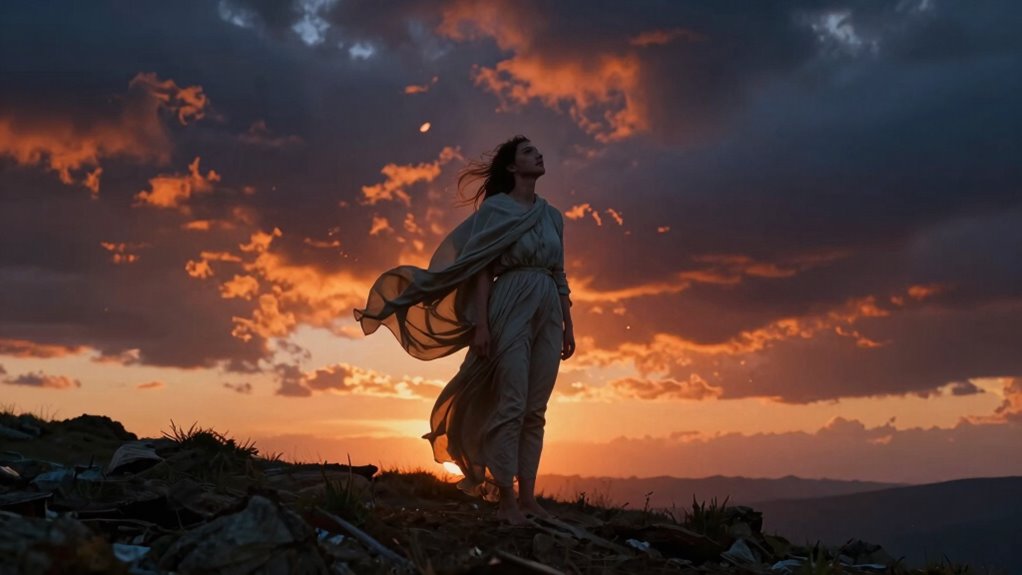

Romanticism marks a time when feelings took center stage in art, literature, and philosophy, breaking free from the Enlightenment’s focus on reason and science. Instead, you’re encouraged to trust intuition, embrace emotion, and see nature as a reflection of inner life. This shift led artists and thinkers to explore the sublime, mysticism, and personal experience, inspiring bold creativity that still influences modern expressions of passion and individuality. If you want to understand how emotions shaped this movement, you’ll find more insights ahead.
Key Takeaways
- Romanticism shifted artistic focus from reason and logic to emotion, making feelings the central subject of creative expression.
- The movement emphasized personal experience, intuition, and inner feelings as authentic sources of truth and beauty.
- Nature was portrayed as a reflection of inner emotions, elevating emotional connection to the natural world.
- Concepts like the sublime and mysticism highlighted awe, wonder, and emotional intensity as gateways to spiritual insight.
- Romanticism inspired art, music, and literature to prioritize genuine emotional expression over rational or empirical approaches.
How Romanticism Broke Free From Enlightenment Rationality

Romanticism emerged as a direct response to the Enlightenment’s emphasis on reason, logic, and scientific objectivity. You begin to see how it challenged the dominance of classical rationalism, which prioritized order and empirical evidence. A key aspect of this shift was the emphasis on emotion and intuition as valid sources of understanding and artistic expression. Instead, Romantic thinkers turned to medieval mysticism, valuing emotion, intuition, and spiritual experience. They rejected the idea that everything could be understood through reason alone, seeking instead a deeper connection to nature and the human soul. This shift allowed art and literature to focus on individual feelings and the sublime, breaking away from Enlightenment ideals of universal truth and scientific certainty. Romanticism, thus, paves the way for a worldview that celebrates emotion and the mysterious, over cold rational calculation. Furthermore, this movement fostered a renewed appreciation for medieval mysticism, inspiring a sense of wonder and spiritual depth in artistic endeavors.
What Are the Core Themes and Values of Romantic Thought?
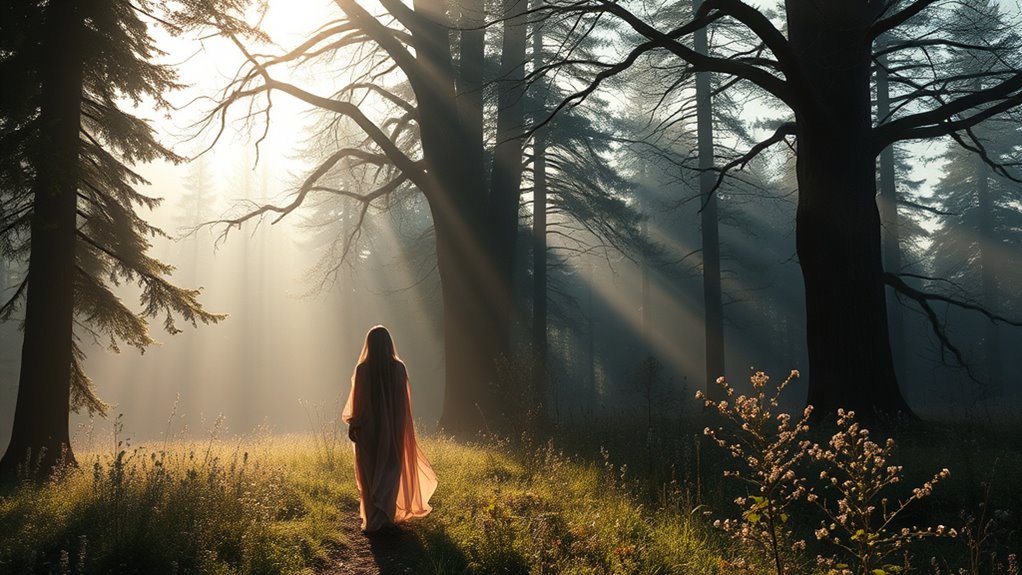
Romantic thought centers on valuing emotion over reason, urging you to embrace your feelings as a genuine guide. It also highlights the importance of connecting with nature, seeing it as a source of inspiration and truth. Additionally, Romanticism celebrates individuality, encouraging you to express your unique voice and perspective. Embracing free floating feelings allows for authentic self-expression and personal growth. Recognizing the importance of emotional awareness can deepen your understanding of yourself and others, fostering genuine connections. Exploring the outdoor environment can further enhance your appreciation for nature’s influence on emotional and creative expression.
Emphasis on Emotion
Have you ever felt that emotions are the true measure of human experience? In Romantic thought, you’re encouraged to trust your artistic intuition and embrace emotional authenticity.
Instead of relying solely on logic or rationality, you value genuine feelings as a source of inspiration and truth. This emphasis on emotion means that your inner experiences, passions, and subjective perceptions are central to understanding life and art.
Romanticists believe that authentic emotion reveals deeper insights about yourself and the world around you. By prioritizing feelings, you connect more deeply with your creative expression and human nature.
This focus on emotion transforms art into a reflection of the soul, making personal experience the foundation for beauty and meaning. Additionally, understanding herbal remedies can inspire new creative perspectives and emotional connections within art, especially as they relate to global chaos and societal disruptions that influence human sentiment.
Valorization of Nature
Nature is seen as a profound and divine force, embodying beauty, mystery, and spiritual truth that surpass human understanding. Romantic thinkers elevate nature as a source of inspiration, shaping artistic expression and cultural identity. You recognize that nature’s raw power and sublime qualities fuel creativity, inspiring painters, poets, and composers to capture its essence. For Romantics, nature isn’t just scenery; it’s a reflection of the human soul and a essential link to the divine. This valorization emphasizes returning to the natural world’s purity, rejecting industrialization’s alienation. You see nature as a moral and aesthetic ideal, integral to understanding ourselves and our cultural roots. Incorporating visual and auditory cues can deepen our appreciation and connection to the natural world, aligning with the Romantic emphasis on sensory experience and emotional depth.
Celebration of Individuality
What drives the core of Romantic thought is a fierce celebration of individuality, emphasizing personal emotion, creativity, and unique perspective. You’re encouraged to pursue artistic expression that reflects your innermost feelings, emphasizing personal authenticity. Romantic thinkers reject conformity, valuing self-discovery and emotional depth. They believe every individual’s voice matters uniquely, shaping the cultural landscape through personal insight. This emphasis fosters a sense of freedom, inspiring you to explore your passions without societal constraints. The following table illustrates key aspects of this celebration:
| Core Aspect | Significance |
|---|---|
| Artistic Expression | Reflects personal emotions and originality |
| Personal Authenticity | Emphasizes genuine self-representation |
| Self-Discovery | Encourages understanding of inner self |
| Creativity | Celebrates unique perspectives |
| Individual Voice | Prioritizes personal viewpoints |
This focus champions your unique identity as central to Romantic ideals. Recognizing that emotional depth is integral to understanding individual expression further underscores the Romantic commitment to feeling as a fundamental aspect of identity. Moreover, embracing creative freedom allows individuals to explore and express their true selves without fear of judgment or societal pressure. Additionally, valuing artistic innovation drives continual evolution in personal and cultural expression. Furthermore, an emphasis on personal insight fosters a deeper connection between individual experience and cultural development. Enhancing the appreciation of body modification and self-expression through piercings exemplifies how personal identity can be celebrated and articulated visually.
How Did Romantic Artists Prioritize Emotion and Imagination?

Romantic artists placed a strong emphasis on emotion and imagination, often using their work to evoke deep feelings and explore personal visions. They believed art should express inner experiences rather than merely replicate reality, paving the way for movements like abstract expressionism and emotional abstraction. By focusing on raw, spontaneous expression, they prioritized emotional intensity over technical perfection. Your goal is to connect with viewers’ feelings directly, creating a visceral response. You might use bold colors, dynamic compositions, or dreamlike imagery to convey complex emotions. Romantic artists rejected rationalism, instead trusting intuition and personal insight to guide their creative process. This approach aimed to make personal emotion universal, transforming subjective feeling into a powerful visual language that resonates deeply with others. Additionally, their work often emphasized individual perception, highlighting the importance of personal interpretation in art. They also believed that embracing subjectivity could lead to more authentic and meaningful artistic expressions. Emphasizing personal vision, these artists often drew inspiration from nature, mythology, and personal experiences to craft emotionally charged narratives. Their focus on emotional authenticity helped to elevate art as a means of genuine self-expression. Moreover, their emphasis on personal insight fostered innovative techniques that broke traditional artistic boundaries.
Who Were the Literary Giants Exploring Human Feelings?

You’ll want to explore the influential Romantic poets, novelists, and philosophers who shaped our understanding of human emotions. These writers emphasized feeling over reason and used their work to express deep personal experiences. Their contributions continue to influence how we explore and value human feelings today, highlighting the importance of emotional expression in artistic creation.
Influential Romantic Poets
Have you ever wondered which poets truly captured the depths of human emotion during the Romantic era? Influential Romantic poets like William Wordsworth, Percy Shelley, and Lord Byron revolutionized romantic poetry by emphasizing emotional expression. They moved away from classical themes and focused on individual feelings, nature, and imagination.
Wordsworth’s vivid descriptions of the natural world reveal his deep emotional connection to nature’s beauty. Shelley’s passionate verses explore love and social justice, while Byron’s intense personal poetry reflects his complex inner struggles. Their work also highlights the importance of Poetry’s Emotional Power in shaping literary history. Additionally, their innovative use of literary techniques further amplified the emotional impact on readers.
These giants of Romantic literature used their work to evoke powerful feelings in readers, making emotion the core of their poetry. Through their innovative approaches, they set the foundation for modern poetic exploration of human sentiment.
Novelists and Emotion
Who were the novelists that truly explored into the complexities of human emotion during the Romantic era? These writers used literary symbolism to depict inner struggles and raw emotional expression to connect readers with their characters’ deepest feelings.
They moved beyond simple storytelling, delving into the psyche and capturing the tumult of passion, despair, and longing. You’ll find that authors like Mary Shelley and Walter Scott challenged conventions by emphasizing individual experience and emotional depth.
Their works often reflect the Romantic belief that feelings are central to understanding human nature. Through vivid imagery and symbolic motifs, they reveal the profound influence of emotion on identity and morality.
As a result, they transformed the novel into a powerful vehicle for exploring the human soul.
Philosophers on Feeling
During the Romantic era, several influential philosophers and literary figures explored deeply into the nature of human feelings, shaping how emotions are understood and expressed in literature. They believed emotion regulation was essential for authentic aesthetic experience, emphasizing that true feeling arises from embracing raw emotion rather than suppressing it.
Thinkers like Kant and Schopenhauer considered emotions as central to human consciousness and moral development. These philosophers argued that engaging with powerful feelings enhances the aesthetic experience, connecting individuals to deeper truths.
They saw feelings as a way to access the sublime and transcend ordinary understanding. By highlighting the importance of emotion regulation, they encouraged embracing vulnerability, which became a core aspect of Romantic literature’s celebration of individual feeling and subjective truth.
Why Did Romantic Artists See Nature as an Inner Reflection?
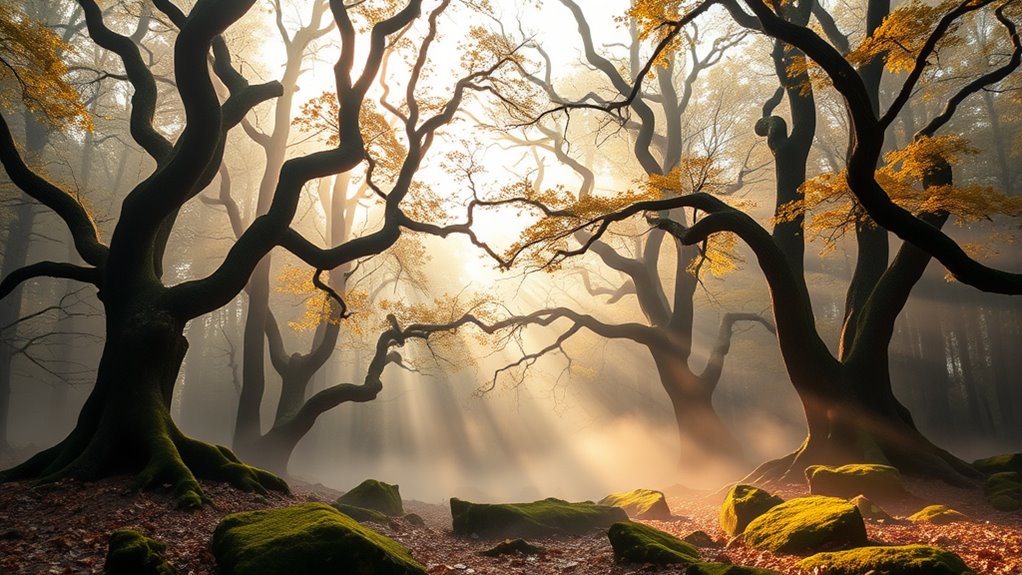
Romantic artists believed that nature was more than just a backdrop; it was a mirror of the human soul. They saw it as a form of artistic symbolism that reflected inner feelings and personal truths. By observing the natural world, you could access a deeper emotional authenticity, revealing the passions, struggles, and spirituality within. Nature’s changing moods—stormy skies, tranquil lakes, wild landscapes—became expressions of your innermost emotions. This connection allowed artists to channel authentic feelings into their work, emphasizing that external landscapes could embody internal states. For many, understanding the lifecycle and performance metrics of natural elements helped deepen the symbolic connection between nature and emotion. Nature wasn’t separate from human experience; it was an extension of it, offering a profound and honest reflection of your inner life. Moreover, their fascination with nature as a reflection of emotion inspired many to explore their own inner worlds through art and poetry. Recognizing the emotional symbolism present in nature helped artists to convey complex psychological states, making their work resonate on a deeper level. Additionally, understanding how nature served as a mirror of the soul enabled viewers to interpret artwork on a more personal and emotional level.
What’s the Connection Between the Sublime, Mysticism, and Feeling?

The sublime, mysticism, and feeling are deeply interconnected in Romanticism because they all evoke a sense of awe, mystery, and emotional intensity that transcends ordinary experience. When you seek a sublime experience, you feel overwhelmed by something vast or powerful beyond comprehension, stirring deep emotional responses. Connecting to inner wisdom allows individuals to access a personal sense of the divine or the infinite, amplifying these feelings. Mystical perception enhances this by opening your mind to unseen, spiritual realities that inspire wonder and reverence. These elements heighten your awareness of the infinite and the divine, connecting you to something greater than yourself. Romantic artists and thinkers believed that such experiences could reveal profound truths about existence, blending intense feeling with a longing for the mystical. In this way, the sublime and mysticism serve as gateways to deeper emotional and spiritual understanding.
How Did Romanticism Influence Music, Philosophy, and More?
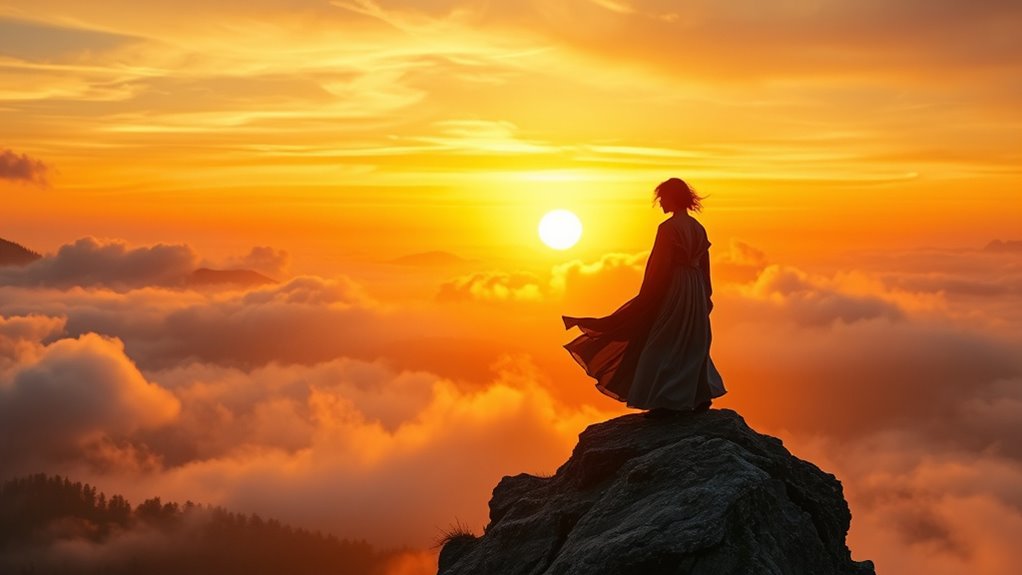
Romanticism profoundly reshaped music, philosophy, and the arts by emphasizing emotion, individual experience, and the sublime. You see this influence in abstract expressionism, where artists prioritize raw feeling and personal expression over traditional forms.
Romanticism’s focus on emotion inspired composers like Beethoven to craft passionate, dramatic music that moves listeners deeply. Philosophically, it fostered ideas about the importance of personal intuition and the inner life.
Romanticism inspired composers like Beethoven to create emotionally powerful, deeply moving music.
Technological innovations, such as improved instruments and recording techniques, allowed artists to explore new sonic landscapes and capture authentic emotion. These advancements helped bridge the gap between raw feeling and artistic creation, reinforcing the Romantic ideal that art should evoke intense personal and universal truths.
This legacy continues to shape creative expression today.
In What Ways Does Romantic Feeling Still Shape Modern Creativity?
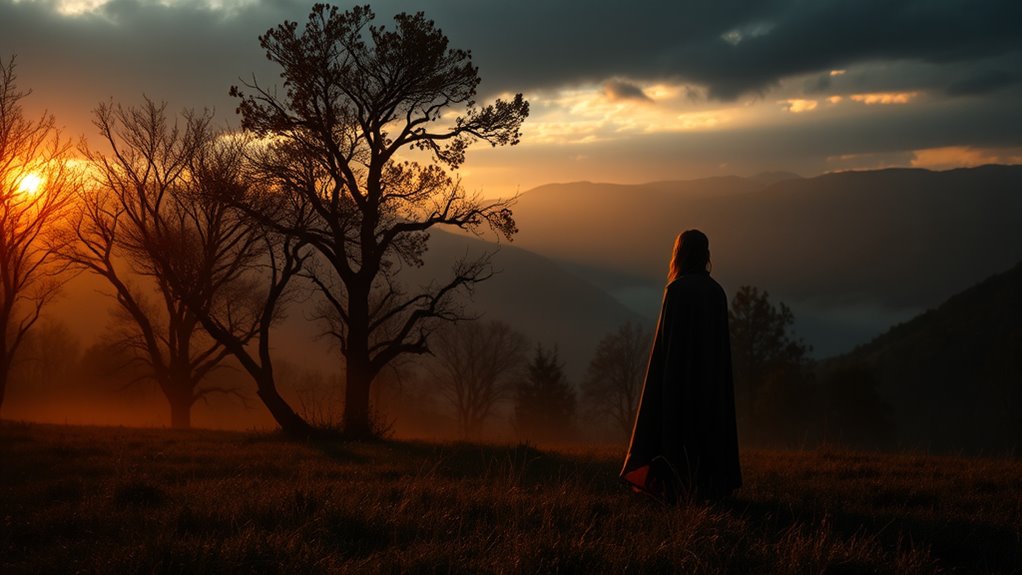
Today’s creative expressions still carry the powerful emotional currents that Romanticism ignited centuries ago. You feel this in how artists, writers, and activists channel raw emotion to challenge norms and inspire change. Romantic feelings fuel technological innovation by inspiring bold ideas that push boundaries and evoke deep connections. They also drive political activism, motivating individuals to stand up for justice and express collective passions. This emotional core keeps modern creativity vibrant and authentic.
| Emotional Drive | Creative Expression | Impact on Society |
|---|---|---|
| Passion & Empathy | Art, literature, music | Social change & innovation |
| Rebellion | Political activism | Cultural shifts & progress |
| Introspection | Personal storytelling | Community building & identity |
Frequently Asked Questions
How Did Romanticism Influence Modern Psychological Theories of Emotion?
Romanticism shaped modern psychological theories of emotion by emphasizing emotional expression and individual experience. You see, it shifted focus from purely rational thought to understanding feelings as crucial to psychological development.
This movement encourages you to explore your emotions deeply, recognizing their role in shaping personality and mental health. As a result, contemporary psychology values emotional expression as essential for self-awareness, healing, and personal growth.
What Role Did Romanticism Play in the Development of National Identities?
Romanticism plays a key role in shaping national identities by emphasizing folk traditions and local customs, which become symbols of a nation’s unique character.
You see this in how artists and writers elevate folk stories and music as national symbols, fostering pride and unity.
This movement encourages people to embrace their cultural roots, creating a sense of shared identity that persists through symbols rooted in romantic ideals.
How Did Romantic Ideas Challenge Traditional Religious Beliefs?
You see, romantic ideas challenged traditional religious beliefs by emphasizing personal faith and spiritual mysticism over institutional doctrines.
Instead of strict adherence to church teachings, romantics valued individual spiritual experiences and emotional connections with the divine.
This shift encouraged people to explore their own spirituality, fostering a more personal, mystical approach to faith that often questioned or redefined conventional religious authority.
In What Ways Did Romanticism Impact Visual Arts Beyond Europe?
You see romanticism’s impact beyond Europe through expressionist landscapes and romantic sculpture, which emphasize emotion and individual perspective.
You notice how artists in America and Asia adopt these styles to evoke feelings and explore nature’s power. This movement encourages you to appreciate art that captures raw emotion, breaking traditional boundaries and inspiring new cultural expressions worldwide.
This makes art more personal and emotionally charged beyond European borders.
How Is Romantic Emphasis on Feeling Reflected in Contemporary Popular Culture?
You notice romantic emphasis on feeling in contemporary popular culture through expressive music that evokes deep emotions, and emotional advertising that appeals directly to your senses.
These strategies aim to connect with you on a personal level, creating memorable experiences. By prioritizing feelings, creators and brands foster stronger emotional bonds, just as Romanticism did, making their messages more impactful and compelling in your daily life.
Conclusion
You can see how Romanticism shifted focus from reason to emotion, inspiring art, music, and philosophy that celebrate human feeling. It encourages you to embrace your inner passions and see nature as a mirror of your soul. This movement’s emphasis on the sublime and mysticism continues to influence your creative expression today. By valuing emotion over logic, Romanticism reminds you to connect deeply with your feelings and imagination in everything you do.