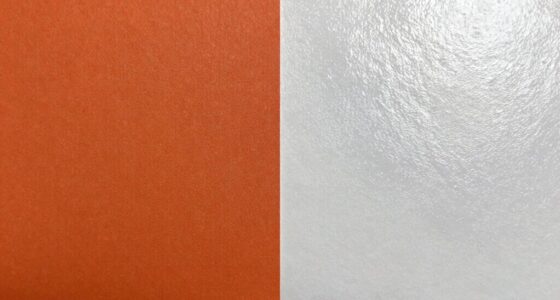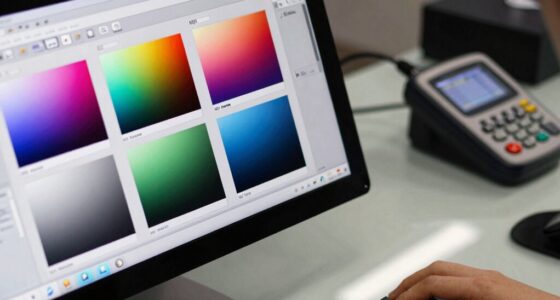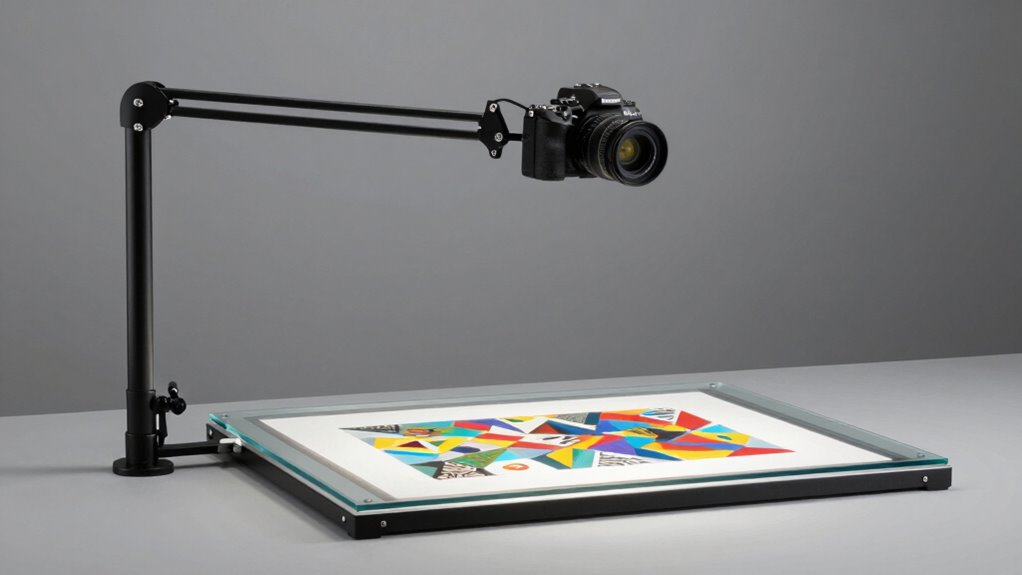

Overhead rigs and copy stands help you achieve stable, precise artwork documentation by preventing camera shake and misalignment. They allow you to control lighting for even, glare-free images that reveal textures and details. You can easily adjust angles and height to capture accurate perspectives or close-ups without distortion. These tools streamline your workflow, reducing errors and saving time. If you keep exploring, you’ll discover how they can elevate your documentation process even further.
Key Takeaways
- Provide stable, shake-free support to ensure sharp, distortion-free images of artwork.
- Enable precise, adjustable positioning for consistent perspective and accurate documentation.
- Allow controlled, even lighting to reduce glare and shadows, ensuring true color and detail capture.
- Streamline workflows by setting up equipment once for multiple shots, reducing errors and time.
- Facilitate high-resolution imaging and calibration for detailed, professional-quality artwork reproduction.
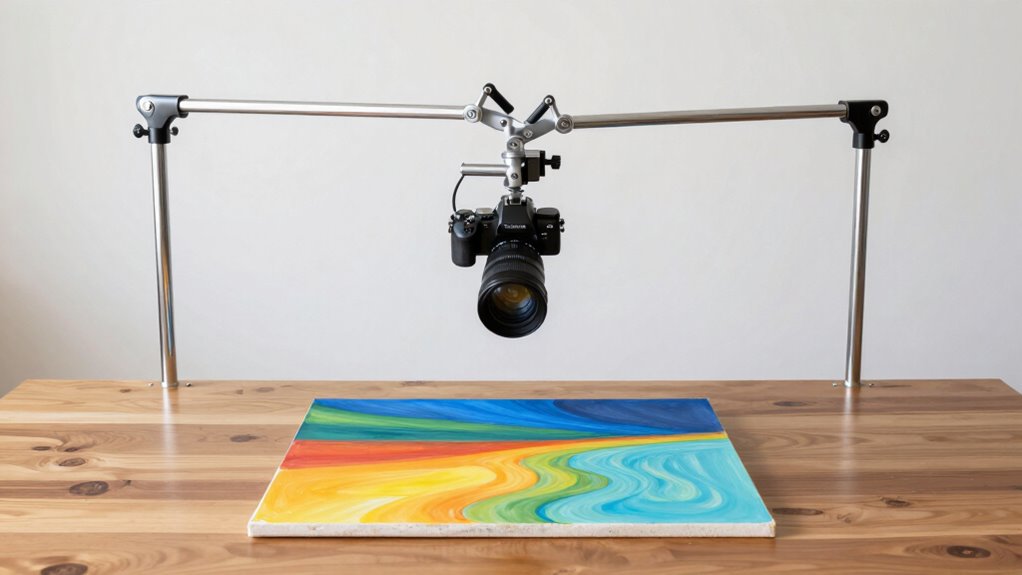
When documenting artwork, overhead rigs and copy stands are essential tools that help you capture high-quality images with precision and consistency. These devices are designed to provide stable support, enabling you to focus on capturing the artwork accurately without worrying about camera shake or misalignment. One of the main advantages they offer is control over lighting setups, which is crucial for revealing the true colors, textures, and details of the piece. With overhead rigs, you can position lights directly above the artwork, reducing shadows and glare, and ensuring even illumination. This consistency in lighting helps produce clear, true-to-life images that are indispensable for documentation, reproduction, or digital archiving. Additionally, the use of overhead rigs and copy stands allows for precise positioning of equipment, which further enhances image quality and reproducibility. Properly calibrated equipment can also help prevent distortion, ensuring the images accurately represent the artwork’s proportions and details. Maintaining consistent calibration is also vital for archival quality and long-term preservation of digital records.
In addition to lighting, overhead rigs and copy stands give you greater flexibility with camera angles. You can easily adjust the height and position of your camera to achieve the most accurate perspective, whether you’re capturing a close-up of intricate brushwork or the entire artwork. This control over camera angles ensures you avoid distortion and perspective issues, which are common when shooting from awkward or inconsistent positions. The ability to precisely align your camera also means you can maintain uniformity across multiple images, an essential factor if you’re documenting a collection or preparing images for publication. Moreover, the stability provided by these tools helps reduce camera movement, ensuring sharper images even during longer exposures.
Using these tools streamlines your workflow. Instead of juggling handheld shots and risking uneven lighting or skewed angles, you can set up your camera and lights once, then focus on capturing multiple images with minimal adjustments. This efficiency saves you time and reduces the chances of errors, especially when documenting numerous pieces. Additionally, the stability provided by overhead rigs and copy stands makes it easier to incorporate additional equipment like macro lenses or scanners, enhancing detail capture for detailed artwork.
Furthermore, these tools support high-resolution imaging, which is indispensable for preservation and detailed analysis. When you work with overhead rigs and copy stands, you can consistently position your camera at the optimal distance and angle, ensuring you maximize image quality. This consistency is especially important for archival purposes, where every detail counts. They also facilitate easier calibration and setup, which is vital for achieving consistent results across multiple sessions.
In essence, overhead rigs and copy stands solve the common challenges of controlling lighting setups and camera angles during art documentation. They provide stability, precision, and efficiency, helping you produce accurate, detailed, and professional-quality images every time. Whether you’re photographing a delicate watercolor or a large sculpture, these tools empower you to document artwork with confidence and clarity.

Mark Twain Life Science Workbook, Classifications of Living Organisms, Ecology, and more Biology, Study Guide and Test Prep, Interactive Notebook for Grades 5 and Up
As an affiliate, we earn on qualifying purchases.
Frequently Asked Questions
How Do I Choose the Right Overhead Rig for My Artwork Size?
To select the appropriate overhead rig for your artwork size, consider your piece’s dimensions and camera stability. Choose a rig that can comfortably accommodate your largest artwork without sagging or wobbling. Guarantee it offers adjustable height and angle settings for ideal framing. Additionally, prioritize models with stable supports to maintain lighting consistency and prevent movement, which helps produce clear, professional documentation of your artwork.
What Are the Maintenance Requirements for Copy Stands?
Imagine a gentle breeze sweeping across an organized studio—your copy stand stays reliable with regular cleaning routines. You should regularly dust and wipe the stand with soft cloths, making sure moving parts are lubricated with maintenance tools like light oil. Check screws, joints, and clamps periodically for stability. By maintaining your copy stand this way, you guarantee smooth operation, longevity, and consistent documentation quality for your artwork.
Can Overhead Rigs Be Adjusted for Different Camera Angles?
Yes, overhead rigs can be adjusted for different camera angles, giving you excellent camera angle flexibility. You can easily modify the tilt, height, and orientation to capture artworks from various perspectives. Just make certain the rig remains stable during adjustments to maintain rig stability, preventing blurry or misaligned shots. Properly adjusting your overhead rig allows you to get the perfect shot, whether you need a straight top-down view or an angled shot for detail.
Are There Specific Materials Recommended for Building DIY Copy Stands?
For building a DIY copy stand, you should consider using materials like PVC pipes, adjustable clamps, and a sturdy platform, which are affordable and easy to work with. Wood or metal can also work if you need extra stability. Keep your budget in mind, opting for lightweight yet durable materials. These choices guarantee you create a functional, adjustable copy stand without overspending, perfect for art documentation projects.
How Do Overhead Rigs Impact the Quality of Digitized Art?
Overhead rigs markedly improve the quality of digitized art by ensuring lighting consistency and enhancing image clarity. You’ll notice more even illumination across your artwork, reducing shadows and glare that can distort details. This consistent lighting allows you to capture sharp, true-to-life images of your art, making your digital archives more accurate. By stabilizing the camera and artwork, overhead rigs help you produce high-quality, professional-looking digital reproductions with ease.
Conclusion
By now, you see how overhead rigs and copy stands make art documentation more precise and efficient. They eliminate shadows, reduce glare, and give you consistent angles—crucial for accurate records or reproductions. Don’t you want your artwork’s details to shine through perfectly? Investing in these tools not only saves time but also elevates your documentation quality. Isn’t it time you upgraded your setup to capture every detail flawlessly?

Mark Twain Physical Science Workbook, Matter, Forces, Motion, Energy, and more Physics, Study Guide and Test Prep, Interactive Notebook for Grades 5 and Up
As an affiliate, we earn on qualifying purchases.