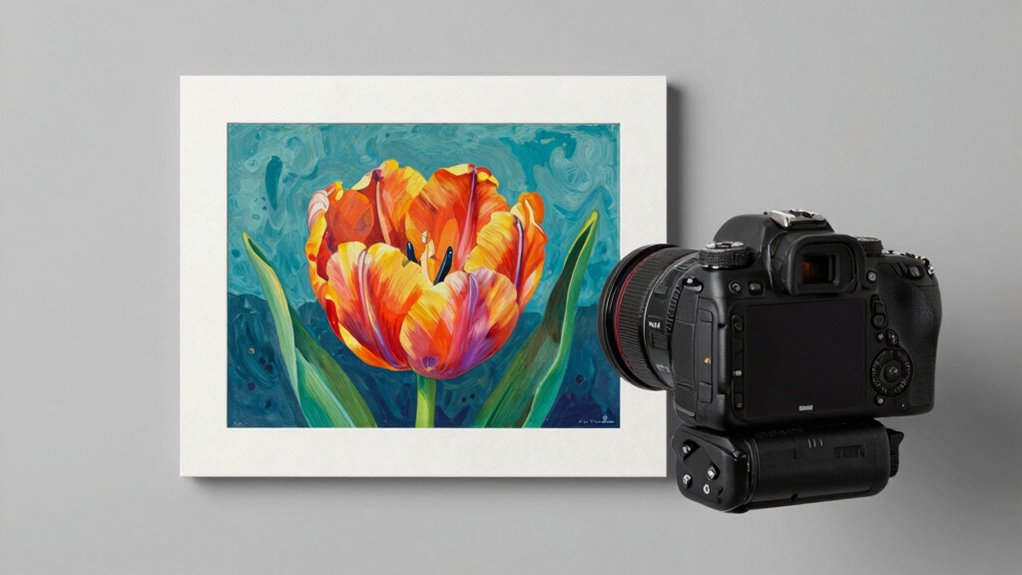

To choose lighting for flat art reproduction without harsh reflections, position lights at 30 to 45 degrees from the surface, avoiding direct overhead or front placement. Use diffusers or softboxes to soften the light and reduce glare, and guarantee the light sources have a high CRI for accurate color capture. Keep the color temperature consistent around 5000K to 5500K for true-to-life colors. If you continue exploring, you’ll discover even more tips to perfect your setup.

Prime made for students and young adults
- Fast, free delivery for dorm and study essentials
- Prime Video and Amazon Music included
- Member-only deals
Key Takeaways
- Position lights at 30 to 45 degrees from the artwork to minimize direct reflections.
- Use diffusers or softboxes to soften light and reduce glare.
- Choose light sources with a high CRI and a color temperature around 5000K to ensure accurate colors.
- Avoid placing lights directly overhead or in front of the artwork to prevent hotspots and reflections.
- Test and adjust lighting setup beforehand to achieve even illumination and eliminate harsh reflections.

Selecting the right lighting is vital when reproducing flat art, as it directly impacts color accuracy, detail, and overall presentation. To achieve true-to-life reproductions without harsh reflections, you need to consider both the color temperature of your light source and the lighting angles. Color temperature, measured in Kelvin, influences how colors appear under different lighting conditions. For flat art, a neutral or daylight-balanced light—around 5000K to 5500K—is ideal because it mimics natural daylight, guaranteeing that colors are represented accurately without warm or cool tints skewing the image. Avoid lighting that’s too warm (below 4000K), which can add an unwanted yellowish hue, or too cool (above 6000K), which might give a bluish cast. Consistent color temperature across your light sources helps maintain uniformity and prevents color shifts during reproduction. Additionally, the spectral quality of light plays a crucial role in accurately capturing the artwork’s true colors and details. Properly choosing light sources with a high color rendering index (CRI) ensures that colors are rendered faithfully, which is essential for accurate reproduction. Lighting angles are equally vital to prevent reflections and glare. When illuminating flat art, you want to position your lights at angles that minimize direct reflections hitting the camera lens or viewer’s eye. Typically, placing lights at a 30 to 45-degree angle from the artwork’s surface works well. This setup allows the light to evenly spread across the piece, enhancing details without creating hotspots or glare. You should also avoid placing lights directly overhead or straight in front, as these positions tend to produce harsh reflections that obscure important details and distort colors. Using diffusers or softboxes can further soften the light, reducing sharp reflections and shadows, and creating a more even illumination that captures subtle textures and details. Additionally, employing multiple light sources at strategic angles can help balance the overall lighting. By combining a main light with fill lights positioned at different angles, you can eliminate shadows and ensure uniform coverage. Make sure your lights are adjustable so you can fine-tune their position and intensity as needed. When working with flat art, it’s a good idea to test your setup beforehand, adjusting the lighting angles and color temperature until reflections are minimized and the colors appear true to life. It’s also beneficial to consider the diffusion techniques used to control light quality and further reduce glare. Proper lighting setup is essential for achieving an accurate and glare-free reproduction, especially when working with delicate or reflective surfaces. Remember, the goal is to create an environment where the artwork’s details are preserved and colors are faithfully reproduced, without unwanted glare or reflections distracting from the piece. Properly choosing and positioning your lighting setup ensures your flat art looks as stunning in reproduction as it does in person. Additionally, understanding the properties of light can help you optimize your setup for the best results.
art reproduction softbox lighting
As an affiliate, we earn on qualifying purchases.
As an affiliate, we earn on qualifying purchases.
Frequently Asked Questions
Can LED Lights Cause Color Distortion in Art Reproduction?
Yes, LED lights can cause color distortion in art reproduction if their spectrum isn’t carefully selected. Some LEDs emit uneven spectral output, which may affect color accuracy. To prevent this, choose LEDs with a broad, balanced spectrum that closely mimics natural light. This guarantees your art’s colors are accurately represented, without distortion, and helps you achieve consistent, true-to-life reproductions.
What Is the Ideal Color Temperature for Photographing Flat Art?
The ideal color temperature for photographing flat art is around 5000K to 5500K, which guarantees accurate color reproduction. This range mimics natural daylight, promoting color accuracy and true hues. To achieve this, use lights with good color rendering and diffuse the light to prevent harsh reflections. Proper light diffusion minimizes glare, while maintaining the right color temperature helps your images accurately reflect the artwork’s true colors.
How Do I Prevent Glare on Glossy Artworks During Lighting Setup?
To prevent glare on glossy artworks, focus on light positioning and gloss control. Keep your lights at a shallow angle to the artwork’s surface, reducing direct reflections. Use diffusers or polarizing filters to soften and control glare effectively. Adjust the light’s angle and distance until you achieve even illumination without harsh reflections. Regularly review your setup, ensuring that the glossy surface remains free of distracting glare for a clean, professional reproduction.
Are Flicker-Free Lights Necessary for High-Quality Art Reproduction?
Flicker-free lighting isn’t strictly necessary, but it’s highly recommended for high-quality art reproduction. Continuous light sources with flicker-free technology provide consistent illumination, ensuring your images are sharp and free of flickering artifacts. This stability helps you capture accurate colors and details without the distractions of flickering effects, especially during prolonged shoots. Investing in flicker-free lighting improves both the quality of your reproductions and the efficiency of your workflow.
How Does Ambient Light Affect the Accuracy of Art Color Reproduction?
Imagine your workspace bathed in natural daylight, which can subtly shift the colors of your art. Ambient light influences how accurately you perceive and reproduce colors, making consistent color calibration essential. If ambient light varies, it compromises the fidelity of your reproduction, causing colors to look different in different settings. To guarantee true color accuracy, you need controlled lighting conditions and regular calibration, minimizing the impact of natural daylight and other environmental factors.
As an affiliate, we earn on qualifying purchases.
Conclusion
Remember, when it comes to lighting your flat art reproduction, less is often more. Aim for soft, diffused light to avoid harsh reflections and bring out the true colors and details. Think of it like shining a gentle dawn on your artwork, revealing its beauty without overpowering it. By choosing the right lighting setup, you’ll guarantee your art shines as brightly as it deserves, proving that sometimes, a subtle touch makes all the difference.
adjustable photography softboxes
As an affiliate, we earn on qualifying purchases.
As an affiliate, we earn on qualifying purchases.
As an affiliate, we earn on qualifying purchases.
Fall Picks
fall essentials
As an affiliate, we earn on qualifying purchases.